
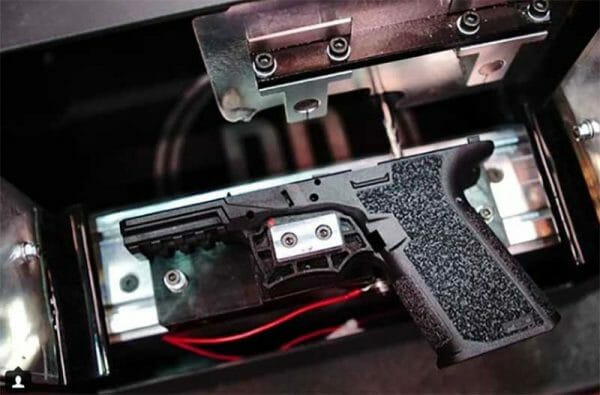
The Bureau of Alcohol, Tobacco, Firearms and Explosives (ATF) and the Justice Department (DOJ) are asking the 3D printing industry to block the printing of gun parts.
Earlier this month, the government held an event hosted by ATF Director Steve Dettelbach and U.S. Deputy Attorney General Lisa Monaco. The government invited federal law enforcement, members of the 3D-printing industry, and academia to the conference in Washington, DC. The goal was to pressure the industry to stem the tide of 3D-printed gun parts.
“Law enforcement cannot do this alone,” Monaco said during the meeting. “We need to engage software developers, technology experts, and leaders in the 3-D-printing industry to identify solutions in this fight.”
The ATF and DOJ discussed people using 3D printers to make machinegun conversion devices (MCDs) such as “Yankee Boogles.” A “Yankee Boogle” is a device made on 3D printers that allows a user to convert a semi-automatic AR-15 to a fully automatic firearm. It can be made on any 3D printer with under a dollar of PLA filament. The ATF claims it takes them 37 minutes to produce each Yankee Boogle.
The ATF acknowledged running a print farm in Martinsburg, West Virginia, at its Firearms and Ammunition Technology Division (FATD). A print farm is a place where multiple 3D printers are used to produce numerous items at once. The ATF print farm consists of 12 Creality Ender 3 printers. These printers run between $200 and $300. They can often be found on sale at Micro Center for $100. The ATF claims that its printers cost $2500 but didn’t clarify if they paid that for each one or the entire print farm.
Neither the ATF nor the DOJ said precisely how the 3D print industry could prevent the printing of gun parts. It will be hard to impossible for the industry to prevent the printing of firearms parts, whether they are frames, silencers, or MCDs. One method would be adding blocking programming into the slicer software. A slicer converts a 3D file (STL) into a printable file that holds all settings (3mf).
That might work with some slicing software, but it wouldn’t work with all slicer software. No one is tied into a particular slicer. Many slicers are open source, meaning even if every slicer added the ability to block gun parts, which is highly unlikely, a fork for the slicers without the added prevention code could be made relatively quickly.
Another possibility is for companies that use cloud printing, such as Bambu Labs, to add a feature where the file is scanned when uploaded to the cloud, but most 3D printers do not use cloud printing, which means this solution wouldn’t work for many printers on the market. Also, even the Bambu printers can print directly from a micro-SD card. This method would slow down the printing of gun parts.
Another way that might be possible is to bake in some type of blocking capabilities to a printer’s firmware that would either insert random garbage into a file to poison it or totally prevent the printing of a 3D model. It is a giant leap to give the firmware the capability to identify every gun part, but if the concern is just MCDs, it might be possible to add it to off-the-shelf printers. Even that has limitations, though. Custom firmware exists for almost every printer on the market, meaning that if someone wanted to print a gun part, they would simply have to change the firmware, which is relatively straightforward.
The final option would be to use some type of AI to tell whether a part is a gun part. This task would be a heavy lift, and most printers, including the ones at the ATF, wouldn’t be capable of doing it without added hardware. Maybe combining all the techniques would cut down on gun parts produced by 3D printing, but there are always homemade 3D printers to get around any type of blocking.
The ATF and DOJ might have asked for help from the industry and academia because they had no good answers to its perceived problem. The government is trying to put the genie back into the bottle, but that might not be possible. Chances are the industry and academia probably don’t have a solution either.
The Gun-CAD world is resilient and decentralized. It might be too late for the government to stop the signal. The 3D printing world has made gun control obsolete.
About John Crump
Mr. Crump is an NRA instructor and a constitutional activist. John has written about firearms, interviewed people from all walks of life, and on the Constitution. John lives in Northern Virginia with his wife and sons, follow him on X at @crumpyss, or at www.crumpy.com.



better answer disband atf and jail most of them for violations of rights
“And your father’s still perfecting ways of making sealing wax” — Rolling Stones Some people just can’t wrap their minds around the nature of the problem. If the traditional methods of gun control ever worked, they certainly don’t any more, and probably won’t in the future. Ban 3D printers? People will just make them from off the shelf hardware. Ban the sharing of certain .STL files? Third graders can and will use TinkerCad or the like to make new ones. Ban printer supplies? The first ones used string trimmer line. Can you see “universal background checks” being used to limit… Read more »
Keep in mind there are already legislators in Congress that are trying to license, register, and/or restrict citizen ownership of 3D-printers, CNC machines, LASER engraving machines, and more.
This is a sustained and multi-pronged attack by elected and unelected government employees on 1A freedom of speech and 2A Rights.
Disband and jail ALL atf personnel from the biggest a$$Hole agent to the lowest secretary…….and jail garland
F the american gestapo, the stasi and all secret police
My interpretation: Yet another complete waste of taxpayer funded resources by “our” government.
Only question: How deep into this rabbit hole will they go before realizing it won’t work?
After this experiment in 2A infringement fails, about a dozen ATF families will get a “free” 3D printer along with a couple years supply of filament.
Fatf and Fdoj. Wasn’t interested in one, but now I have to go buy one just because they are trying to infringe on my rights.
This is akin to outlawing hamburger cooking on a George Foreman Grill to save McDonald’s. Ain’t gonna happen.
I have a novel idea…why don’t we just outlaw murder, burglary, robbery, breaking and entering, rape, destroying property and everything else we can figure out would have a VICTIM involved and leave all these nonsense so called laws by the way side? The only problem would exist between lawyers being put out of work, the down sizing of all federal enforcement agencies and maybe even less law enforcement running around figuring out ways to put people in a cage. What do you think of my idea? Oh wait…come to think of it I think my list is of things that… Read more »
‘You can’t stop the signal, Steve.’
I’d like to know what color the sky is in their fantasy world. Even if they could coerce all 3D printer manufacturers into compliance, it would be for naught. That would just create a highly lucrative grey/black market for pre control or hacked printers.
We all know well background checks and registration have done to eliminate criminal use of guns.
Even if they could somehow prevent file sharing over the internet (which violates 1A), files can be be shared by sending flash drives through the mail.
Can’t stop the signal!!