
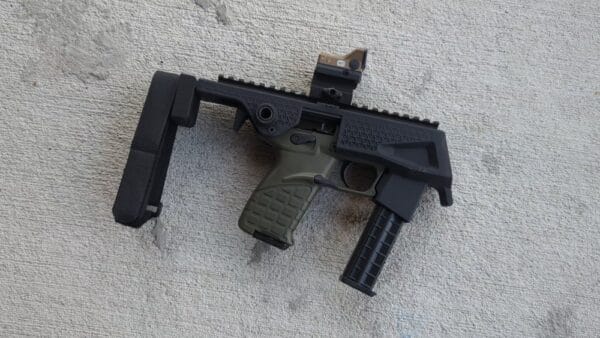
The KelTec P17 is a fine gun. It’s okay, and after a healthy break-in period, mine runs like an absolute champ. I had some issues with the sights, namely not being able to adjust enough to find the proper point of aim. I didn’t have much of a need for it, and it was a gun likely to sit in the back of my safe and be unused. Until I saw the Farrow Tech FT17 PDW Kit.
KelTec P17
Live Inventory Price Checker

|
Kel-Tec P17 22LR Pistol 3.93" Threaded Barrel 16+1 Round Green | MidwayUSA | $ 224.99 |
|

|
Kel-Tec P17 22LR Pistol 3.93" Threaded Barrel 16+1 Round Black | MidwayUSA | $ 219.00 |
|

|
Kel-Tec P17 Optics Ready 22LR Pistol 3.8" Threaded Barrel 17+1 Round Black | MidwayUSA | $ 259.00 |
|

The FT17 PDW Kit breathed a new sense of life into an odd but fairly standard .22LR handgun. The Farrow Teach kit transforms your little P17 into a poor man’s MP7. The FT17 kit keeps the overall profile small, but creates a viable and handy micro-sized .22LR platform. It’s probably the cheapest way to obtain a PDW-type firearm.

The P17 is a cheap little handgun, often easy to find for less than 200 dollars. The FT17 kit comes in various configurations, each with its price point. The configuration you see here is the FT17 Pro Kit with the aluminum Steadybrace. The standard kit lacks the magazine holder positioned in front of the pistol. This setup retails for $285.
The FT17 – Construction and Installation
The FT17 kit is primarily made from polymer and appears to have been constructed through additive manufacturing, aka fancy 3D printing. These aren’t a couple of guys with an Ender 3, but what I assume are some high-end commercial-grade machines. I’m admittedly nothing more than a 3D printer hobbyist, but the work on the FT17 is excellent.

The brace rails are metal and smoothly slide in and out of the FT17 kit. There is a good bit of movement to the brace rails, but it’s still very usable. Installation was quick and easy. KelTec’s use of screws for everything plays a roll in the installation of the kit. You remove two KelTec screws and replace them with screws that attach the kit to the gun.
Up front, a screw locks into the rails, and the entire kit comes together easily. I did it while suffering through season 2 of The Last of Us and didn’t miss a story beat or Marvel-level joke.

The FT17 kit integrates a metal optics rail across the top, which is a nice touch. A polymer trail would get eaten up over time. A charging handle hooks to the slide and attaches under the kit’s frame. It’s a small tab that’s easy to use to charge the weapon and fix malfunctions. Up front, there is plenty of room to install a suppressor or muzzle device.

With the Pro Kit, we have a magazine holder that friction-fits a P17 magazine into the front of the gun. The magazine release and safety are still accessible with the kit locked in place. Even the micro-sized bolt release is easy to access, but the charging handle is a better option.
To The Range With the FT17
A red dot is a must-have for the FT17. I tossed a pistol dot on, and a riser, and bam, I was ready to rock and roll. This is supposed to be a PDW, and the idea behind a PDW is that shooters can engage at ranges well beyond that of a normal handgun. When I say engage, I don’t mean just hitting the target, but hitting it with ease and quickly in all sorts of positions. With a 25-yard zero, I went out to 50 yards and started lighting it up.

It was easy to hit an IPSC-sized piece of steel, which is a fairly large target and one I can hit with a handgun anyway. I focused on a row of gongs varying from eight to four inches. The eight and six-inch gongs were easy fodder for the FT17. The four-inch gong was a little more elusive, but if I slowed things down a fair bit, I could hit it.

I could keep a 33% reduced-sized ISPC target doing nothing but dinging. At 50 yards, the FT17 was a beast. At 100 yards, it still proved decently accurate. A red dot and shaky brace arms make it a little tougher to hit smaller targets, but dinging that IPSC-sized steel target wasn’t a problem.
Going Fast
We also want to go fast with a PDW and a .22LR braced pistol, which is not hard. There is barely any recoil and no muzzle rise to speak of. You can shoot through a 16-round magazine in what feels like no time at all. The trigger went slack multiple times as I fired an entire 16-round magazine, which surprised me. You can shoot that fast.

I shot a Bill Drill from the low ready and landed six rounds of .22LR in 1.5 seconds. I will admit that wasn’t cold. I kept slowing myself down, expecting more recoil and a need for more control. Only after I leaned into the American tradition of near-uncontrolled mag dumping did I cut my times while not reducing accuracy.
Speaking of, I shot a ton of failure-to-stop drills with this rig, and it was like gliding over ice. It’s so fast and easy to do. I barely have to see the dot before releasing a rapid double tap of .22LR and finishing with a well-aimed headshot.

Reloads were awkward at first, and reloading from the front magazine pouch felt clumsy. However, it’s a completely different movement, and after a few practice runs, it went smoothly. The magazines don’t always drop free from the P17, so it’s best to rip them out. The friction-fit magazine pouch holds the magazines without a problem and releases them with a short tug.
Does It Affect Reliability?
I had some issues with the P17 after my initial purchase. It seems to require a break-in period. I was a little nervous that the kit would push the P17 back to its more unreliable nature. Consider my worries abated. The P17 ran like a clock inside of the FT17. I had zero malfunctions as I shot through a brick of basic Blazer .22LR.

I went through 500 rounds without a problem related to the FT17. I had a few failures to fire, which tend to happen with rimfire cartridges, and I don’t think it’s a P17 problem. My P17 has this weird issue where the slide becomes sluggish, and I can watch it slowly close on the next round. That problem seems to have disappeared with the FT17 kit installed.
The only main difference is that the slide release doesn’t work well with the FT17 kit installed. It doesn’t always close, often stopping halfway. This is never an issue using the charging handle. The charging handle is awfully skinny, and I have a small fear of breaking it if I were too rough, but that hasn’t been a problem, so maybe it’s an unfounded fear.
Cyberpunk 2025
A PDW implies defensive use. While you certainly could use the FT17 as a defensive weapon, it probably wouldn’t be my go-to. I do think there is a place for .22LR in the self-defense conversation, but if I’m going with a larger platform than a pistol, I probably want a centerfire caliber.

There could be a place for this kit amongst the recoil-sensitive. It certainly has no recoil and packs a punch with 16 rounds of .22LR in a very small and lightweight platform. I would choose a magazine full of Velcoitors or Federal Punch for defensive .22LR.
For me, this is a total fun gun. It’s a PDW wannabe that’s super cheap to shoot. It’s a training and practice gun and a gun and kit that invokes a certain Cyberpunk styling that breaks it away from being boring. If you want something fun, different, and small, an FT17-equipped P17 can get it done.
About Travis Pike
Travis Pike is a former Marine Machine Gunner, a lifelong firearms enthusiast, and now a regular guy who likes to shoot, write, and find ways to combine the two. He holds an NRA certification as a Basic Pistol Instructor and is the world’s Okayest firearm’s instructor.



Be much more useful if they had this chassis for the PMR30 in .22 mag
That 5-round group on the target’s brow ridge would give one a terminal sinus headache, .22 or not.
Interesting item and article. Thanks!
Their website does a crappy job of explaining the options. That alone would keep me from ordering.