
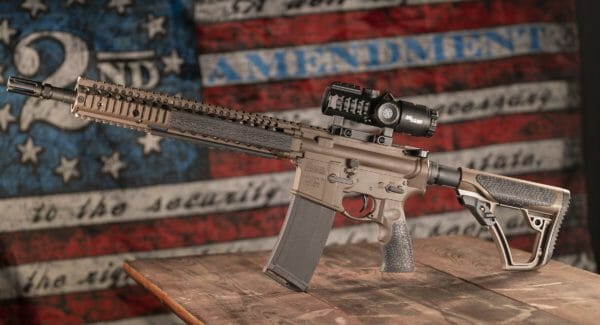
One of the most overlooked components of the AR-15 is its buffer weight, yet it plays a massive role in how your rifle feels and functions. Choose the wrong buffer, and you might deal with failures to feed, brass ejecting erratically, or more recoil than necessary. Choose the right one, and you’ll get a softer-shooting, more reliable rifle that cycles smoothly.
Whether you’re running a bone-stock carbine, a suppressed SBR, or a competition-tuned blaster, the right buffer weight can make all the difference. Let’s break it down.
Why Buffer Weight Matters
Your AR-15’s buffer assembly is made up of three components: the buffer, buffer spring, and buffer tube. Together, they control how the bolt carrier group (BCG) travels rearward, absorbs recoil, and returns to battery after each shot.
Choosing the right buffer weight affects:
- Bolt Speed & Cycling – Too light, and your BCG moves too fast, causing premature wear. Too heavy, and it may not cycle reliably.
- Recoil Impulse – A heavier buffer slows the BCG, spreads the recoil impulse over more time, and makes follow-up shots easier.
- Parts Longevity – Matching buffer weight to your gas system reduces battering on the receiver extension and bolt lugs.
- Reliability – A properly tuned buffer system extracts and ejects consistently and chambers the next round with authority.
Know Your Gas System
Before choosing a buffer, you need to know what gas system you’re running: pistol, carbine, mid-length, or rifle. The length of your gas system determines how much pressure drives the BCG rearward.
| Gas System | Typical Barrel Length | Gas Port Distance |
|---|---|---|
| Pistol | 7.5″–10.5″ | ~4.3″ |
| Carbine | 10″–18″ | ~7.3″ |
| Mid-Length | 14″–20″ | ~9.3″ |
| Rifle | 20″+ | ~12.6″ |
- Overgassed rifles (common with carbine-length setups) run hotter and faster, leading to increased recoil and wear on parts; a heavier buffer can help mitigate this.
- Undergassed rifles may require a lighter buffer or an adjustable gas block.
Knowing your gas system is the first step toward buffer tuning that actually works.
Common AR-15 Buffer Weights Explained
There are several common buffer weights to choose from. Each one affects your rifle’s cycling differently:
| Buffer Type | Weight | Best Use Case |
|---|---|---|
| Carbine Buffer (Standard) | ~3.0 oz | Included in most AR-15s. Works with mid-length gas systems but can feel snappy in carbine-length setups. |
| H1 Buffer | ~3.8 oz | Slightly heavier. Slows BCG speed just enough to reduce felt recoil. Good for mid-length/rifle gas setups. |
| H2 Buffer | ~4.6 oz | The sweet spot for many 14.5″–16″ rifles. Excellent for taming over-gassed carbines and suppressed setups. |
| H3 Buffer | ~5.0–5.4 oz | Ideal for suppressed ARs, SBRs, or rifles chambered in 300 BLK, 7.62×39, or 6.5 Grendel. |
| Rifle Buffer | ~5.0 oz | For fixed-stock rifles with A2-length buffer tubes and rifle-length springs. |
| Pistol Buffer | 5–8.5 oz | For pistol-caliber carbines (PCCs). Adds mass to slow the blowback cycle and reduce felt recoil. |
The A5 Buffer System Option
The VLTOR A5 system deserves its own mention. Developed at the request of the U.S. Marine Corps, it mimics the smooth recoil impulse of a rifle-length buffer while letting you run a collapsible stock.
It uses a slightly longer buffer tube and rifle-length spring. Many shooters report that it dramatically smooths recoil and improves reliability, especially when paired with an H2 or H3 A5 buffer weight.
Live Inventory Price Checker

|
Ar-15 Buffer Retainer Springs - Brn Ar-15 Buffer Retainer Spring | Brownells.com | $ 4.99 |
|
|
Armaspec SRS-H Gen 4 3.8oz AR-15 Buffer Kit | GunMag Warehouse | $ 108.99 |
|
|
|
Luth-AR Mil-Spec AR-15 Buffer Tube, Black - LBS-15M | Palmetto State Armory | $ 27.99 $ 24.99 |
|
|
|
AR-15 Buffer Tube End Plate Sling Loop w/ Swivel Slot | Monstrum | $ 19.95 |
|
Factors That Affect Buffer Choice
Buffer weight isn’t one-size-fits-all. A few things to consider:
- Barrel Length & Gas Port Size – Shorter barrels and larger ports typically require heavier buffers.
- Suppressor Use – Suppressors add backpressure, which speeds up the action. A heavier buffer tames the extra gas.
- Ammo Type – Hot 5.56 NATO loads generate more pressure than light .223 plinking ammo.
- Adjustable Gas Block – The easiest way to fine-tune your rifle. Use it in combination with buffer weight for optimal results.
I was recently shooting my 10.5″ AR pistol, which had a standard carbine buffer installed. Although that worked, the gun was extremely gassy. To reduce some of that gas and smooth out the recoil, I swapped out the carbine buffer for an H2 buffer. While that did improve things, it was still not quite where I wanted it to be. I then tried an H3 buffer a buddy of mine had, and that was the sweet spot for my gun. The H3 was able to slow the BCG down enough to let more gas out of the barrel instead of into my face. A byproduct of that was a much smoother shooting shorty too.

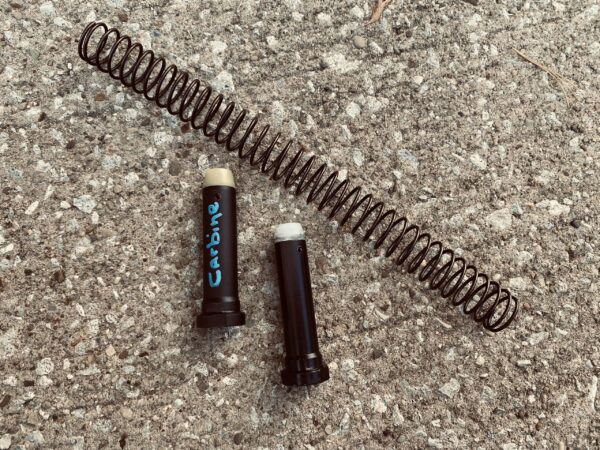
The only way to figure this stuff out is to get on the range and test things out. I’m now waiting on an H3 buffer and gas mitigating charging handle from Griffin Armament.
How to Swap Your Buffer
Changing your buffer weight is simple:
- Unload Your Rifle – Remove the magazine, clear the chamber, and verify it’s safe.
- Separate Upper and Lower – Push out the rear takedown pin and pivot the receivers apart.
- Depress Buffer Detent – Capture and remove the buffer and spring.
- Install New Buffer – Slide the new buffer into the spring and reinsert into the tube.
- Reassemble & Function Check – Make sure the BCG cycles properly before live fire.
Take the opportunity to clean your BCG and buffer tube while you’re in there; it’ll keep your rifle running smoothly.
Final Thoughts: Finding Your Rifle’s Sweet Spot
Choosing which buffer weight to run in your AR-15 is part science, part experimentation. Start with the recommended weight for your gas system, then test-fire with your preferred ammunition. Look for consistent ejection (typically at 3–4 o’clock), smooth cycling, and reliable lock-back on an empty chamber.
If your rifle feels too violent, step up to a heavier buffer. If it struggles to cycle or short-strokes, drop down a weight or adjust your gas system.
Tuning your buffer weight is one of the easiest ways to improve your rifle’s reliability and shooting experience. Get it right, and your AR-15 will run flatter, cleaner, and more consistently, no matter what role you built it for.
About Scott Witner
Scott Witner is a former Marine Corps Infantryman with 2ndBn/8th Marines. He completed training in desert warfare at the Marine Air Ground Combat Center, Mountain Warfare and survival at the Mountain Warfare Training Center, the South Korean Mountain Warfare School in Pohang, and the Jungle Warfare school in the jungles of Okinawa, Japan. He now enjoys recreational shooting, trail running, hiking, functional fitness, and working on his truck. Scott resides in Northeastern Ohio.


That’s easy. The one that makes it work best.
Heavier buffers do not increase (bolt lock time) to allow more residual pressure to escape the barrel, the difference is insignificant. This is a common mistake I read all the time. Colt discovered this when they replaced their buffer with the original Edgewater buffer. The cam track cut, port location/size and powder pressure curve does do this. The LMT enhanced longer straight cut carrier and the Leitner-Wise/VKTR carriers with their different cam track cuts do increase (bolt lock time) to allow more residual pressure to drop before extraction occurs. Heavier buffers (do) slow the carriers velocity, will prevent bolt bounce… Read more »
I use a Kynshot hydraulic buffer with a JP Springs precision ground (od) buffer spring. The spring is ground to give a close fit to the buffer tube, eliminating that slappy spring sound and the hydraulic buffer cuts recoil about 30%.
I use a heavier Kynshot hydraulic buffer in my 300 HAMR AR15. Smooth. They also recommend that buffer for 9mm blowback carbines. Need to do a swap out test using that buffer on my 9mm carbine.
Explain to me how an adjustable gas block will solve the problem of an under-gassed barrel. You can’t increase the size of the port in the barrel with a gas block.
I stick with the buffer that comes with it from the factory. Early on I tried changing the buffer, even got a BCM special buffer/spring/tube to make things softer… Disaster and wasted money. The AR15 must recoil in nice weather. If it doesn’t, dirt, sand, mud, carbon build up will jam it. The recoil makes the BCG cycle through it. Now if it gets cold, snowy, freezing, and your ammo doesn’t burn as hot as it does when it’s 70 to 90 degrees, the AR15 will jam. A proper cycling AR15 will always have recoil, and will always be softer… Read more »