
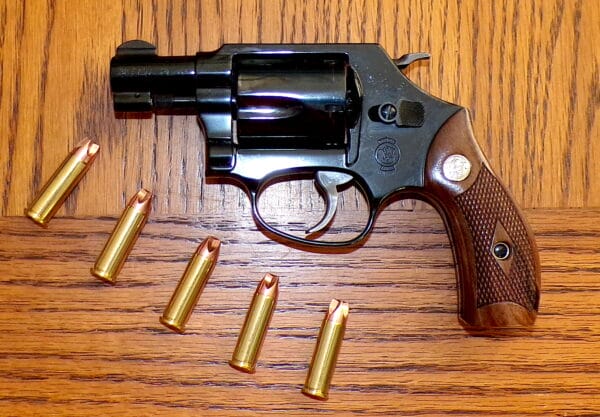
In this world of micro-9-striker-fired carry guns, the .38 Special snub-nosed revolver might seem like a throwback to the early Iron Age. I find it ironic that, in the current carry gun environment, folks still seem to want to tote a 5- or 6-shot wheelgun in a pocket. Count me among them.
I’ve owned several short-barreled wonders… my current version is a Diamondback SDR .357 Magnum. Talk about a peach of a wheelgun… 6 shots of .357 on tap, with a great trigger and sights.
But it always wasn’t that way… the guns that we know as .38 snubbies are a fairly new invention. Relatively speaking, of course. Of course, there have been pocket-sized revolvers for the past 150 years or so, but it wasn’t until 1950 that the world of pocket guns got a pretty big boost. That was when Smith & Wesson unveiled their Chief’s Special, the gun that became the Model 36. This two-inch snubby was chambered in .38 Special.
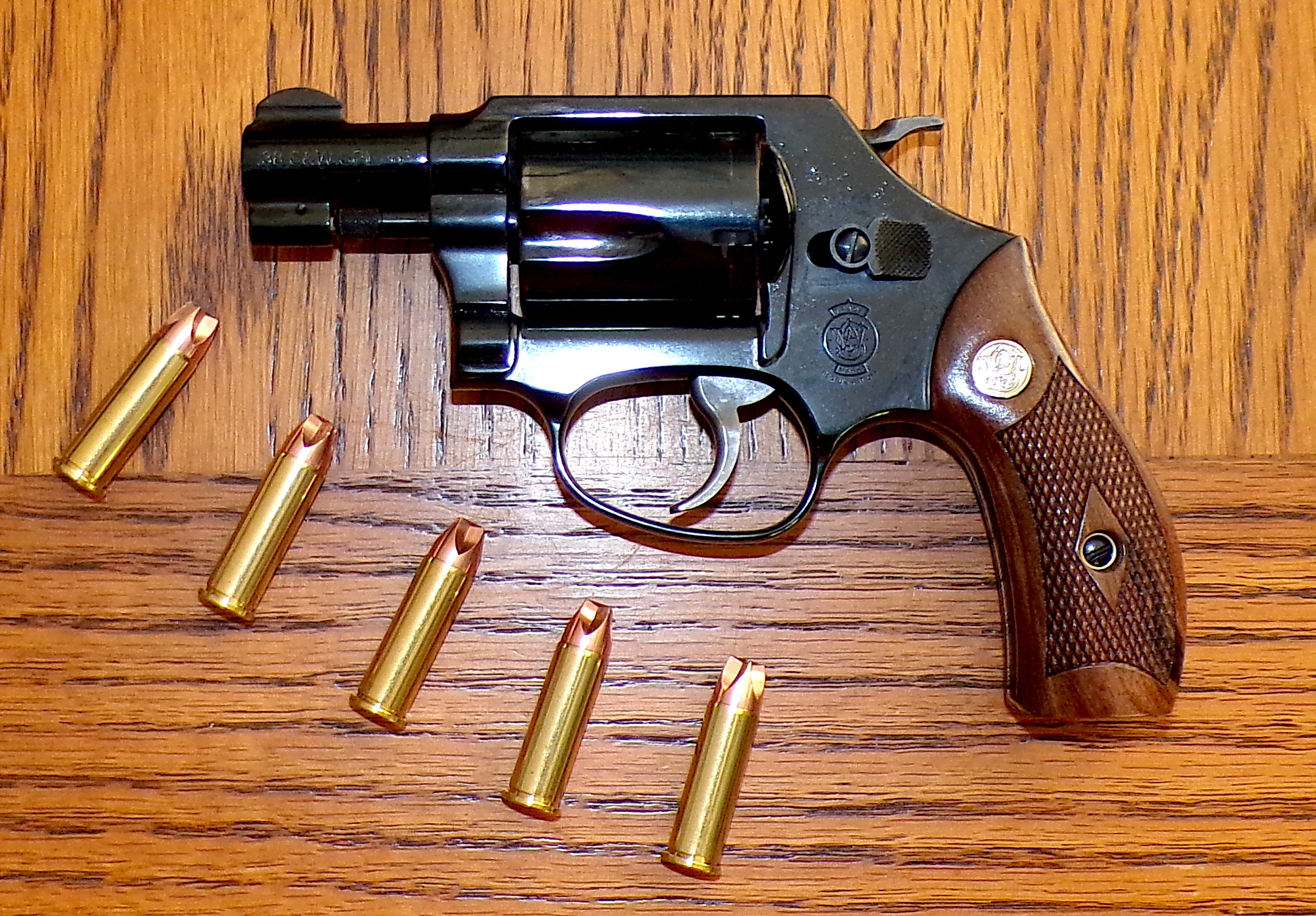
Smith & Wesson Model 36 “Chief’s Special”
The gun that we know as the Chief’s Special was introduced at the International Association of Chiefs of Police (IACP) convention in 1950. It was chambered in the more powerful (for that time) .38 Special. This was a cartridge whose power and energy exceeded that of the .38 Long Colt and the .38 S&W. It was a bit longer, which necessitated coming up with a larger frame than the I-frame that those two cartridges utilized.
Hence, we got a 5-shot, two-inch pocket revolver that was designed from the get-go to be carried as a backup by law enforcement, or as a primary arm by plainclothes officers… like police chiefs were known to dress back then.
The gun was built on the new J-frame. We know all about the J-frame now… S&W has based its .38 Special snub-nosed line on that frame. I own one, a model 643… what I call the “humpback whale” of snubbies, as it uses a shrouded frame to enclose all but the tip of the hammer. This allows for thumb-cocking, but prevents the hammer from getting snagged on your pocket during the draw. Their J-frame line has sold many guns for them.
So… the Model 36 has been made for years, but it was only recently – January 2025 – that what is known as the Classic version came out. This was a no-internal-lock revolver that was styled like the original. Many shooters despise the lock that S&W felt compelled to include on many of its revolvers. The Classic series – models 10, 19, and 36 – have no such aberration. I am not a fan of the lock – I’ll leave it at that.
I’m glad that S&W brought out the classic series… they released other guns in the past as part of this series. The one I particularly remember coming out a few years ago is the Model 29 .44 Magnum. I owned one back in the early ‘80s, a blued, 6.5”-barreled version. The original had a 6” barrel, but I didn’t quibble over the half-inch. I own an 8 ⅜” 629 now that has accounted for several deer… there’s just something about shooting a classic.
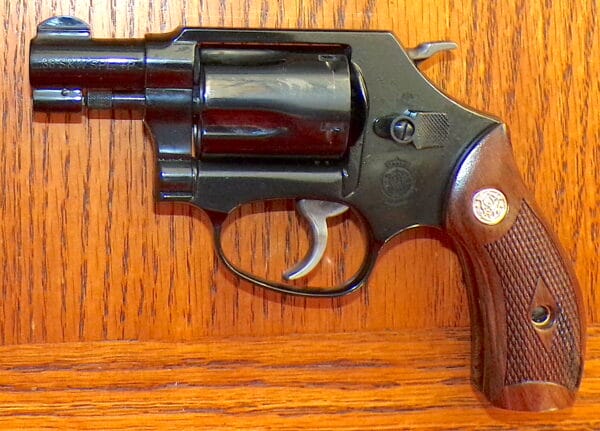
There are similarities between the current classic 36 and the original. This Model 336 has walnut stocks and a half-moon front sight, like the original. The deep blue finish is typical of S&W’s premium revolver lines throughout the years. Of course, metallurgy has come a long way since 1950… this little gun can be rated for +P ammo, a good thing.
Live Inventory Price Checker
|
|
Smith & Wesson Model 36 Classic .38 Special +P Revolver 1.88" 5rds, Blue | Palmetto State Armory | $ 899.99 $ 799.99 |
|
|
Smith & Wesson Model 36 38 Special +P Revolver 1.88" Blued Barrel 5 Round Walnut Grip | MidwayUSA | $ 799.00 |
|
|
Smith & Wesson Front Sight Pin Models 14, 16, 17-8, 19, 24, 27-4, 29-3, 36, Classic & DX | MidwayUSA | $ 2.29 |
|
|
|
Smith and Wesson Model 69 .44 Magnum 4.25"Revolver, Stainless - 162069 | Palmetto State Armory | $ 1044.99 $ 949.99 |
|
Let’s look at the Model 36… first, specifications:
- Width 1.33 In
- Length 6.94 In
- Height 4.3 In
- Weight 19.64 Oz
- Caliber 38 S&W Special
- Size Small
- Capacity 5
- Action Single/Double Action
- Barrel Length 1.88
- Grip Wood
- Sights Black Blade
- Optic Ready No
- Safety None
- Color/Finish Blued
- State Compliance CA, CO, CT, DE, HI, IL, MA, MD, NJ, NY, RI, VT, WA
- Threaded Barrel No
- Barrel Material Carbon Steel
- Frame Carbon Steel
- MSRP: $849
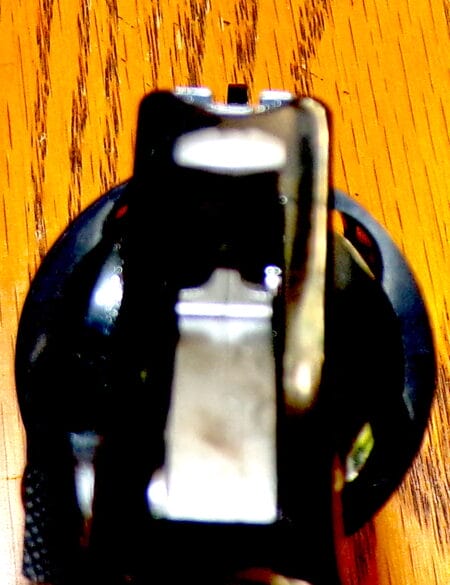
Now, for a few photos…


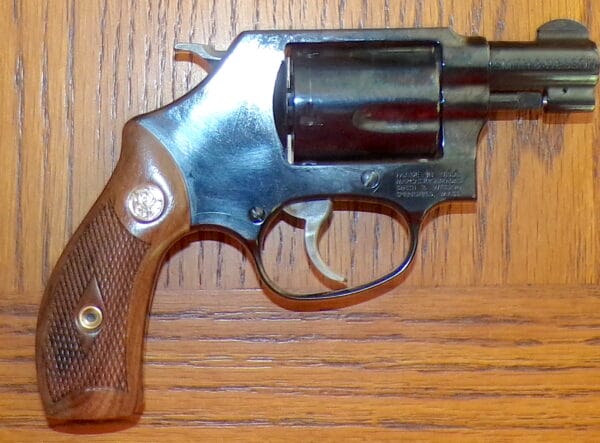

Range Time

I grabbed some Black Hills Ammunition .38 Special loads and headed to my backyard range, setting targets up at 10 yards. Here are some samples…


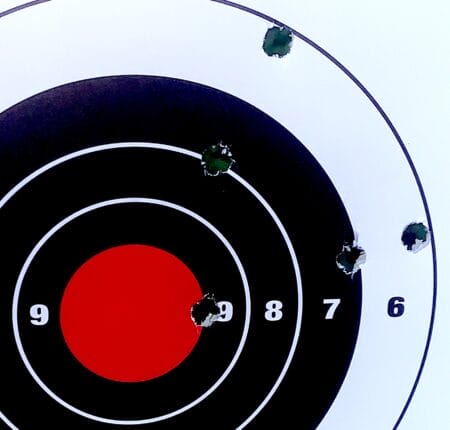
HoneyBadger +P 100-grain load. It shot a bit to the right, which was probably me, but the elevation was right on. It clocked about 950 fps out of this short barrel and was stout in recoil. The HoneyBadger line of machined, solid-copper fluted bullets is gaining a good reputation in self-defense circles. When I carry my Diamondback SDR snubbie, it will be loaded with these.
The gun exhibited acceptable accuracy at the given range. All loads I tried were right on in terms of elevation… that can be a problem when shooting ammunition that varies in velocity, as did these three loads. All in all, it worked very well.
Summary
For those who like simplicity in a carry weapon, a .38 snubbie fills the bill. With modern bullet technology, you get energy figures close to what 9mm delivers. Add in the fact that all you need to do in case the gun doesn’t fire is to pull the trigger again, and you have a viable weapon. Five rounds, with a reload strip or loader in your pocket with five more, has been proven to be adequate many times.
I’m glad they brought out this iconic revolver. It became the father of the J-frame line, and, as such, has earned a place in history. If you are like me and are a fan of revolvers, you might want to give it a look.
About Mike Hardesty
With experience spanning over 45 years, Mike Hardesty has long enjoyed shooting and reloading. An inveterate reloader, he casts bullets and reloads for a diverse array of firearms, each handled with long-practiced precision. Living in rural Indiana, his homestead boasts a personal 100-yard range where he shares his love for guns to his four sons, their wives, and eleven grandchildren. As a recognized author, his writings have been featured in notable platforms like Sniper Country, Bear Creek Arsenal Blog, Pew Pew Tactical, TTAG, Dillon Precision’s Blue Press, and Gun Made, revealing his ongoing passion for firearms at the age of 72.


No Hillary Hole! Now S&W just needs to do the same with the rest of their revolvers, as opposed to just with a select few.
I much prefer the model 60.
One can carry it for years and show no wear and tear.
Where as the blued guns look like they have been carried for years
Nice pocket gun! I have one that looks like it but mine is the old RG brand which is not supposed to be nearly the quality of a S&W. I bought it almost 50 years ago as at the time it was the only gun I could afford larger than a .22. Surprisingly it has held up well. Never had a problem and I take it along with all my firearms when I go to the range. I have put a lot of rounds through it and it still is accurate and dependable. Although I have some more powerful and… Read more »
From the article,
The one I particularly remember coming out a few years ago is the Model 29 .44 Magnum. I owned one back in the early ‘80s, a blued, 6.5”-barreled version. The original had a 6” barrel, but I didn’t quibble over the half-inch.
The 6.5″ barrel was the first barrel length made for the M29,
Though catalogued at the beginning as being available with either a 4- or 6 1/2-inch barrel, the first 500 .44 Mags. were made with a 6 1/2-inch barrel.
https://www.americanrifleman.org/content/a-look-back-at-the-smith-wesson-model-29/