
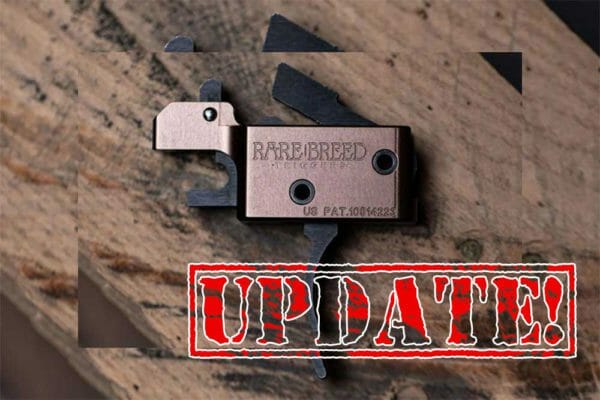
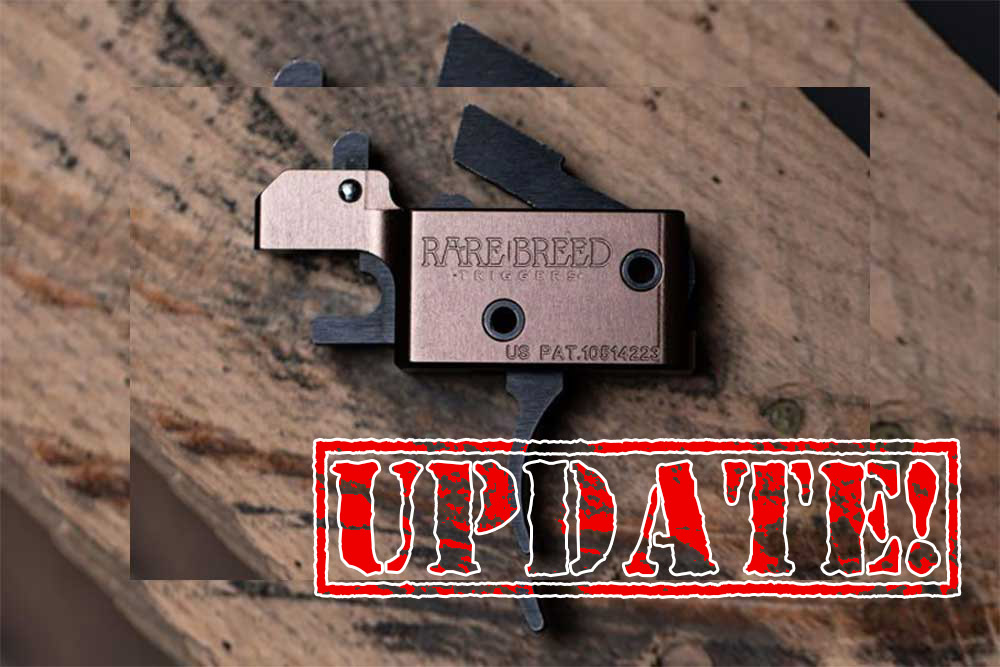
New Jersey and 15 other anti-gun state governments are suing the National Association for Gun Rights (NAGR), Texas Gun Rights (TGR), Attorney General Pam Bondi, the Department of Justice (DOJ), Bureau of Alcohol, Tobacco, Firearms and Explosives (ATF), ATF Acting Director Daniel P. Driscol, Rare Breed Triggers, and the named plaintiffs in NAGR v. Garland. The states seek to block the returns of forced reset triggers (FRT) to their owners that the ATF confiscated under former ATF head Steve Dettlebach.
Last month, the DOJ settled a case after a Texas United States District Court judge ruled that FRTs are not machine guns. The settlement resulted in all lawsuits against Rare Breed Triggers being dropped nationwide, and all triggers confiscated by the ATF to be returned to their owners. The 16 states attempted to intervene in the case, but the courts rebuffed their effort. Now, those same states are trying to get a preliminary injunction to block the return of the triggers to their rightful owners.
The complaint starts by listing the number of deaths from firearms and calls violence with firearms an “epidemic.” None of the statistics involve FRTs. The states appear to try to equate FRTs with gun deaths. They also provide monetary figures that they claim gun-related crimes cost cities.
According to the states, FRTs are machinegun conversion devices (MCD) and use crimes committed with Glock switches in their complaints, trying to conflate the two devices. Glock switches function as MCDs, whereas FRTs do not.
An FRT speeds up the rate of fire but does not act as an MCD. According to the National Firearms Act of 1934 (NFA), an MCD is a device that converts a semiautomatic firearm into a machinegun. The legal definition of a machinegun is a gun that expels multiple rounds with a single function of a trigger. An FRT does not meet that definition. Only a single round is fired by a single function of the trigger. That distinction means that a firearm equipped with an FRT is still a semiautomatic firearm, no matter the rate of fire.
The states also complain about the number of hours the ATF committed to seizing triggers from gun owners. The suit claims that 16 to 24 hours of law enforcement time were used for each trigger confiscation. The plaintiffs do not cite any legal precedent that suggests an item illegally confiscated after an extended period doesn’t have to be returned. The plaintiffs also reference new laws in states that ban FRTs. They claimed that if the federal government doesn’t ban them, it will cost the states extra money to enforce state laws. The states have traditionally borne the cost of enforcing state laws, so that these laws would be no different.
The complaint reads: “Because the distribution of FRTs into many Plaintiff States will violate state laws, those States will incur greater law enforcement costs from having to enforce their prohibitions on the sale, distribution, and possession of FRTs or FRT-equipped firearms. This case includes the substantial cost of retrieving FRTs or FRT-equipped firearms that are distributed or possessed in violation of state law. As noted above, ATF’s own evidence indicates that each FRT retrieval takes approximately 16 to 24 hours of law enforcement time.”
The case is on shaky ground, to begin with. The legal statute challenged is 18 USC 922, a criminal statute that does not constitute a civil cause of action, which is the exact action the states are trying to achieve. Additionally, the lawsuit is a challenge under the Administrative Procedures Act (APA). The APA does not and has never applied to legal settlements.
The states are attempting to use the APA to invalidate the settlement, which would be the first time in the country’s history that this has been done. By the letter of the law, this case should be dismissed, but the plaintiffs seemed to have “judge-shopped.”
The plaintiffs are suing in the United States District Court for the District of Maryland. This choice isn’t random. This District Court is one of, if not the most liberal, courts in the country. Some claim that Judge Paula Xinis, who oversees this court, is a judicial activist, and there is ample evidence to support this claim. The Judge is the same Judge who ordered the return of suspected gang member Kilmar Abrego Garcia back to the United States. Mr. Abrego Garcia is currently being charged with human trafficking and has been tied to the violent Salvadoran street gang, MS-13.
With the Judge in the case, a slam-dunk win for the defendants might not be so cut and dry, but in the end, the plaintiffs should win what many are calling a harassment lawsuit.
About John Crump
Mr. Crump is an NRA instructor and a constitutional activist. John has written about firearms, interviewed people from all walks of life, and on the Constitution. John lives in Northern Virginia with his wife and sons, follow him on X at @crumpyss, or at www.crumpy.com.




These AGs may be setting a regrettable precedent by suing NAGR and TGR. I would hope and expect to see Everytown, Giffords, et. al. as defendants in cases brought by NAGR, SAF, NRA, GOA, FPC and State specific groups. If attorneys general can wage lawfare without legal standing or basis, so can we.
someone needs to remove this judge then sue for all the damages caused by the bs
The biggest problem here is how our side is framing the issue. Look at the title of the article, “Anti gun states…”. That’s incorrect. The Second Amendment is about more than firearms, it’s about all the deadly terrible bearable arms of the soldier. Yes, that includes guns, but also it includes a whole lot more. The “pro gun” movement, if it can’t or won’t, realize, what it’s fighting for, that the Second Amendment is about more than semi auto AR15’s, magazine capacity, suppressors, concealed carry or in this case, forced reset triggers, it will fail, because it doesn’t understand what… Read more »
They have no standing, and the time it took fbtfe to steal legally owned property is irrelevant other than to prosecute each FBATFE agent for theft. There is no epidemic of violence, using guns or not, as compared to a hundred years ago. Courts have already ruled these aren’t machine guns and FBATFE violated the law by stealing property and usurping Congress by attempting to rewrite the law on machine guns. Yet the doj is so corrupt with criminals in robes who are nothing but activists for authoritarianism, so the case could go either way.
They complain that FRTs are “machinegun conversion devices” because they increase rate of fire to “meet or exceed the rate of fire of purpose-built machineguns”. I’d like to see an FRT that makes an AR15 fire faster than an M16 set on full auto.
As for anything that increases rate of fire being a “MCD”: is Jerry Miculek gonna have to surrender his trigger finger???
“FRT’s in free states is back,and it’s going to stay that way!”
Congress can always redefine what constitutes a machine gun and/or add FRTs (and similar devices) as a separate component of 26 USC § 5845(b) (federal MG definition). I highly doubt they will but you know, never say never!
Hey Crump, that is a good report!
FRTs are so hot that I can not get one. I’m on a waiting list.
Did you hear about the lawsuit against the ATF where they swatted a house at night and got the wrong house? Ya, LOL, it was one of their own people!!! LMAO!! 🙂
Yep. Now isn’t that special!!!
As the confiscations were dependent upon an interpretation of the BATFE and the DOJ’s settlement of the lawsuit obviates that justification, both the settlement agreement and the law require that the confiscated property be returned to the rightful owners. The states haven’t got a legal leg to stand on in this suit.