
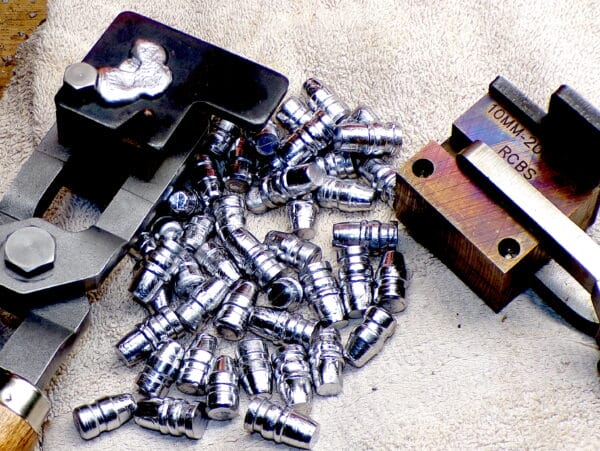
Casting your own bullets has always been one of the best ways for reloaders to save money and gain total control over their ammo. It’s a craft that connects you to more than a century of shooters who poured their own lead and tailored every round to their needs. I’ve been at it for decades, starting with a little 4‑pound Lee pot and aluminum moulds, cranking out everything from plinking rounds to hunting loads. But as my casting needs grew—and as I wanted classic bullet designs like Elmer Keith’s legendary .44 SWC—I realized it was time to step up my gear. That’s where RCBS came in, and after switching to their steel moulds, 25‑pound furnace, and heavy-duty Lube-A-Matic sizer, I learned a few things every caster should know.
RCBS Bullet Moulds
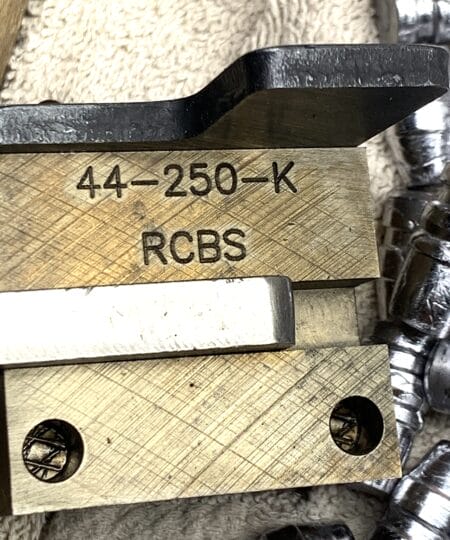
I settled on the RCBS version of that semi-wadcutter bullet, after adding a 10mm 200-grain truncated cone flat point bullet mould, as well.

These moulds are different than what I had used before. For one thing, they are heavier than the aluminum models. Being made out of steel, they will not warp. Both are double-cavity. I guess the main difference between my new moulds and my old ones is the scale… My new RCBS moulds are heavy-duty. They are larger, and the handles are larger, as well.
I then “graduated” from that 4-pound pot to a larger 10-pound one. But, with my recent casting upgrade, I moved to an RCBS bullet furnace. They sell just one — a big unit that holds 25 pounds of alloy. It’s a doozy, with a built-in thermostat that allows you to set the target temperature. It comes in both a 120- and a 240-volt version.
Rounding out the trio of casting equipment, I added a Lube-A-Matic bullet lubricator/sizer. I had, years ago, used a Lyman sizer, but it wore out and I got lazy (or cheap). I went with tumble-lubed bullets and bought cast bullet liquid alox. After a stint in powder coating (which works, but that’s a separate article), I went full circle back to a lubri-sizer.
I mentioned, above, aluminum moulds. Since many casters use aluminum moulds, let’s look at the difference between those and RCBS’s steel ones since we’re discussing casting in general.
Live Inventory Price Checker
|
RCBS Summit Single Stage Reloading Press | MidwayUSA | $ 299.99 |
|
|
|
RCBS Summit Single Stage Reloading Press | Ammunition Depot | $ 413.09 $ 299.99 |
|
|
RCBS Partner Single Stage Reloading Press Kit 2 | MidwayUSA | $ 326.99 |
|
|
RCBS Partner Single Stage Reloading Press | MidwayUSA | $ 184.99 |
|
Differences Between Aluminum And Steel Moulds
I have used both types of moulds and have discovered a few differences. I mentioned weight above… steel tends to be heavier than aluminum. You need to be aware of this, because your casting sessions may build a bit more muscle with steel moulds!
Bullet moulds tend to be fairly uniform in size, so the RCBS moulds are heavier than the aluminum ones. Add in the larger handles, and you know that you’ve got something substantial in your hand.
(Speaking of the handles, you’ll notice in the top photo that the mould may be installed in the handles so that the sprue plate can swing either way. I didn’t have that option before. I have them going different ways to see which way works best for my left-handed self. No decision yet.)
Another difference between the two types concerns maintenance. Aluminum moulds don’t rust under normal conditions, but steel will. RCBS recommends leaving the last bullets you cast in your session in the mould… That way, they won’t rust. I just wipe the metal surfaces with a bit of oil after things have cooled down.
One final difference I need to mention has to do with warming the moulds up prior to casting. I have to admit that aluminum moulds heat up pretty quickly and throw decent bullets quickly. Steel moulds need a bit more warm-up. It’s common to get some wrinkled bullets with both types of moulds, especially if there’s any oil or other substance in the mould, so make sure you wipe the cavities out with an alcohol-dampened cleaning patch prior to heating the mould up, at least the first time you use it. I discuss maintenance below.
RCBS Lube-A-Matic
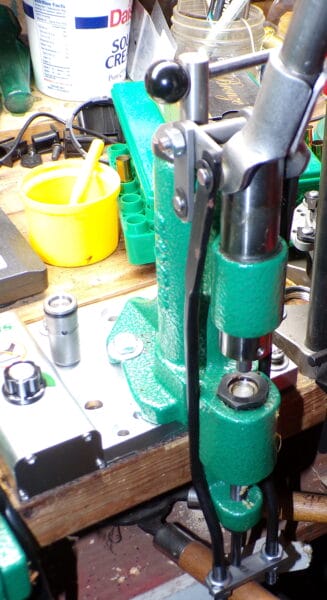
This lubricator/sizer is typical of the breed, but like everything RCBS builds, it’s heavy-duty. I have it sitting on the heater that is designed for it (you can see the temperature knob), so that using the machine in the winter in an unheated building is not an issue… Bullet lube will flow as needed.

If you’ve used a similar machine, you will be familiar with the drill, but I do have one tip. When you buy a sizing die for the Lube-A-Matic, you need to order a top punch that fits the bullet nose’s profile… or do you?
I discovered, years ago, that sometimes the recommended top punch for a given bullet and sizing die may not be the best choice. For example, the recommended top punch for the 10mm die (for the 200-grain flat point) eats into the bullet nose, as it is too small for the bullet’s nose and digs into the bullet. Before, I simply cut a round piece of leather and stuck it into the top punch… that cushioned the nose and didn’t deform the bullet.
Recently, I simply ordered an oversized top punch… a .445”… to use with both the 10mm and the .44 caliber bullets. I won’t need to swap it out, and it won’t deform either bullet. Interesting, the things you learn over the years.
RCBS Pro Melt-2

Melting lead alloy is not really hard… You can do it in an old iron skillet over a good fire or a propane burner. Shooters have done that for well over a century. It does help, however, to have a tool that you can use that will allow you to set the temperature of your alloy melt. I use wheel weights, and the instructions say to hold that alloy at 775 degrees F. This furnace makes that easy.
Set the display’s buttons to that temperature, and stand back. This furnace has a mould guide below the pot that is adjustable. Also adjustable is the flow rate. This is the spiffiest furnace I’ve ever owned, and I’ve had a few.
Wrinkled Bullets
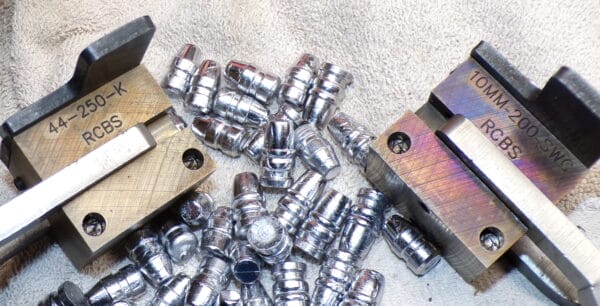
What do you do about wrinkled bullets? There are two main reasons for bullets wrinkling. First, the mould is not up to temperature. I mentioned above that RCBS recommends that you park the mould on the swinging pot cover to allow it to warm up.
The second cause of wrinkles is that you have a bit of oil or other solvent in the mould. I was, as usual, in a hurry to get some shiny bullets down for photos and did not properly clean these brand-new moulds as I should have done. Typically, I will take a cleaning patch with some alcohol on it and work it into the mould’s nooks and crannies. That will remove any shipping oil. Once cleaned, your mould should throw beautiful bullets. Do not put any more oil in the mould.
Care Of Your Moulds
I mentioned above that non-steel moulds do not readily rust. This is true. So, that means for your steel moulds, you must do an extra step or two at the end of your casting session.
First, don’t knock the final bullet(s) out of the mould. Leave them there. Whether or not you knock the sprue off is your call, but don’t empty the mould.
Then, wipe the outside of the mould with an oily rag. I have a big aerosol can of Rem Oil by my bench that I use, but any type of oil will work. The point is to coat the steel, but only on the outside. My bench is in an unheated pole barn. “Un-heated” also means “un-air-conditioned”, so Indiana’s uber-humid summers can cause the finest of steels to go orange. Here’s another reloading-versus-weather tip, thrown in for free… keep your reloading powder in a refrigerator or freezer, if it’s stored in an uncooled area. Heat and humidity are enemies of smokeless powder, so keep it cool and dry.
The Upshot
I am having to learn to use steel moulds for my casting, since I “grew up” with aluminum ones. That’s a good thing! I now have a couple of bullet styles that I have wanted for a long time that were unavailable in the other line of moulds I’d used. I know that steel moulds are not new to many of you, but they are to me. But… It’s worth the learning curve! Pick up a mould or two, add in the very handy, powerful 25-pound furnace and the lubricator/sizer, and your handloads should prosper. Isn’t that what it’s all about? Go here to start your search for RCBS bullet casting solutions.
About Mike Hardesty
With experience spanning over 45 years, Mike Hardesty has long enjoyed shooting and reloading. An inveterate reloader, he casts bullets and reloads for a diverse array of firearms, each handled with long-practiced precision. Living in rural Indiana, his homestead boasts a personal 100-yard range where he shares his love for guns to his four sons, their wives, and eleven grandchildren. As a recognized author, his writings have been featured in notable platforms like Sniper Country, Bear Creek Arsenal Blog, Pew Pew Tactical, TTAG, Dillon Precision’s Blue Press, and Gun Made, revealing his ongoing passion for firearms at the age of 72.



have cast my own and can plate them as well , silver plated some 45s back in the 60s lone ranger and all Roy Rogers & Sons Of The Pioneers – Tumbling Tumbleweeds have some s.900 fine silver cast as well never know when you might run into a werewolf…today I do more with computer controlled lathe lead is not good for precision
Those bullets look like the mold was kinda cold, not filled out very well.
Been casting bullets since 1962, using Lyman cast iron 20lb pot and kitchen or Coleman stove. Went to RCBS bottom pour in 78 and never looked back. Still use the old iron pot to blend WW for ingots. Mix my own linotype for rifle bullets, WW w/2% tin added for improved mold fill out for pistol/revolver. Today’s lead WWs are probably no more than 2% antimony and 1% tin, so 2% added tin works well for pistol up to at least 1100fps w/o leading. I pour 1/2″ layer of silica gel dessicant in a .50 cal ammo can with good… Read more »
I run about 20 different molds and if you don’t want wrinkles heat your mold before you start. I use a double burner hot plate, put the mold on the heat plate while the lead melts in the pot and you won’t get wrinkles. I prefer the Lee aluminum molds as they leave almost no sprue. I use the Lee small pot to melt any lead that might have impuritys and the bottom pore for casting lead that I have cleaned in the small one. The Lee six cavity molds are my go to molds for making lots of bullets.… Read more »
I’ve been casting bullets since mid 60’s. Now after I cast a bunch of bullets and powder coat than size them and I stopped using messy bullet lube. The gun barrels are easier to clean with powder coated bullets..
Been casting my own since January of 81. I have used most of the major brands like RCBS, Lyman, Lee and MP. I use 9mm, 357, 44, 45 and 4570 molds on a regular basis. All of them make good and useful bullets. There are cast lead bullet types, sizes and weights that are not available in factory jacketed form. The least expensive molds are Lee with the rest running about 3x as much. Lee molds are aluminum, rcbs and lyman are steel while mp are brass. If you want hollow point molds the best by far are those from… Read more »