
In a recent debate, two speakers [including Charlie Kirk] discussed whether America needs more gun control or if current laws already go too far.
Both agreed on some points—like the importance of the Second Amendment and the need for responsibility in gun ownership—but they sharply disagreed on where to draw the line between liberty and regulation.
Below is a summary of the key positions and tradeoffs explored in the conversation. Read it over, watch the video, and tell us what you think in our comments below.
Arguments for More Gun Control
- Safety and Prevention:
Supporters believe stronger laws could prevent tragedies like school shootings and protect law enforcement officers. Ideas discussed included red flag laws, stricter background checks, and a federal registry of firearms. - Barring Violent Offenders:
The pro–gun control side argued that those convicted of violent crimes, such as domestic violence, should permanently lose the right to own firearms. - Federal Registry as a Safety Tool:
Advocates suggested that a registry would help police know what to expect when responding to dangerous calls, potentially reducing risk to officers. - Training Requirements:
Similar to driver’s license testing, mandatory firearms training could ensure that new gun owners know how to handle and store firearms safely.
Potential Pros:
- It could reduce access for dangerous individuals.
- It may prevent accidents through required safety training.
- It could give law enforcement better situational awareness.
Potential Cons:
- Risk of government overreach or misuse of registry data.
- The possibility of unjustly disarming lawful owners through faulty accusations or mistakes.
- It may create new barriers for law-abiding citizens seeking self-defense.
Arguments Against More Gun Control
- Protection of Liberty:
Opponents argued that government registration of firearms often precedes confiscation in authoritarian regimes. They believe liberty is best preserved by keeping arms in the hands of citizens. - Ineffectiveness of Restrictions:
Examples were given comparing cities like Houston and Chicago, suggesting that stricter gun laws don’t necessarily mean fewer homicides. - Red Flag Law Abuse:
Cases were cited where veterans and lawful owners lost their firearms due to false or unverified claims, highlighting due process concerns. - Self-Defense and Urgency:
In states where permits take weeks to process, individuals under immediate threat may be left defenseless. Looser laws could allow quicker access for those in danger.
Potential Pros:
- Maintains the ability of citizens to resist tyranny and protect themselves.
- Reduces government control over private property.
- Avoids penalizing law-abiding citizens for crimes they didn’t commit.
Potential Cons:
- It may make it easier for dangerous individuals to obtain firearms.
- Could limit the tools available to law enforcement for risk assessment.
- Less oversight may lead to more accidental misuse by untrained owners.
Shared Ground
Despite their differences, both sides acknowledged:
- Gun ownership is a right that comes with responsibility.
- Some form of safety training could reduce accidental gun deaths.
- Protecting both liberty and safety is a complex balancing act.
Now it’s your turn.
Where do you stand? Do the potential benefits of stricter regulations outweigh the risks to liberty—or is the opposite true? Share your thoughts below.
We are in dangerous times! We are NOT meeting our funding goals! Will you help out?
A Population Capable Of Using And Operating Firearms Is Necessary

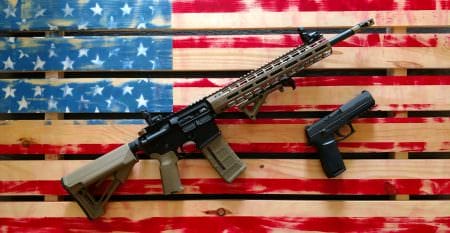
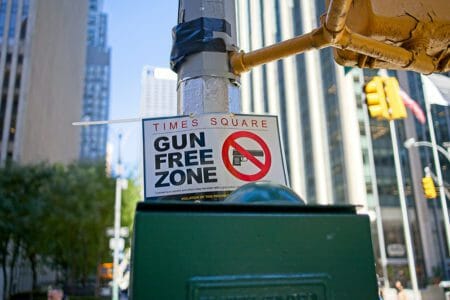


I have never understood how a thinking person could believe that passing laws would affect those who don’t care about laws. For some reason some people seem to think morality can be legislated and that has never been the case and never will.
All laws restricting gun ownership, possession and manufacture/sale are unconstitutional and serve zero purpose other than attempting to control we the people. They certainly don’t reduce or limit crimes. Murder and armed robbery/asault/rape are crimes. Criminalizing a tool will do nothing to prevent or reduce the incident of violence when the perpetrator is intent and willing to violate laws on murder, etc. This is incontrovertible and anyone who claims otherwise is lying or a moron.
Background checks have only existed for about 40 years, and do nothing to prevent crime; all they do is look back on prior behavior. Most mass shooters passed their NICS checks. And even felons deserve to arm themselves after serving their time. Should they commit another crime, they’ll go back to jail or the noose. They don’t lose the right to self defense or free speech or worship
The late Marine Col Jeff Cooper noted…”Killing is a matter of intent, not weapons. You cannot control the act by passing laws about the means.”
The individual that Kirk was “debating” is an idiot. He just repeated talking points of gun grabbers. He did not answer Kirk’s arguments, just kept repeating the tired talking points. He also lied. He is not a gun owner. No gun owner would spout such nonsense.
Could training reduce accidents? Quite possibly. Hunter training has shown to help reduce accidents, motorcycle rider training has done the same, and the list continues. However, none of these are rights with explicit constitutional restrictions placed upon governmental infringement (defined as: undermine, erode, diminish, contravene, encroach, frustrate, defeat). This restriction immediately removes required training to “keep and bear arms” from the table. Is it a good idea? Absolutely, and I strongly encourage anyone who owns a firearm to receive, and continue with, training at least yearly. This would be not just a couple hundred rounds at the range, but actual… Read more »
Once again, the biggest common denominator of mass shootings isn’t even discussed; mental health. The majority of each mass shooter in the last three years (not race in race or gang related) is that the shooter was known to have had mental health issues and most had been involuntary committed for an emergency hold. Then everyone fecries how they weren’t reported to NICS. YES, they weren’t reported but why? Because HIPPA law prevents reporting until the the involuntary commitment exceeds 30 DAYS! And then, many times it isn’t done (similar to military not reporting to civil authorities and vice versa).… Read more »
I agree with belief that America needs better gun control. To that end I’d suggest adding shooting to public school curriculum. That way large numbers of young adults would develop skills to better control their guns. 🙂
Maybe I’m biased as I have such poor gun control. Gun control means hitting what you are aiming at – I’m only able to be close and even that not 100% consistently.
What needs to happen? Before the ACLU took over criminal justice system, armed robbery and rape, for example, were capital crimes and we had asylums for the mentally ill. State governments had more control and accountability, as they were in cliser proximity to the population. Now?? Shoplifting is decriminalized because everyone knows that some jackass with a briefcase and funding from out of town is going to bankrupt the locals by making a federal case out of it. The real roots don’t lie in poverty or unfairness or guns. The destruction of the nuclear family and creation of the Criminal… Read more »
The shared ground is important. Gun ownership is a right that comes with responsibility. I strongly believe that with responsibility comes accountability. Domestic violence, serious assaults, serious crimes against persons, armed robberies, murder or manslaughter – including murder and assault for hire, assaults where hands, feet, head butting, or with opportune weapons, or multiple individuals that constitute significant disproportionate force should result in the loss of Second Amendment rights for life. Some form of safety training could reduce accidental gun deaths. Firearms and training with any other weapon is safety training. How to encourage (or when to require) training is a tough… Read more »