
Opinion
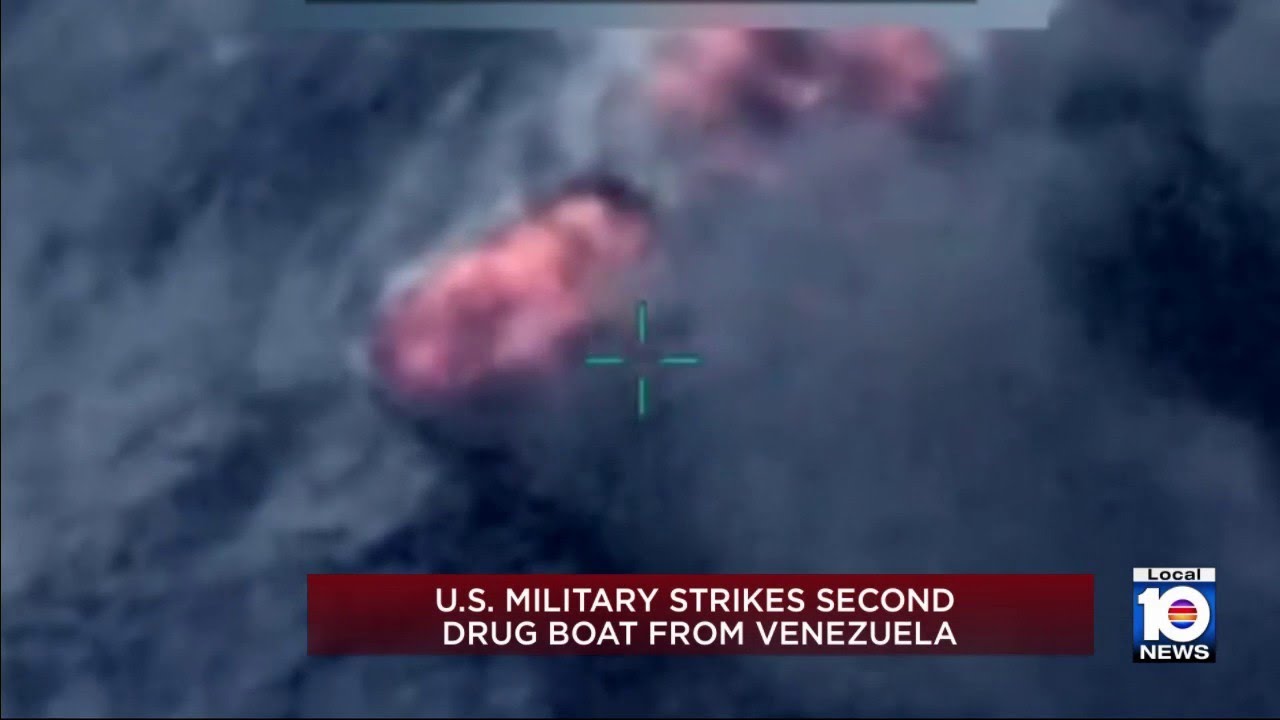
In separate attacks this month, the U.S. military blew up two speedboats in the Caribbean Sea, killing 14 alleged drug smugglers. Although those men could have been intercepted and arrested, President Donald Trump said he decided summary execution was appropriate as a deterrent to drug trafficking.
To justify this unprecedented use of the U.S. military to kill criminal suspects, Trump invoked his “constitutional authority as Commander in Chief and Chief Executive” to protect “national security and foreign policy interests.” That assertion of sweeping presidential power fits an alarming pattern that is also apparent in Trump’s tariffs, his attempt to summarily deport suspected gang members as “alien enemies,” and his planned use of National Guard troops to fight crime in cities across the country.
Although Trump described the boat attacks as acts of “self-defense,” he did not claim the people whose deaths he ordered were engaged in literal attacks on the United States. His framing instead relied on the dubious proposition that drug smuggling is tantamount to violent aggression.
While that assumption is consistent with Trump’s often expressed desire to kill drug dealers, it is not consistent with the way drug laws are ordinarily enforced. In the absence of violent resistance, a police officer who decided to shoot a drug suspect dead rather than take him into custody would be guilty of murder.
That seems like an accurate description of the attacks that Trump ordered. Yet he maintains that his constitutional license to kill, which apparently extends to civilians he views as threats to U.S. “national security and foreign policy interests,” transforms murder into self-defense.
Trump has asserted similarly broad authority to impose stiff, ever-changing tariffs on goods imported from scores of countries. Last month, the U.S. Court of Appeals for the Federal Circuit rejected that audacious power grab, saying it was inconsistent with the 1977 statute on which Trump relied.
The Federal Circuit said the International Emergency Economic Powers Act, which does not mention import taxes at all and had never before been used to impose them, does not give the president “unlimited authority” to “revise the tariff schedule” approved by Congress. The appeals court added that “the Government’s understanding of the scope of authority granted by IEEPA would render it an unconstitutional delegation.”
Trump’s invocation of the Alien Enemies Act against alleged members of the Venezuelan gang Tren de Aragua also has run into legal trouble. This month the U.S. Court of Appeals for the 5th Circuit concluded that Trump had erroneously relied on a nonexistent “invasion or predatory incursion” to justify his use of that 1798 statute.
Trump argued that the courts had no business deciding whether he had complied with the law. “The president’s determination that the factual prerequisites of the AEA have been met is not subject to judicial review,” Deputy Assistant Attorney General Drew Ensign told the 5th Circuit.
Trump took a similar position in the tariff case. As an opposing lawyer noted, it amounted to the claim that “the president can do whatever he wants, whenever he wants, for as long as he wants, so long as he declares an emergency.”
Trump also thinks his presidential powers include a mandate to protect public safety by deploying the National Guard, with or without the approval of state or local officials. In pursuing that plan, he claimed at a Cabinet meeting last month, he has “the right to do anything I want to do,” because “I’m the president of the United States.”
As Trump sees it, that means “if I think our country is in danger — and it is in danger in these cities — I can do it.” In effect, Trump is asserting the sort of broad police power that the Constitution reserves to the states.
If Trump’s crime-fighting plan provokes legal challenges, he is apt to argue that his authority is not only vast but unreviewable. That dangerous combination is emerging as a hallmark of his administration.
About Jacob Sullum
Jacob Sullum is a senior editor at Reason magazine. Follow him on Twitter: @JacobSullum. During two decades in journalism, he has relentlessly skewered authoritarians of the left and the right, making the case for shrinking the realm of politics and expanding the realm of individual choice. Jacobs’ work appears here at AmmoLand News through a license with Creators Syndicate.



I have no problem what President Trump is doing. None whatsoever. It wouldn’t have been necessary if the previous administrations didn’t bend/break the law in the first place!
Good thing we’ve the 2nd Amendment.
odummer used military to kill Americans, not foreign agents , and tn international waters laws that exist are old ..outdated yes but still unchanged pirates can be dealt with same way
As a matter of principle, more power in any branch of the Federal Government is almost always a bad thing.
I voted for Trump three times, and I want nothing more than a full restoration of our country, culture and values. And desperate times do bring desperate measures. But, that is also our danger now. This is almost a replay of Germany, when Hitler came to power. Hitler was also a populist and could do whatever he wanted to do. Imagine the Democrats coming back to power after Trump builds a police state for them, with digital IDs, surveillance everywhere, and the power to not just censor your opposition, but punish and destroy them for wrong think? It could make… Read more »
I believe that the president acted within his Constitutional authority. Sullum just wants to sell more print magazines.
Drug laws are different in International Waters.
Obama un-lived a U.S. citizen without much pushback. Just because he was hanging out with his jihadist BFFs. Arkansas Governor Orval Faubus deployed the National Guard in the school integration crisis at Little Rock Central High School in 1957 to prevent nine African American students, known as the Little Rock Nine, from entering the school. Later, President Eisenhower federalized the National Guard to support the integration and protect the students after a federal court ordered that they be allowed to attend. I’ve got nothing on tariffs. But Trump has a worthwhile goal to shrink the balance of trade. It would… Read more »
the department of justice has been taking over local police departments since the so called crime bill of 1994. and people think it was only about gun control and gang bangers. supposedly they conduct an investigation but in reality they bully them into agreeing to onerous oversight by threatening constant harassment by way of inspections and lawsuits that causes officers to spend more time filling out forms than doing actual police work. and that is by design and the Clinton administration and especially the Obama administration abused it as much as they could. and anyone who thinks the cartels with… Read more »
Amazing that there is so little in Reason magazine that is reasonable.