
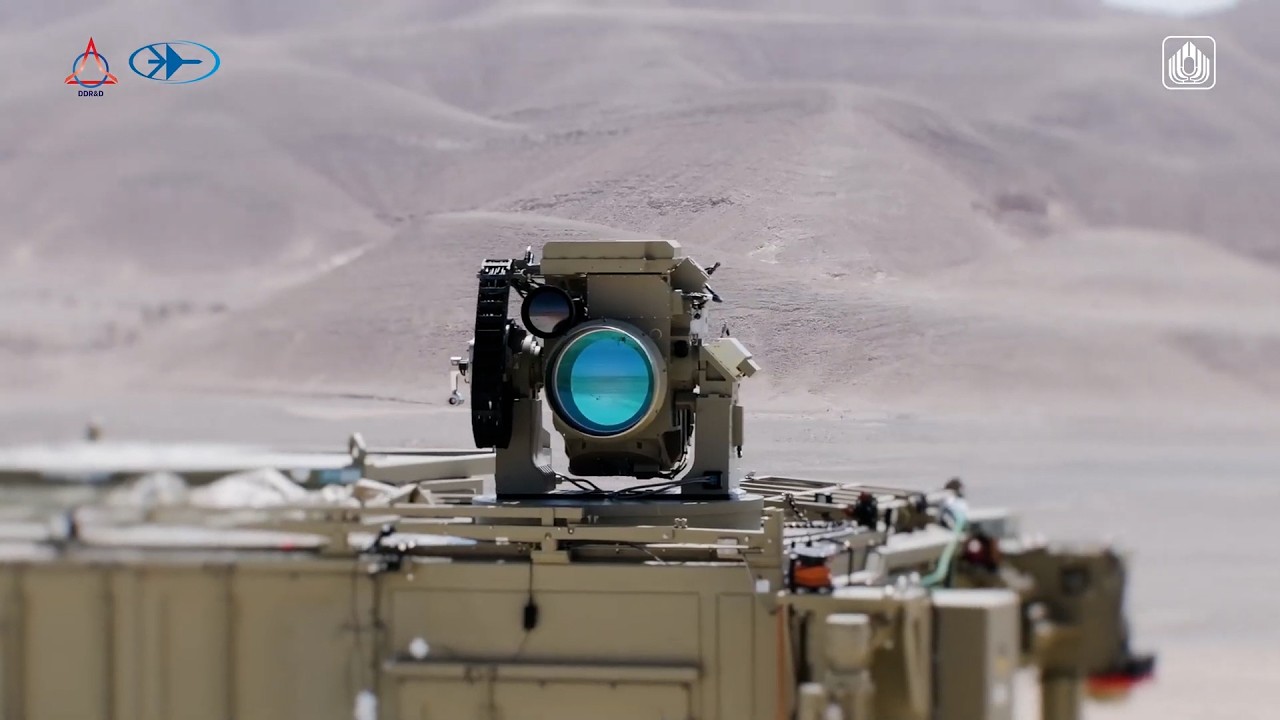
The Israeli anti-drone and anti-missile laser weapon, the Iron Beam 450, is said to be ready to be deployed in Israel. From the timesofisrael.com:
The Iron Beam is not meant to replace the Iron Dome or Israel’s other air defense systems, but to supplement and complement them, shooting down smaller projectiles and leaving larger ones for the more robust missile-based batteries such as the David’s Sling and Arrow systems.
As long as there is a constant source of energy for the laser, there is no risk of it ever running out of ammunition. Officials have hailed it as a potential “game-changer” in the battle against projectile attacks.
The Iron Beam 450 has a 450 millimeter aperture. It has a range of about 10 kilometers and a published beam power of 100 kilowatts. A significant amount of the funding for the development of the Iron Beam has come from the United States. The USA has been developing laser weapons for decades.
This correspondent’s team supported an early feasibility test in 1975. Much of the Anti-Ballistic Missile laser technology, primarily to do with aiming and concentrating the beam, was supported by my colleagues in the late 1980s and early 1990s.
That technology, or very similar concepts, is used by the Iron Beam. There are a couple of more minor brothers of the 450, about half and one-tenth of its power. The least powerful, the Lite Beam, can be mounted on a land vehicle. The Lite Beam is said to have a beam power of 10 kilowatts and a range of a couple of kilometers. The middle-powered unit is said to be “mobile”, with a power of 50 kilowatts.
Designed to operate autonomously or in conjunction with the Iron Dome’s command and control systems, Iron Beam introduces a strategic shift by enabling low-cost intercepts without depleting expensive missile stockpiles. According to Brig. Gen. (Res.) Dr. Daniel Gold, head of DDR&D, “Combining laser and missile interceptors will significantly strengthen our defense envelope against rockets, missiles, UAVs, and emerging threats.”
The Iron Beam system is expected to reduce Israel’s cost per intercept for short-range threats significantly. While Iron Dome interceptors cost tens of thousands of dollars per shot, a single Iron Beam engagement may cost only a few dollars in electricity. This economic edge is especially vital during prolonged conflicts or saturation attacks, where traditional interceptor stocks could quickly run low.
The Iron Beam system has been under development since 2014. It utilizes two solid-state laser units that run off electricity. They are said to combine the beams for maximum range and effect. The AirBorne Laser (ABL) system, canceled in 2011, utilized a chemical laser. The storage and transport of the highly energetic, toxic chemicals used to power the ABL were always a significant problem. Solid-state laser systems do not have that problem.
Solid-state lasers have been tested and employed by the United States military. In 2017, a Lockheed engineer claimed the lasers they were testing converted 43% of the electrical energy into beam power. It was an amazing claim. If true, the Iron Dome lasers are probably more efficient.
The cost of producing the system is not immediately apparent. One correspondent estimated the price at $ 60,000 per unit, excluding development costs. At a cost of electricity per engagement of $5, it appears to be a cost-effective operation. If true, it is inexpensive compared to most anti-air defense systems. The Iron Beam 450 will be deployed for all to see in action in Israel. Its capabilities will soon be demonstrated to the world.
Laser systems have problems with dust, rain, clouds, fog, smoke, essentially anything in the air. Israel has mostly clear air. Such a system seems potentially valuable for the drone war in Ukraine, but Ukraine has clouds and precipitation much more frequently than does Israel.
A similar system may be under development in China. The LY-1 is the designation for a system supposedly designed for ship defense. It is unclear what the LY-1 capabilities are.
Laser systems for individual soldiers are already in use for range finding, as well as potentially blinding opponents. Buck Rodgers’ laser rifles may arrive this century, as lasers become smaller, lighter, and more efficient, and batteries continue to make gains in energy density.
Drone Incursions Over Denmark Spark Preparedness Discussions
FGC-9 and 3D-Printed Firearms are In Use in Myanmar Conflict | VIDEO
About Dean Weingarten:
Dean Weingarten has been a peace officer, a military officer, was on the University of Wisconsin Pistol Team for four years, and was first certified to teach firearms safety in 1973. He taught the Arizona concealed carry course for fifteen years until the goal of Constitutional Carry was attained. He has degrees in meteorology and mining engineering, and retired from the Department of Defense after a 30 year career in Army Research, Development, Testing, and Evaluation.


If someone in the world has one, then the Chinese will steal the design.
I have a good idea. How about if we are $40 trillion in debt, we don’t even joke about sending money to other countries for any reason. If Israelis wants a war, let them pay for it.
We need to borrowing from our kids and grandkids to have a “better” life today.
We have given Israel more foreign aid than any other country, $180 Billion since WW2… What does Israel ever do for us? (besides spying on us and making our politicians serve Israeli interests)
Lasers will become one part of a layered defense against drone munitions. Electronic warfare, proximity fused auto cannons, anti-drone interceptors, and swarm missiles all are parts to the puzzle. Last ditch defenses like vehicle mounted kinetic kill interceptors and personal defense shotguns have their place too.
I don’t know how or why the Food and Drug Administration was given regulatory power over laser beams. Even if we could never be allowed lasers powerful enough to trim our trees and bushes, it would be nice if we were allowed lasers powerful enough for daylight sighting purposes.
Using a LASER like this also significantly reduces the amount of Rare Earth Elements required to shoot down incoming weapons: better strategically, better for the military budget, and better for the environment.
The LASER units require only a single use of the REEs for the LASER and its support and power systems which can shoot down multiple missiles/drones with a single LASER installation, but each smart missile and its internal guidance system requires its own amount of REEs, which quickly add up as unlike in the LASER installation, these critical materials are destroyed with each missile fired.
The MSR is the civilian variant of a military firearm. I’m taking bets on what year a civilian version of “The Buck Rogers Laser Rifle” will be available to us common folk. How’s the year 2041 sound?
American taxpayers shouldn’t be used to fund the Israeli government’s genocidal war machine.
“Foreign aid” must end, no matter the country it’s being sent to.
Merle was right,
Merle Haggard – America First
Sounds like something the jews would use to snipe palestinian kids in the head, if they were able to