
This article first appeared on AmmoLand News on September 29, 2025, and appears here now with fresh updates.
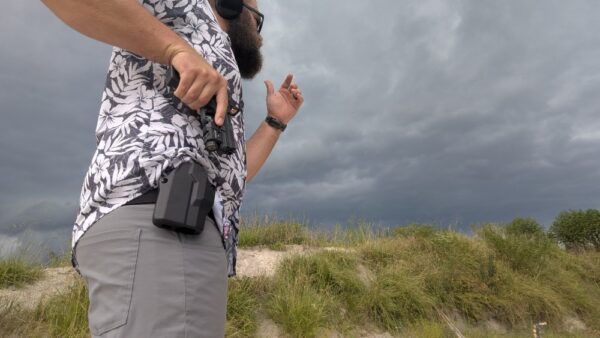
Adding a dash of movement to your shooting can change the game. It’s easy to get sucked into the static world of range work, where we don’t do much moving. In the real world, bad guys aren’t polite enough to stand still while you launch rounds into them. Movement can be a big part of fighting. With that in mind, is it better to move and shoot at the same time, or to move, shoot, then move?
Personally, I thought the answer was easy. Off the top of my head, I’d say it’s better to move, stop, shoot, then move again. This is a conclusion honed by a lot of competition shooting, which is often sprint, shoot, sprint. The more I thought about it and the more I reflected on my own experiences in gunfighting, the more I realized that the answer is a lot more complicated than that.
Sadly, I’m beginning to think there is never a simple answer when it comes to anything to do with guns, self-defense, or shooting in general.
Move and Shoot – Bottom Line Up Front
It’s hard to accurately shoot while moving. The more you “press the gas,” the harder it is to land accurate shots. It takes a fair bit of training and practice to become proficient at moving and shooting accurately. Standing still and taking a shot will always be the more accurate approach. It’s a skill that only applies to close-quarters shooting and goes out the window when the range increases much beyond spitting distance.
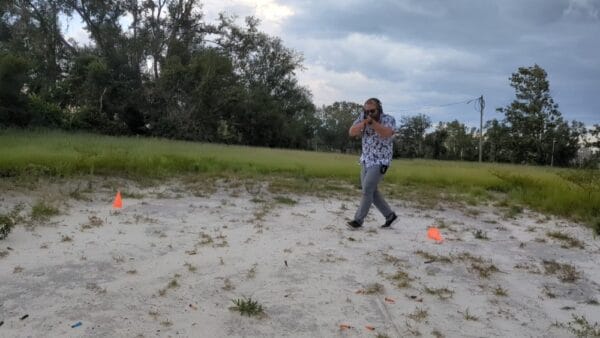
Standing still has its downsides. You’re vulnerable. As soon as you stop, the enemy has an easier time targeting you. You’re no longer disrupting your opponent’s OODA loop when you stand still. When you need to move, you’ve lost momentum, which might interrupt your OODA loop.
The ability to move and shoot simultaneously has several significant advantages. Moving targets are harder to hit. You can create distance, which makes you harder to hit. When moving, you’re forcing your opponent to react to you, which can put them on the back foot.
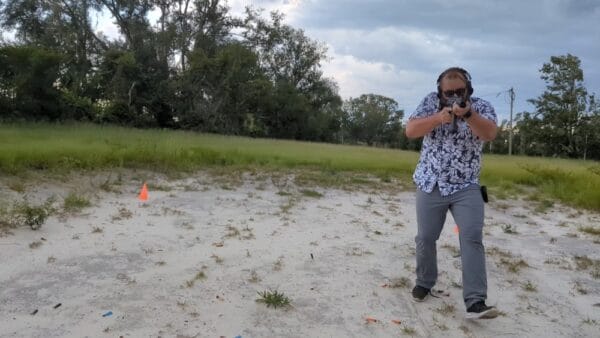
If you have to move and shoot, you want to do it quickly. You don’t want to do a slow walk while shooting. Slow targets are easy to hit. You have to find the right combination of speed and accuracy to make moving and shooting worth it.
Live Inventory Price Checker
|
CCI Blazer Brass 9mm 115gr FMJ Ammunition, 1145 fps, 1000-Round Case | Bereli | $ 229.00 |
|
|
|
CCI Blazer Brass 9mm 115 Gr FMJ 1000 Rounds (Loose Packed in a Box) | Ammunition Depot | $ 307.49 $ 256.49 |
|
|
|
1000 Rounds of CCI Blazer Brass 9mm 115 Grain FMJ Ammo | Palmetto State Armory | $ 229.99 |
|
|
|
CCI Blazer 9mm 115gr FMJ Aluminum Case Ammunition, 50 Round Box - 3509 | Palmetto State Armory | $ 14.99 $ 12.99 |
|
Tasks and Goals
Shooting is a wide world that encompasses hunting, competition, defensive use, offensive use, and plain old plinking. When we break down the idea of “move and shoot” or “shoot then move,” we have to discuss the different tasks and goals a shooter may have.
Competition
In the competition world, I’m trying to land accurate shots as fast as I can on a multitude of targets, and I’m often being forced to move by the layout of the stage. What works best for me is a sprint, stop, shoot, and then sprint to the next portion of the stage. Moving and shooting is rarely beneficial, but it can be a valuable tool depending on the stage.
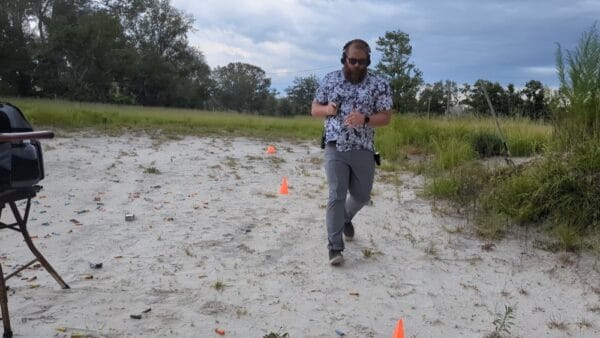
For action shooting matches, my go-to move is to move, stop, shoot, rather than move and shoot at the same time. Competition shooting can vary, and while I’ve never shot PRS or competed in the Tactical Games, I imagine standing still and shooting makes more sense.
Civilian Defensive Situations
If we leave the match and hit the defensive applications of firearms, you fall into the world of “situation dictates.” Most defensive shooting encounters won’t require any movement at all. However, “most” isn’t “all.”
Let’s approach this from a realistic perspective. A lot of ranges aren’t going to allow you to move and shoot at the same time. This makes it difficult, if not impossible, to build the skills necessary to move and shoot quickly and accurately. If you’re blessed with a range or training opportunities that allow you to move and shoot, then you have an edge most people don’t.
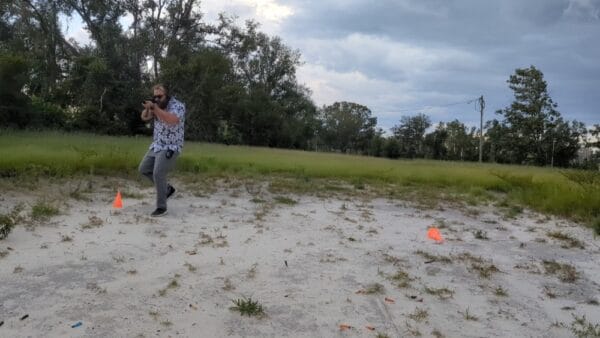
For most average concealed carriers, shooting while moving isn’t going to be an extremely viable skill. If you have to move during a defensive encounter, your best bet is to sprint to cover as fast as you possibly can and engage from cover. The difficulty curve of shooting while moving opens up the chance of misses, and misses could equal innocent people getting hit.
This could change for an inside-the-home defensive encounter. You might have to shoot while “pieing” a corner, and since the range is so short, it’s less likely you’ll miss. As someone with a family I love, I have a more aggressive stance for inside-the-home defense, and I’m going to close on the threat rather than try to survive long enough to escape.
Police and Military
Police and military forces can take the offensive, which might encourage shooting and moving at the same time. If your fireteam is clearing a room, you can’t stop in the doorway to shoot a threat. You have to move and shoot at the same time. You might have to gain an advantageous position while laying down cover fire.
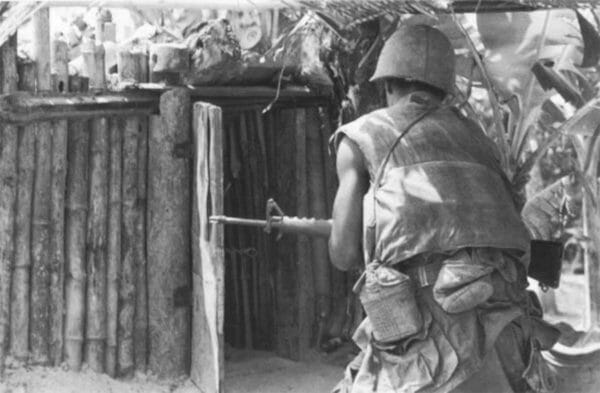
I’ve fired a SAW while moving across an open field, and I had to move to stay on line with my fireteam. If I fell behind, they could cut off my field of fire, and then the machine gun is out of play, so moving and shooting became necessary to get across that field.
Police and military forces have the benefit of range access where they can train these skills. If you don’t train to move quickly while shooting accurately, you’ll be at a disadvantage.
The Platform Matters
I geeked out about this subject. I went to the range, set up some cones, and ran drills with a handgun. Then I started thinking: what differences will we see between platforms?
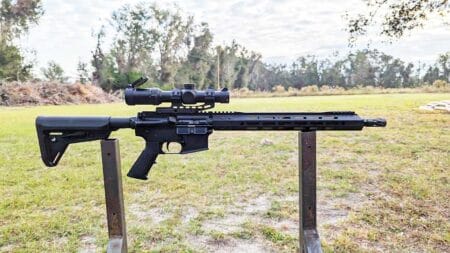
I ran some shooting drills with an optic-equipped handgun, a rifle, a shotgun, and a 9mm subgun. I did some basic linear and lateral movements. Finally, I did runs where I moved and shot, and others where I sprinted and shot.

What I found was that it was always easier to sprint, stop, and shoot. It was faster and more accurate. Speed and accuracy are important, but I’m also shooting at targets that aren’t shooting back and aren’t moving.
As you’d imagine, long guns are much easier to shoot and move with. The third point of contact helps stabilize the gun. Shotguns also tend to be well-suited for moving and shooting, which makes sense since they tend to be better at hitting moving targets. The spread of buckshot can help make it easy to put shots into the A-zone.
Rifles are easy, but shorter is better. It’s easier to control shorter guns than longer guns when moving. Red dot-equipped handguns appeared to be easier to use in motion than iron-sight-equipped handguns and proved more accurate to shoot.
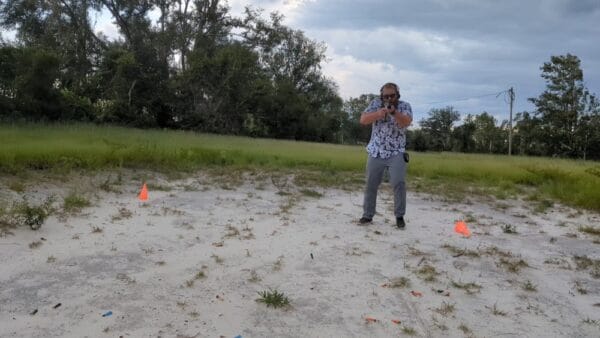
It’s generally better to move quickly, be able to pump the brakes, shoot, then move quickly again. The old “exploding off the X” comes into play, and you don’t want to start gathering momentum; you want to be momentum.
With that said, if you have a range that allows shooting and moving, or can take a class that teaches it, it’s another skill you can put in the box when you need it.
About Travis Pike
Travis Pike is a former Marine Machine Gunner, a lifelong firearms enthusiast, and now a regular guy who likes to shoot, write, and find ways to combine the two. He holds an NRA certification as a Basic Pistol Instructor and is the world’s Okayest firearm’s instructor.


Without even reading the article, for me, circumstances will dictate.
Situation and time dictate tactics. Shooting on the move is difficult but can be accomplished — with training and practice. Duck walk. Deliberate, heal down first then rock the outside of the foot forward until the toe is down foot placement with knees bent will help keep your sights on target better while moving. This works forward and backward is toe down first then rock back on heal. Sidesteps get you lateral movement. If you move fast enough to get your sights off the target you are moving too fast to send rounds down range. The faster you move the… Read more »
Comments are one month old. I must have missed this one. In the Marine Corps I was taught about suppressive fire. When in a group this works because only an idiot would raise his head when bullets are flying at them. So, for a person that is by themselves, if moving closer or to something that provides sufficient cover is better, than moving while shooting makes total sense to me because it doesn’t matter if you hit the target or not because they won’t raise their head until the fire stops and then you have not only gained position but… Read more »
shooting while moving , you have to be able to shoot reload ,you have a pistol they have a mac 10 you better be able to move and shoot
Everything is contextual. We should not “always” do anything except safely handle our firearms and hit what we shoot at. I’ve been teaching to move while hitting since 1988, when I introduced it in classes of LEOs at a state training facility. Moving begins upon realizing there is an imminent deadly threat while simultaneously obtaining or manipulating/presenting our firearms. Generally, within 2 – 7 yards of the threat, moving hard while hitting allows us to put fire accurately on the threat while encouraging him to miss us, and is very valuable when moving toward nearby cover. Firing while moving hard… Read more »
T. Pike makes some valid points but missed some things as well. Most ranges do not allow the opportunity to practice shooting while in motion, not “many.”. If you live in or near an urban setting, forget it unless you drive a long ways. And you are not walking around your city or subdivision with a rifle, shotgun or submachine gun. Even in ‘small town USA’ that would attract attention. And if you keep one or some in your vehicle, it would be smarter to drive away if at all possible. It is reasonable to practice movement with those in… Read more »
Does anybody know… where in Broward County Florida, or in any Communist County, can you practice moving and shooting? Even at the ranges where I’ve been to locally, they don’t allow drawing your gun from a holster!!, let alone moving, drawing, aiming and firing. Forget moving, drawing and firing from your holster is a fundamental muscle memory you must have, especially when legal considerations dictate that you should never draw your weapon unless you intend to pull the trigger. Make no mistake, millions of American gun owners, will not be ready to use their weapon when the need presents itself.… Read more »
Moving first. Because even if you don’t have a firearm, moving is what you should do. Move out of the line of fire. Move to cover (or at least concealment). Move by way of departing the area entirely. Even move to engage physically. None of these require a firearm. Because what are you going to do, just stand there? Obviously, there will be times you can’t or shouldn’t move. But if you can, you probably can’t go wrong by using movement to avoid being a target. The most important thing is to not get shot (or clobbered or cut/stabbed). If… Read more »
When under direct fire GET UNDER COVER OR HIT THE DECK first! Then determine proper response. If any.
The answer is, it depends on what’s going on, and what arm(s) you have.
Also, police and military may make “offensive” moves, there might just be a Militia to counter them.