

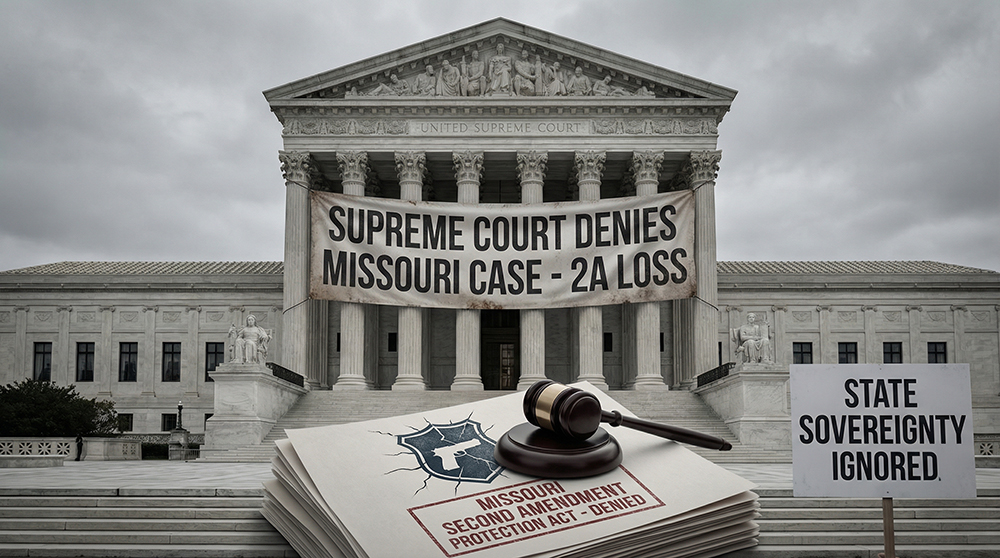
The Supreme Court just delivered a significant blow to Second Amendment advocates across the nation. On October 6, 2025, the high court refused to hear Missouri’s appeal of its Second Amendment Protection Act, effectively killing one of the most ambitious state-level efforts to shield gun owners from federal overreach. For those who believe in robust gun rights and state sovereignty, this represents a devastating setback with implications that reach far beyond the Show Me State.
Missouri’s Second Amendment Preservation Act, passed in 2021, aimed to establish a firewall between state resources and federal enforcement of gun control measures. The law declared certain federal firearms regulations “invalid” within Missouri’s borders and prohibited state and local officials from assisting federal authorities in enforcing them. Perhaps most notably, it authorized private citizens to sue agencies that cooperated with federal gun enforcement for $50,000 per occurrence.
The Department of Justice under Attorney General Pam Bondi attacked the law relentlessly, maintaining the Biden administration’s litigation strategy despite President Trump’s executive orders directing agencies to protect Second Amendment rights. Benjamin Hyun Sanderson, Deputy Director of Federal Affairs for Gun Owners of America, minced no words about the betrayal. “Why did the Department of Justice with Attorney General Pam Bondi, at the helm, attack and effectively end Missouri’s Second Amendment protection?” he asked in a video statement. “This was seen to fly in the face of President Trump’s own executive order, protecting Second Amendment rights.”
Federal courts showed no sympathy for Missouri’s federalism arguments. A district judge struck down the entire statute as unconstitutional under the Supremacy Clause. The Eighth Circuit affirmed that decision in August 2024, treating Missouri’s law as impermissible nullification rather than legitimate non-cooperation with federal enforcement.
Missouri’s petition to the Supreme Court raised fundamental questions about state authority. Can federal courts second-guess a state’s reasons for exercising Tenth Amendment rights? May states decline cooperation with federal enforcement when their motivation stems from constitutional disagreement? These questions deserved answers from the nation’s highest court. Instead, the justices simply denied certiorari without comment, leaving Missouri gun owners without recourse.
The practical consequences hit immediately. Local police departments in Missouri can now rejoin federal task forces without fear of crippling civil penalties. Information sharing with the ATF and other federal agencies will resume unimpeded. Federal firearms prosecutions in Missouri will proceed with full local cooperation available. The state-level shield that the Second Amendment Protection Act attempted to create has been dismantled entirely.
“Through a deliberately layered program of professional development, artificial intelligence-assisted archival research and open-access instructional media, the Firearms Research Center will empower teachers to cultivate in K-12 students the habits of mind essential to critical inquiry, evidentiary reasoning and civic deliberation,” Mocsary says in explaining the educational initiative. But for Missouri gun owners facing renewed federal enforcement cooperation, educational programs offer cold comfort.
The broader implications extend nationwide. Every state that considered similar Second Amendment sanctuary legislation now faces clear judicial hostility. The Supreme Court’s refusal to intervene sends an unmistakable message that aggressive state resistance to federal gun enforcement, particularly laws declaring federal statutes invalid or penalizing local cooperation, will not survive constitutional scrutiny.
“Thanks, Pam Bondi. They’re killing a state-level Second Amendment protection law. What a major mess up by the Department of Justice,” Sanderson stated bluntly. His frustration reflects a movement that expected different treatment from a Republican administration but instead watched the Trump Justice Department maintain Biden-era legal positions that undermine state attempts to protect gun rights.
Missouri legislators are already working on revised versions of the law, attempting to craft language that might survive federal challenge. But the Supreme Court’s decision leaves little room for optimism about bolder approaches to state-level Second Amendment protection.
About José Niño
José Niño is a freelance writer based in Charlotte, North Carolina. You can contact him via Facebook and X/Twitter. Subscribe to his Substack newsletter by visiting “Jose Nino Unfiltered” on Substack.com.





Q. How does the civil war start?
A. One bad SCOTUS decision.
Not if, just when.
My prediction is a very probable one, when lefty morons take back full control they WILL expand SCOTUS and they WILL attempt to ban guns, and it will be that bad decision from SCOTUS that brings USA into chaos.
Not if, just when.
most pro gun administration………..ever.
Some say Trump will be the last republican president. We are being set up for a long downward spiral toward exactly what we are watching real time in the UK. (which by the way, since the takeover of Londonistan yesterday seems to have a near total news blackout)
You had all better take the message of DEFIANCE to heart because we are about to be tested.
And remember children……..if it’s time to bury your guns, it’s really time to dig them up and use them.
ANY LAW REPUGNANT TO THE CONSTITUTION IS NULL AND VOID…..
And what did anyone expect from Red Flag Barbie?
“The Department of Justice under Attorney General Pam Bondi attacked the law relentlessly, maintaining the Biden administration’s litigation strategy despite President Trump’s executive orders directing agencies to protect Second Amendment rights.”
The Tenth Amendment is determined by the States as the Framers created it. Not the Feds. The Tenth Amendment nullifies and is not Nullified, even if the Supreme Court doesn’t like it. So, would the Feds invade the states like Lincoln did to violate U.S.?
Seems strange that the federal courts would invoke the supremacy clause since it is the 2nd amendment to the US Constitution that the Missouri law deemed as the supreme law of the land.
The Missouri law indicates that federal laws that infringe on the right of the people to keep and bear arms are unconstitutional and state agencies that aid and abet federal agents in violating our protected natural rights could face hefty fines.
Consider the following statements:
Every state that considered similar Illegal Immigrant sanctuary legislation now faces clear judicial hostility.
Every state that considered similar Juvenile Transgender Surgery sanctuary legislation now faces clear judicial hostility.
Every state that considered similar Sharia Law sanctuary legislation now faces clear judicial hostility.
Every state that considered similar Furry sanctuary legislation now faces clear judicial hostility.
These “Second Amendment Protection Act” laws were doomed from the onset under the Supremacy Clause. Like “Second Amendment Sanctuary” declarations by local governments, they are feel-good provisions that do nothing except to give anti-gun politicians cover by allowing them to vote for worthless pronouncements. You can blame Bondi for many things, but acknowledging reality should not be one of them.
“Keep doing a great job, Pam.” – Trump
Makes me sick.
pam needs to go and a true constitutionalist needs to replace her before midterms
The Supreme court and the Congress continue to give the Executive Branch more power. States Rights supporters are losing in this push to make Trump king.