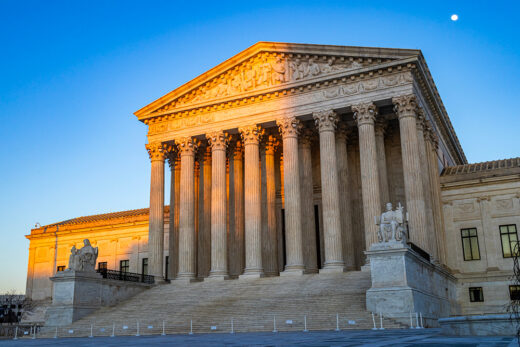
The Supreme Court has agreed to hear consolidated challenges to AR-15 bans in Cook County and Connecticut. From the Trump Justice Department’s position to the battle over Heller’s common-use test, these are the major issues gun owners should watch as Viramontes and Grant move toward oral argument.
The en banc Third Circuit has struck down New Jersey’s bans on covered semi-automatic rifles and magazines holding more than ten rounds. The ruling confirms that “common use” belongs at Bruen’s second step, where the government bears the burden.
Lindsey Graham’s gun-rights record was imperfect, but his role in confirming Gorsuch, Kavanaugh, and Barrett helped build the Supreme Court majority that delivered Bruen, Hemani, and Wolford.
Congressional researchers say the Supreme Court’s Hemani decision may reach beyond the marijuana gun ban and prompt lawmakers to examine other federal prohibited-person laws.
The Wolford ruling could strengthen national carry reciprocity and shape the Supreme Court’s coming showdown over AR-15 and magazine bans.
After striking down Hawaii’s “vampire rule” in Wolford, the Supreme Court again refused to settle whether 1791 or 1868 controls the Second Amendment’s historical test.
The U.S. Supreme Court has agreed to hear two major Second Amendment challenges to bans on modern semiautomatic rifles. For gun owners, Grant v. Higgins and Viramontes v. Cook County could become the long-awaited test of whether AR-15-style rifles are protected “arms.”
The Supreme Court’s Wolford v. Lopez decision is more than a win over Hawaii’s “vampire rule.” It is a reminder that the right to armed self-defense exists before government permission.
The Supreme Court’s decision in Wolford v. Lopez does more than defeat Hawaii’s private-property carry restriction. It also limits how lower courts can dodge Bruen and narrow the Second Amendment before history and tradition are even considered.
The Supreme Court ruled that Hawaii cannot make concealed carry illegal by default in businesses open to the public, handing gun owners a major post-Bruen victory.
The Supreme Court’s Hemani decision reinforces a simple constitutional reality: the government cannot restrict the right to keep and bear arms unless it can prove the restriction fits America’s historical tradition.
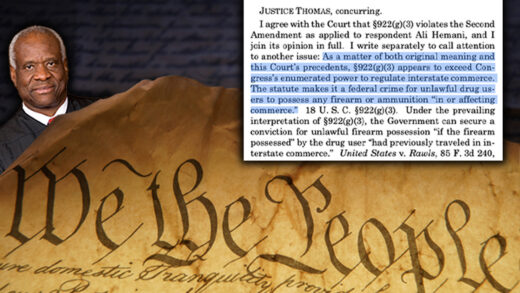
Justice Clarence Thomas says the federal government’s constitutional problem may extend far beyond marijuana users. His Hemani concurrence invites courts to reconsider whether Congress has the authority to criminalize purely intrastate gun possession under §922(g).
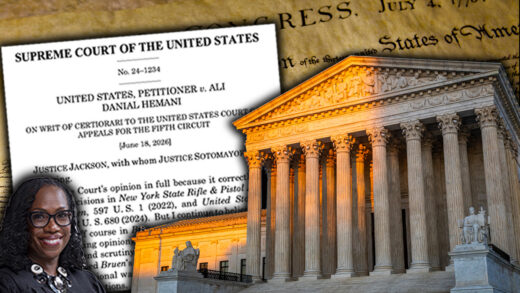
Justice Ketanji Brown Jackson joined the unanimous judgment protecting Ali Hemani’s Second Amendment rights. Her concurrence, however, called Bruen a “failed experiment” and urged a return to government-friendly means-end scrutiny.
In a unanimous 9-0 ruling, the Supreme Court rejected the federal government’s attempt to disarm a regular marijuana user under 18 U.S.C. § 922(g)(3), strengthening Bruen and requiring individualized evidence before Second Amendment rights are stripped away.
The Supreme Court declined to hear NSSF v. James, leaving New York’s gun-industry public nuisance law standing for now.
Two major Second Amendment cases are sitting before the Third Circuit, and the court’s silence may be strategic.
The Supreme Court denied review in United States v. Cockerham, leaving in place a narrow Fifth Circuit ruling that rejected a lifetime federal gun ban as applied to a man convicted of failing to pay child support.
Teachers have been known to report students over perceived off-campus gun concerns before, even when no cause for them existed.
Maryland could no longer deny ordinary citizens carry permits after Bruen, so it tried a new tactic: ban carry almost everywhere people actually go. Now gun owners are asking the Supreme Court to step in.
The Supreme Court has denied Patrick Tate Adamiak’s case, leaving the former Navy sailor with a June resentencing hearing or a presidential pardon as his remaining paths to freedom after a 20-year sentence tied to demilled gun parts and ATF claims of machine gun possession.
Patrick “Tate” Adamiak was sentenced to 20 years in federal prison after the government treated cut-up parts, separated components, and inert training tubes as National Firearms Act weapons. Now Palmetto State Armory, the National Association for Gun Rights, and the Right to Bear Association are asking the Supreme Court to step in.
DOJ is now challenging both Denver’s AR-15 ban and Colorado’s statewide magazine ban. The Supreme Court already has hardware-ban cases in front of it. It should take one.
ATF’s new rule removes the bump-stock language invalidated by the Supreme Court in Garland v. Cargill, but it does not fully restore every affected regulation to its pre-2018 form. Gun owners should pay close attention to what ATF left behind.
The Second Amendment Foundation is asking the U.S. Supreme Court to review Patrick Tate Adamiak’s NFA case, warning that lower courts are narrowing Bruen before the government ever has to defend its firearms laws with historical evidence.
The 2025–2026 Supreme Court term and related lower-court litigation could define the next phase of post-Bruen Second Amendment law, from public carry and prohibited-person restrictions to AR-15 bans and the future of NFA registration.
The Supreme Court’s review of United States v. Hemani could determine whether the federal firearm ban for marijuana users under 18 U.S.C. 922(g)(3) has any real historical basis. The case puts one of the most outdated and contested prohibitions in federal gun law squarely in front of the justices.
By refusing to hear Schoenthal v. Raoul, the Supreme Court left standing a Seventh Circuit opinion that treats public transit as a sensitive place and could encourage broader carry bans in crowded public spaces.
New filings in NSSF v. James tell the Supreme Court that New York is trying to bypass PLCAA, revive anti-gun nuisance litigation, and pressure the firearms industry nationwide through lawfare.
Critics argue Chief Justice John Roberts has helped slow or block major Second Amendment cases, leaving key questions from Heller, Bruen, and Rahimi unresolved.
March For Our Lives is backing the federal ban on gun ownership for regular marijuana users as the Supreme Court weighs United States v. Hemani.

 RSS feed

![iStock.com/[Greggory DiSalvo]](/wp-content/uploads/2026/07/Congress-Senate-Political-Parties-iStock-2259628333-520x347.jpg)