
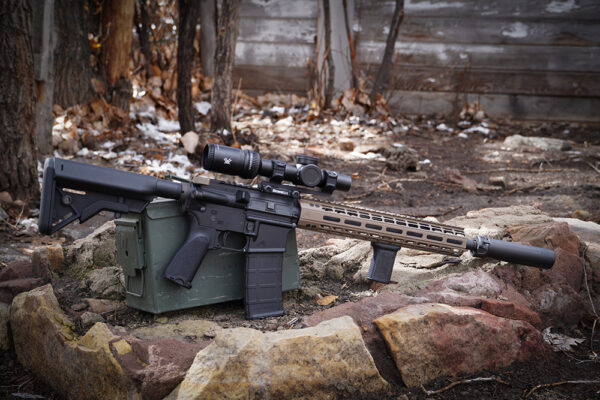
The Trump Justice Department just sharpened its attack on Washington, D.C.’s gun-control regime, and this time the target is bigger than a single bad law.
In a First Amended Complaint filed May 14, 2026, the United States argues that the District of Columbia, its Metropolitan Police Department, and Acting Police Chief Jeffrey Carroll are violating the Second Amendment by enforcing local laws that ban AR-15-style rifles and suppressors. The lawsuit, filed in the U.S. District Court for the District of Columbia, asks a federal judge to declare those bans unconstitutional and block D.C. from enforcing them.
This is not another private citizen begging the courts to recognize what the Constitution already says. This is the United States government suing the District of Columbia and saying, in plain terms, that D.C.’s gun laws deprive Americans of their civil rights.
That is a major shift.
For decades, anti-gun politicians have treated the Second Amendment like a second-class right. They have banned commonly owned rifles, criminalized ordinary gun parts and accessories, buried lawful owners in registration schemes, and then acted shocked when Americans objected. D.C. has long been one of the worst offenders. This amended complaint puts that record directly in the federal government’s crosshairs.
The filing opens with the point gun owners have been making since Heller: the Second Amendment protects a pre-existing right, not a privilege handed out by politicians. DOJ cites Heller, McDonald, and Bruen to argue that law-abiding Americans have the right to possess and use arms that are in common use for lawful purposes.
That is where D.C.’s AR-15 ban runs into trouble. D.C. does not simply say, “AR-15s are banned,” at least not in the clean way some states do. Instead, the District uses its registration scheme to get the same result. Under D.C. law, a person may not possess a firearm unless it is registered with the police. Then D.C. refuses to issue registration certificates for so-called “assault weapons,” a category that includes AR-15-platform rifles.
The result is the same: possess an AR-15 in D.C., and you are treated like a criminal.
The complaint correctly attacks the loaded phrase “assault weapon” for what it is: political language, not a serious firearms term. The AR-15 is not exotic or rare. It is not some strange military artifact sitting outside the American firearms tradition. It is the most popular rifle platform in the country.
DOJ’s amended complaint leans hard into that reality. The complaint cites estimates that Americans own 20 to 30 million AR-15s. It also points to Justice Kagan’s recent observation that the AR-15 is “the most popular rifle in the country.” It then cites Justice Kavanaugh’s statement in Snope v. Brown, where he noted that because millions of Americans own AR-15s and most states allow them, challengers have a strong argument that AR-15s are protected under Heller’s common-use test.
If the Second Amendment protects arms in common use for lawful purposes, then D.C. cannot ban the most popular rifle in America just because anti-gun politicians dislike it. The Constitution does not allow local officials to veto ordinary rifle ownership with scary language and a registration trap.
The complaint also lays out why Americans own AR-style rifles. DOJ cites surveys showing they are used for recreational target shooting, home defense, hunting, defense outside the home, and competition. In other words, the exact kind of lawful purposes the Second Amendment protects.
The filing also undercuts the usual gun-control narrative that AR-15s are uniquely tied to crime. DOJ notes that FBI homicide data from 2019 showed only 364 homicides with rifles of any kind, compared with 6,368 with handguns, 1,476 with knives or cutting instruments, 600 with hands, feet, or other personal weapons, and 397 with blunt objects.
Anti-gun politicians do not want Americans to see those numbers. The numbers wreck the narrative.
D.C.’s suppressor ban gets the same treatment.
The complaint points out that suppressors are regulated under the National Firearms Act. A buyer must purchase through a licensed dealer. Submit paperwork. Provide personal information, submit fingerprints and photos. Go through an ATF background check and wait for approval before taking possession. That process is already burdensome.
D.C. goes further. It bans suppressors outright.
The District’s law refers to suppressors as devices intended to make firearms “silent” or to lessen or muffle the sound of gunfire. That language plays into Hollywood nonsense. Suppressors do not turn firearms into whisper-quiet assassin tools. They reduce noise, protect hearing, make training safer, and are commonly owned by lawful Americans across the country.
DOJ cites roughly six million registered suppressors in the United States as of April 2026. It also points to prior ATF statements that suppressors are rarely used in criminal shootings and should not be treated as a public-safety threat.
That should be obvious to anyone who understands firearms. Criminals are not lining up to pay, register, submit fingerprints, and wait on ATF paperwork to commit crimes with suppressors. Law-abiding Americans are the ones being punished by bans like D.C.’s.
The most interesting part of the amended complaint is the legal vehicle DOJ is using. The United States is suing under 34 U.S.C. § 12601, a federal civil-rights statute that allows the Attorney General to seek relief when a governmental authority or its agents engage in a pattern or practice of conduct by law enforcement officers that deprives people of constitutional rights.
That statute is usually discussed in the context of police misconduct cases. DOJ is now applying it to Second Amendment violations.
The argument is simple and powerful: MPD officers are required to enforce D.C. law. D.C. law makes it a crime to possess protected arms. When officers routinely enforce unconstitutional gun bans, they are engaging in a pattern or practice that deprives people of rights secured by the Constitution.
Gun rights are civil rights. The right to keep and bear arms is not a hobby, not a lifestyle preference, and not a local policy question for anti-gun city councils to erase. When a city criminalizes the possession of arms protected by the Second Amendment, it is not merely “regulating guns.” It is violating constitutional rights.
The complaint asks the court to declare that D.C. is a governmental authority under Section 12601, that MPD officers are law enforcement officers under that statute, and that enforcing D.C.’s laws against AR-15-style rifles and suppressors deprives citizens of their Second Amendment rights. DOJ also asks for preliminary and permanent injunctions barring D.C. from enforcing those provisions.
Washington, D.C. has already been at the center of one of the most important Second Amendment cases in American history. Heller should have ended the District’s fantasy that politicians can ban ordinary arms and call it public safety. Instead, D.C. kept pushing.
Now, the DOJ is telling the court that enough is enough. The amended complaint does not merely defend AR-15s and suppressors. It advances a broader principle: when government officials enforce gun bans that violate the Second Amendment, they are violating civil rights.
For years, anti-gun officials have acted as if the Second Amendment is the one right they can ignore without consequence. They would never tolerate a city using a registration scheme to ban unpopular books, religious items, political speech, or protest signs. But when the object is a rifle owned by millions of peaceable Americans, they suddenly discover endless patience for “local control.”
The Constitution does not work that way.
The AR-15 is in common use. Suppressors are in common use. Both are possessed by law-abiding Americans for lawful purposes. D.C.’s decision to ban them is not a policy disagreement. Like all gun control, it is a constitutional violation.
If DOJ follows this case through, it could become one of the most important Second Amendment enforcement actions in the country. Not because D.C.’s bans are uniquely clever, but because they are so familiar. The same anti-gun playbook is used across the country. Redefine common firearms as dangerous, criminalize possession, and force gun owners to spend years fighting in court.
This amended complaint turns that fight around. The United States is now arguing that enforcing those bans is itself a civil rights violation.
Good. It is about time the Second Amendment was treated that way.
DOJ Is Finally Fighting Hardware Bans. Now SCOTUS Needs To Step In.
About Duncan Johnson:
Duncan Johnson is a lifelong firearms enthusiast and unwavering defender of the Second Amendment—where “shall not be infringed” means exactly what it says. A graduate of George Mason University, he enjoys competing in local USPSA and multi-gun competitions whenever he’s not covering the latest in gun rights and firearm policy. Duncan is a regular contributor to AmmoLand News and serves as part of the editorial team responsible for AmmoLand’s daily gun-rights reporting and industry coverage.



The DOJ does not go far enough in its suit. For when government officials PASS or enforce gun bans that violate the Second Amendment, they are violating civil rights, “under color of law” and must be fired, barred from public service, and imprisoned for it! The laws demand it. They require it. Government is prohibited outright from having ANY AUTHORITY WHATSOEVER over citizens’ arms. The least restriction or limitation, from hardware bans to permits and licenses, IS A DIRECT AND UNCONSTITUTIONAL INFRINGEMENT. All gun laws are repugnant to the Constitution.
It says, “Shall not be infringed” for a reason. No civil right enshrined in the constitution has that language except for the second amendment. Shall not be infringed means exactly that. It was worded into that amendment due to past experience with government and people in authority in general. Without the right to keep and bear arms all other rights and freedoms soon fail. This was evidenced by king George and parliament for decades prior to the war for independence. Any/every infringement of the constitution, in this case the second amendment, is a blatant infringement of civil law and it… Read more »
There needs to be a flood of these from the DOJ Civil Rights Division, accompanied by more to eliminate the ridiculous “Sensitive Places” nonsense. Walk through a university hospital entrance and look at the cute ‘no weapons’ signs. Unless it’s dark thirty or the ER entrance, there are no checks. There ARE, however, people from all over the world walking in and out with backpacks . If the place meets the criteria for that stuid sign, they should be required to have commensurate security like they do for the ER. checks or face civil action for violating the rights of… Read more »
I sincerely hope this effort follows through all the way to complete success, state to state and everywhere U.S. laws apply. An added bonus would be if this happens in our lifetime and never goes backward. Virginia Governor Spanberger signed the AR-15 ban yesterday that dems passed in February. HERE is a link to a news item appearing today on a Lynchburg, VA TV station website. It is the comments afterward that readers here will find interesting, as the Lynchburg area viewers — central and SW Virginia — have very outspoken opinions both pro-2A and anti-Governor Spanberger. She signed with… Read more »
This does not fit, but is worthy of mention: On this day in 1839, Texas Rangers defeated Mexican insurgent Manuel Flores and his band near the North San Gabriel River. Following the skirmish, documents were discovered that appeared to implicate the Cherokees in a plot to overthrow Texas. President Mirabeau B. Lamar’s subsequent demand for the tribe to leave the Republic instigated the Cherokee War.
I will take your advise Mr. Mayor!
Extremely well written and very informative. Thank you for your effort to keep us up to date on these important issues. My greatest concern is the same as many other’s. I fear that this Administration’s attempt to address these matters and abide by the Constitution will immediately end and make a hard turn for the worse in 2 or 3 years.
DC liberals won’t permit guys “sneaking around” with rifles. These liberals might get shot.
Dear DOJ; while you’re at it, how about you declare that DC’s ( and every blue state’s) gun registration schemes are unconstitutional?
Good luck winning such a suit in a DC-based court…