
By the late 20th century, Mauser was a legendary name searching for relevance. Once synonymous with some of the most influential military small arms in history, the German firm entered the 1980s without a clear vision for what came next. One of the final, and largely forgotten, attempts to keep the Mauser handgun legacy alive was the Mauser Model 80 SA, a licensed Browning Hi-Power clone built not in Germany, but in Hungary.
A recent Forgotten Weapons video featuring Ian McCollum, filmed at Morphy Auctions, offers a rare, close look at this pistol and the story behind it.
Mauser M80SA
Live Inventory Price Checker
|
Sa-35 9mm Luger Magazine - Sa-35 9mm Luger 15-Round Magazine | Brownells.com | $ 29.99 |
|
|
Springfield Armory SA-35 9mm 15-Round Magazine | GunMag Warehouse | $ 26.99 |
|
|
|
Springfield SA-35 9mm Pistol With Checkered Walnut Grips, Black - HP9201 | Palmetto State Armory | $ 816.99 $ 735.99 |
|
|
Springfield SA-35 9mm Pistol With Checkered Walnut Grips, Black - HP9201 | Bereli | $ 675.00 |
|
After World War II, Mauser never truly recovered its footing as a small-arms manufacturer. While the Mauser name remained powerful, the company struggled to produce successful new designs. There were experiments with submachine guns in the 1950s and 1960s, and later attempts to resurrect classic pistols like the Luger and the Mauser HSc for the commercial market—particularly in the United States through partners like Interarms.
None of these efforts delivered lasting success. By the late 1980s, Mauser’s management increasingly turned to a different strategy: outsourcing production entirely and selling firearms made by other companies under the Mauser banner. Italian firm Renato Gamba was one such partner. Another, more consequential one, was FÉG of Hungary.

The Hungarian Hi-Power Connection
In 1973, FÉG legally acquired a license and tooling from FN to manufacture the Browning Hi-Power. This was not a crude reverse-engineered clone, but a legitimate licensed production. FÉG marketed the pistol domestically as the P9 and also produced it for export.
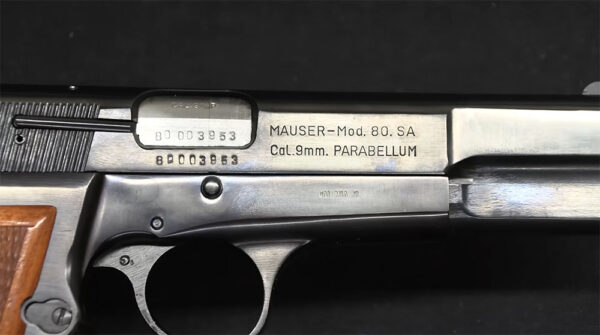
In 1990, Mauser contracted FÉG to produce two pistols: the Model 80 and the Model 90. The Model 80 SA was essentially a copy of the Browning Hi-Power marked with Mauser branding and intended for both European and U.S. commercial markets.
While the slide and frame read “Mauser Werke Oberndorf GmbH,” there was no external indication of Hungarian manufacture. Only subtle proof marks on the barrel and trigger guard reveal FÉG’s role.
A Hi-Power With a Twist
Mechanically, the Mauser 80 SA is pure Hi-Power. It uses standard Hi-Power magazines with 13-round capacity and accepts extended magazines without issue. Field-stripping is identical to FN and Browning examples, and internal parts are largely interchangeable.
There is, however, one notable difference that many shooters would consider an improvement: the absence of a magazine disconnect safety.
Traditional Hi-Powers incorporate a magazine safety that prevents the pistol from firing without a magazine inserted. While intended as a safety feature, it is widely criticized for degrading trigger pull quality. Many serious shooters remove it entirely. The Mauser 80 SA comes from the factory without one, resulting in a cleaner trigger and eliminating the need for modification.
From a shooter’s standpoint, that makes the Model 80 arguably more desirable than many factory Hi-Powers of the same era.

Limited Production, Limited Appeal
Despite these merits, the Mauser 80 SA was never a commercial hit. Production ran from 1990 to 1995. Serial numbers reportedly ended around 4,200, suggesting Mauser’s anticipated higher demand that never materialized.
That lack of success is not difficult to understand. By the early 1990s, the handgun market had moved on. Double-action/single-action pistols, polymer frames, higher-capacity magazines, and modern ergonomics dominated both law-enforcement and civilian markets. Glock, SIG Sauer, Beretta, and others were defining a new era.
In that context, selling a steel-framed, single-action pistol based on a 1935 design, even one as proven as the Hi-Power, was a tough sell. Consumers could buy original Browning or FN Hi-Powers, surplus pistols, or newer designs offering tangible advantages.
The End of Mauser Small Arms
The failure of the Model 80 underscored a broader reality: Mauser no longer had a viable path forward in small-arms production. In 1999, the company shut down its firearms manufacturing operations entirely and sold off its trademarks.
Ironically, those trademarks, including Mauser, eventually ended up under corporate umbrellas associated with other famous gunmakers. Today, the Mauser name still exists, but largely detached from the original company that made it iconic.
Why the Model 80 Matters Today
From a practical perspective, the Model 80 is a high-quality, licensed Hi-Power with excellent build quality and a feature set many shooters prefer. From a collector’s standpoint, its limited production numbers and unusual backstory make it far more interesting than its modest commercial success would suggest.
The Mauser 80 serves as a reminder that brand legacy alone is not enough. Firearms history is full of examples of failures to adapt proving fatal, regardless of past achievements.
About Duncan Johnson:
Duncan Johnson is a lifelong firearms enthusiast and a strong defender of the Second Amendment, where “shall not be infringed” means exactly what it says. A graduate of George Mason University, he enjoys competing in local USPSA and multi-gun competitions whenever he’s not covering the latest in gun rights and firearm policy. Duncan is a regular contributor to AmmoLand News and serves as part of the editorial team responsible for AmmoLand’s daily gun-rights reporting and industry coverage.





That was a good story! I have a vintage Belgian Browning Hi-power. A timeless classic and stunningly beautiful.
One thing I like on pistols that seems to be missing today is when you send the magazine home, it automatically sends the slide into battery. I miss that.