
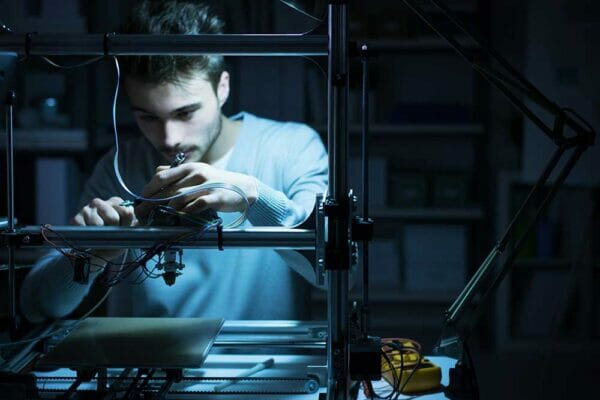
California lawmakers introduced Assembly Bill 2047 on February 17, 2026. The measure, sponsored by Assembly Member Rebecca Bauer-Kahan, would require many 3D printers sold or transferred in California to use state-approved ‘firearm blocking technology’ designed to detect and stop print jobs involving firearms or certain firearm-related parts. As of March 11, 2026, the bill has been referred to the Assembly Committee on Public Safety, with a hearing scheduled for March 24.
The bill adds Title 21.1 (commencing with Section 3273.631) to Part 4 of Division 3 of the Civil Code and Section 29187 to the Penal Code. At its core, AB 2047 defines “firearm blocking technology” as hardware, firmware, or other integrated measures that ensure a 3D printer will not proceed with any print job unless the underlying file, such as an STL or other computer-aided design format, has been scanned by a certified “firearm blueprint detection algorithm” and cleared as non-firearm-related.
The “firearm blueprint detection algorithm” is described as software that evaluates 3D-printing files to determine whether they could program a printer to produce a firearm, illegal firearm parts, or related items such as firearm precursor parts or machine gun conversion devices (MCD). “Illegal firearm parts” include precursors and conversion components as defined in the Penal Code.
Under the proposed law, the California Department of Justice (DOJ) would play a central role in implementation. By July 1, 2027, the DOJ must investigate existing firearm blueprint files and detection algorithms, then publish performance standards for both algorithms and “software controls processes” designed to prevent evasion of detection. Certification applications would open, with certifications issued starting January 1, 2028. The department would maintain a public list of certified algorithms and processes and have the authority to revoke certifications if standards slip.
By March 1, 2028, the DOJ would publish guidance for manufacturers on equipping printers with compliant blocking technology, including standards for integration, whether through direct firmware embedding (where files are evaluated before printing begins) or pre-print software limitations (restricting inputs to proprietary slicers that incorporate detection).
Manufacturers would need to submit self-attestations for each 3D printer make and model by July 1, 2028, confirming the use of certified algorithms and controls, along with testing to meet standards. The DOJ could voluntarily verify these attestations. Starting September 1, 2028, the department will publish and update a public list of compliant printer models quarterly.
The prohibitions kick in on March 1, 2029: No person could sell, offer for sale, or transfer a non-compliant 3D printer in California. Retailers would have an affirmative defense if they checked the DOJ’s list and confirmed the model before completing a transaction.
Exemptions provide relief for certain users. The requirements would not apply to printers made and sold exclusively to state-licensed firearms manufacturers, to the State of California, or law enforcement for official purposes, or to companies in aerospace, biomedical, automotive, chemical, or mechanical engineering fields (or government contractors) when those printers are not offered on the consumer retail market.
Violations carry serious consequences. Civil actions may be brought against sellers of non-compliant printers, with remedies including compensatory damages, injunctions, and, when pursued by the Attorney General, county counsel, or city attorney, penalties of up to $25,000 per violation. Prevailing plaintiffs would recover attorney fees and costs. On the criminal side, knowingly disabling, deactivating, uninstalling, or circumventing blocking technology with the intent to manufacture firearms would be a misdemeanor. Selling or transferring modified printers from the DOJ list would also constitute a misdemeanor. False attestations could trigger perjury charges under existing law.
This legislative effort arrives amid ongoing enforcement actions related to digital firearm files. In early February 2026, California Attorney General Rob Bonta, alongside San Francisco City Attorney David Chiu, filed a civil lawsuit in San Francisco Superior Court against the Gatalog Foundation Inc., CTRLPEW LLC, and associated individuals. The complaint alleges violations of state laws prohibiting the distribution of computer code and instructions that facilitate the unlawful manufacture of firearms and accessories using 3D printers, including designs for handguns, conversion devices, and prohibited magazines. The suit seeks injunctive relief and civil penalties, building on laws effective January 1, 2026, such as those from Assembly Bill 1263, which addressed aiding or facilitating unlawful firearm manufacturing via digital means.
Defendants in that case, including CTRLPEW, quickly countersued in federal court, arguing that restrictions on distributing code infringe on First Amendment protections for expressive speech, citing precedents like Bernstein v. United States. The litigation highlights tensions between regulating practical tools for firearm production and preserving access to information and technology.
AB 2047 shifts the focus from digital distribution to hardware mandates. Critics, including Second Amendment advocates and technology enthusiasts, contend that such requirements represent an unprecedented intrusion into personal manufacturing and innovation. They note that 3D printing serves countless legitimate purposes from custom prosthetics and prototypes to hobbyist projects and question the feasibility of reliable, evasion-proof detection algorithms. Concerns also arise over privacy, as constant file scanning could involve logging user activities, and over potential impacts on industries reliant on open-source or custom printing workflows.
Whether it becomes law will depend on committee reviews, amendments, and votes in the coming months.
Virginia “Assault Firearms” Ban Passes Legislature, Heads to Governor’s Desk
About John Crump
Mr. Crump is an NRA instructor and a constitutional activist. John has written about firearms, interviewed people from all walks of life, and on the Constitution. John lives in Northern Virginia with his wife and sons, follow him on X at @crumpyss, or at www.crumpy.com.




Do they even know what the term “open source” means?
The technology of a 3D printer, including the hardware, firmware, and software is well understood and available to the public right down to the components used to create the motherboard.
In plain English, that even those who claim not to know what a woman is can understand, Larry Kudlow’s 9 year old neighbor can build a 3D printer from scratch in her bedroom. How does the State of California propose to require she include their blocking technology?
https://thenextlayer.com/best-open-source-3d-printers/
https://all3dp.com/2/open-source-3d-printer-designs/
https://www.reddit.com/r/3dprinter/comments/1q27x0v/what_are_good_open_source_printers_these_days/
https://www.selfcad.com/blog/best-open-source-3d-printers
https://www.sovol3d.com/blogs/news/understanding-voron-3d-printing-significance?srsltid=AfmBOopRrTmH4FWYRv8I_c7_sZzZ0Nsb8JmL86RubOLuOctl9zeCVXWB
Ah Yes, law Makers who cannot define what a woman is, let alone understand common firearms lexicon, are going to pass legislation on computer technology.
What could possibly go wrong???