
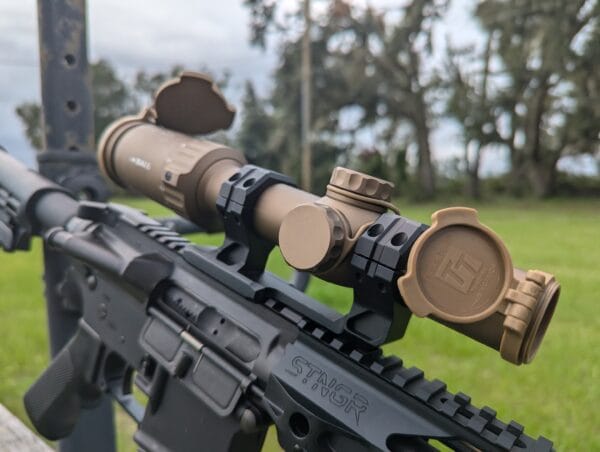
The name Armament Technology Incorporated might not ring many bells, but some of the brands that fall under that name certainly will. Brands like Elcan and Tangent Theta likely sound familiar. Within the ATI family, we now have a brand known as SAI Optics, and they’re bringing us top-quality LPVOs made for modern rifles. They recently sent me a loaner of the SAI 6 to take to the range and see if our neighbors up north can produce a top LPVO.

SAI Optics SAI 6
Live Inventory Price Checker

|
SAI Optics SAI 6 1-6x24mm .1 MRAD FFP 6.8 BDC Rapid Aiming Feature Riflescope RNG16-T170-C30 | EuroOptic.com | $ 999.99 |
|

|
SAI Optics SAI 6 1-6x24mm .1 MRAD FFP Rapid Aiming Feature FDE Riflescope RNG16-T170-C10 | EuroOptic.com | $ 1298.00 |
|

|
SAI Optics SAI 6 1-6x24mm .1 MRAD FFP 7.62 BDC Rapid Aiming Feature FDE Riflescope RNG16-T170-C20 | EuroOptic.com | $ 1298.00 |
|

|
SAI Optics SAI 6 1-6x24mm .1 MRAD FFP MIL Riflescope RNG16-BK22-MB1 | EuroOptic.com | $ 1298.00 |
|
The SAI 6 is a 1-6X first focal plane LPVO. The optic weighs 18 ounces, so it’s not the lightest option, but it sticks to the lightweight side of optics. The main tube is 30mms, and the objective lens is 24mms. The scope is 10 inches wide and 2.6 inches at its widest point.
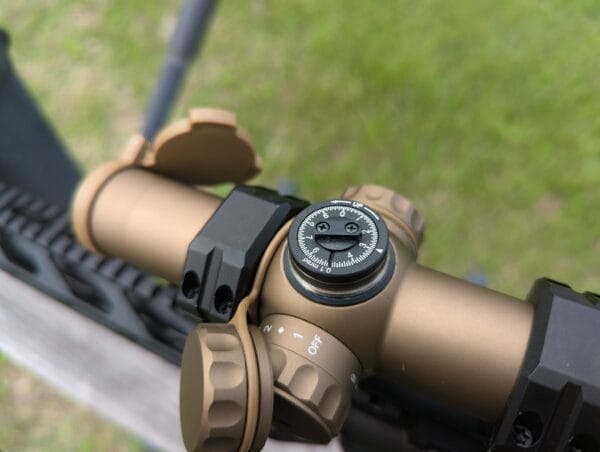
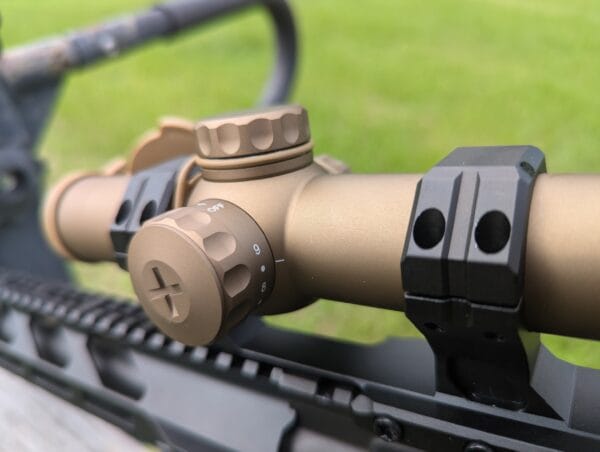
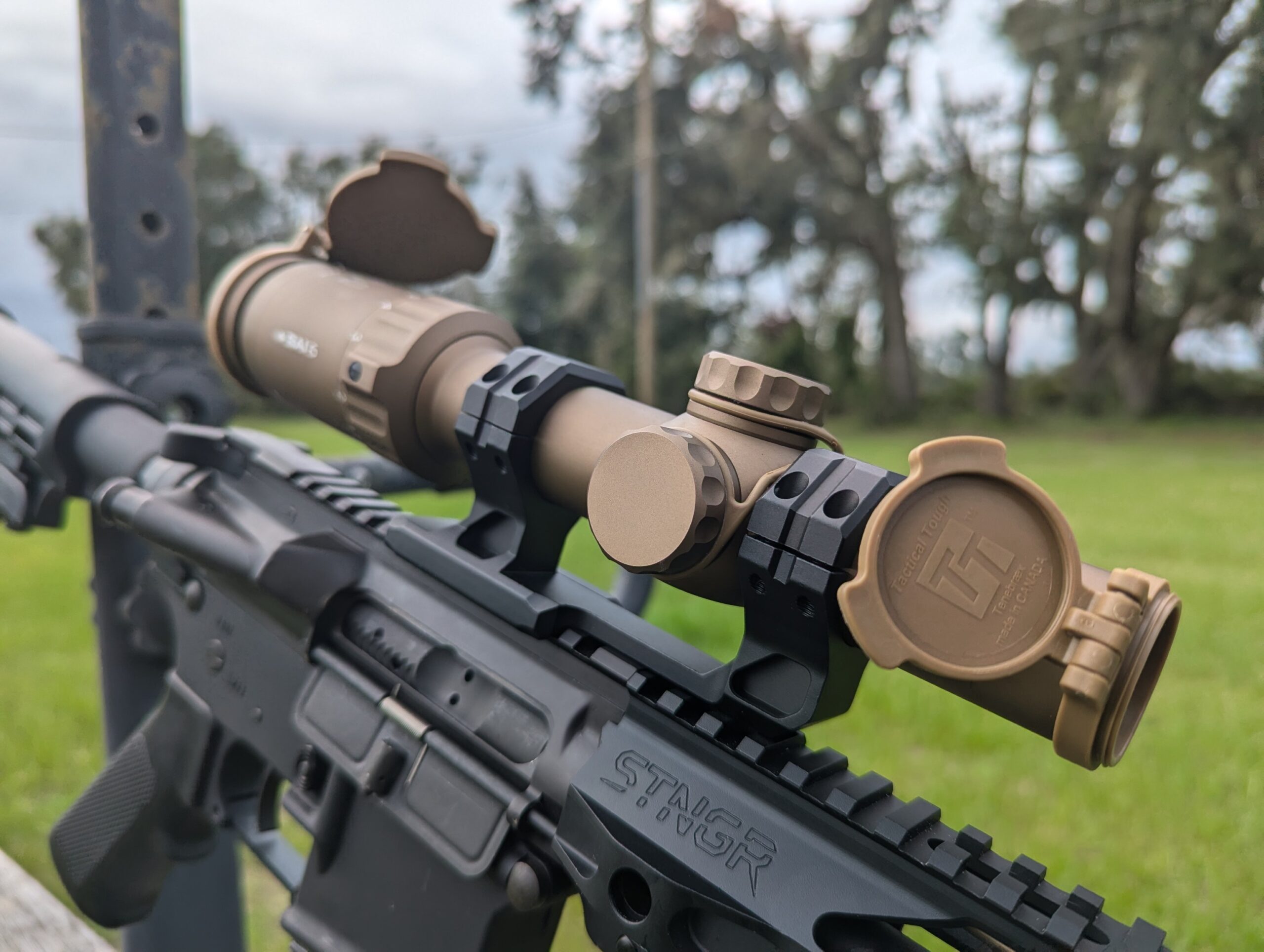
The optic has capped fingertip adjustable turrets. The caps are tethered to the optics, which is a small feature that I always love to see. It’s so simple but so handy. The adjustment range is 35 mils. Each adjustment is a finely tuned 0.1 MRAD. The turrets are numbered, so making broad adjustments is easy and accurate.
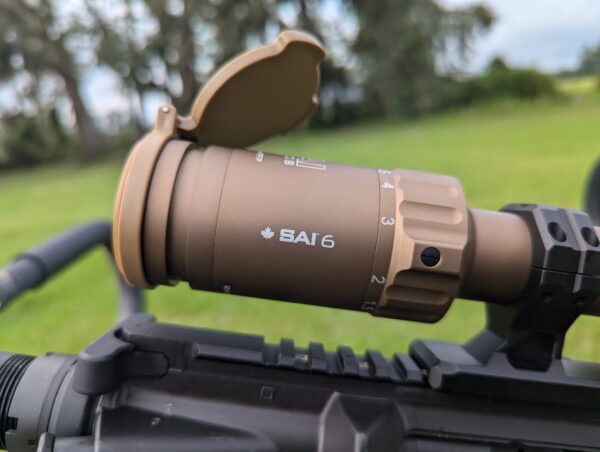
The optic can be submerged for two hours at three meters. It’s also shockproof for up to 1000gs at 10,000 cycles. It’s quite well made and pretty close to bombproof.
Our field of view at the highest magnification level is 6.5 meters at 100 meters. At 1X, it’s 38.8 meters at 100 meters. The eye relief is 3.54 inches, which is quite generous. The SAI 6 seems to be fairly standard as far as the basic specs go. The basic eye relief and field of view aren’t bad. Where the optic starts to stand out to me is the reticle.
The SAI 6 Reticle
The SAI 6 comes in numerous reticle options. You can get a 7.62 BDC, a 6.8 BDC, a 5.56 BDC, and two MRAD options. I went with the 5.56 BDC option. The reticle really is the star of the show with the SAI 6. The design incorporates a crosshair design with your BDC and the typical windage hash marks. The BDC even features a Christmas tree ladder for windage at multiple ranges.
That’s all fairly standard, but the Rapid Aiming Feature helps it stand out. The Rapid Aiming Feature, or RAF, is four lines that surround the reticle at angular locations. If the reticle was a compass and the top of the reticle was north, these lines would be on your northeast, southeast, southwest, and northwest angles.

These angled lines, combined with the thick portion of the horizontal stadia, bring your eyes into the reticle and to the target. More than one shooter who tried this optic pointed out how much they liked the RAF. I certainly enjoy it. One shooter, who isn’t a very experienced shooter, remarked that it’s like a video game.
The center crosshair is fully illuminated, and with an FFP design, the reticle shrinks and grows as the magnification increases or decreases. At 1X, the illuminated reticle forms a small, easy-to-see reticle for quick shots on close-range targets.

As the magnification increases, the reticle grows and becomes more useful for estimating windage and bullet drop. When the magnification hits six, we are greeted with this big, easy-to-see reticle with BDC and windage hash marks. We also get a Vertical Subtraction Optical Rangefinder (VSOR), which was also on the Elcan optics.
At the Range
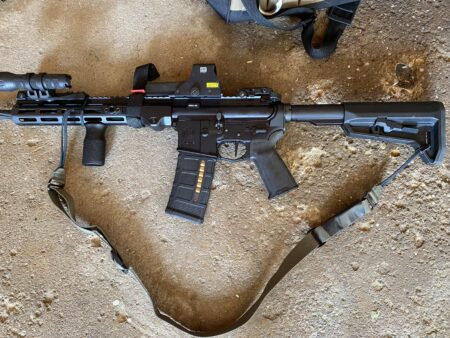
I tossed the SAI 6 onto a lightweight rifle set up with a SilencerCo Velos LBPK suppressor. I proceeded to zero the optic with some simple 55-grain M193 ammo. It’s not the most accurate ammo, but it’s the ammo I can afford to shoot en masse. The turrets at the top have a lot going on. They have audible and tactile clicks and are somewhat minimalist. My only real problem is that my big fingers have trouble moving them one click at a time. I had to slow down a bit and take my time to make the adjustments I wanted.
With a 50/200 zero, I began punching paper and paper. One thing that became evident very quickly was that the glass was super clear. It’s a premium-tier optic, and I expect nothing less, but I still enjoy those clear views. If I nitpicked the optic, I might say there is some chromatic aberration when looking at white-colored objects, but only just so.

Seeing targets at 200 and 300 yards isn’t a problem. Even targets that were somewhat camouflaged against my white sand berm were easy to see and shoot. They stood out even when they should have blended in. In the evenings and mornings, I popped the optic up to see low-light performance, and I was also impressed with the SAI 6 that popped out. Everything was clear and easy to see, and the low light didn’t detract from my ability to make out targets.
Throwing Lead
At super close ranges, the RAF becomes your best friend. When practicing simple ready-up drills, the reticle flowed right to the target, and my eye flowed to the reticle. I was scoring near subsecond ready-up drills cold.
Even at 25 and 50 yards, the reticle works really well for quick shooting. I was surprised at just how intuitive it was and how well it worked when speed was introduced. Even against small gongs, the RAF worked quite well for quick snapshots.
The only complaint I have here is the reticle brightness. It’s pretty bright, but I’m not sure if I’d call it daylight bright. I think it’s as close to daylight bright as an FFP LPVO can get without shoving electronics on the side and making things more complicated.
At high noon in Florida, with a white sugar sand berm, it doesn’t appear all that bright. In other conditions, it’s pretty good but not near-dedicated red dot levels. There are nine brightness levels with an off position between every setting.
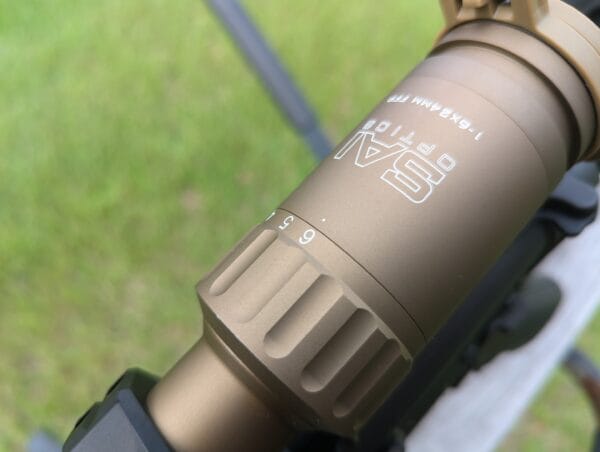
The SAI 6 reticle isn’t obstructive or difficult to use at longer ranges. The optics magnification ring is super smooth and quite nice. You can still clearly and easily see targets at 300 yards. A metal IPSC target acted as fodder at 300 yards, and I could hit it reliably.

I assumed a good supported position and just let the rounds fly. The sound of the oh-so-satisfying ‘ding’ carried nearly every trigger pull. The angular RAF design doesn’t get in the way, even though it gets slightly larger as the magnification increases.
The Brass Facts
The SAI 6 is a premium tier optic with a premium price point. Its MSRP is $1,492. The optic delivers a premium experience, so we can expect a premium price point. It’s lightweight, has an awesome reticle, gorgeous glass, and some small, but smart design features. It’s also quite bombproof. You can check them out here, and pick between black or FDE.
About Travis Pike
Travis Pike is a former Marine Machine Gunner, a lifelong firearms enthusiast, and now a regular guy who likes to shoot, write, and find ways to combine the two. He holds an NRA certification as a Basic Pistol Instructor and is the world’s Okayest firearm’s instructor.


love the reticle. However do we really need another expensive lpvo option. what we need is more “affordable low budget” priced lpvo’s, with top tier features. so that the low income firearms owners can have what they need to kit up, in the case they need to be called to arms. that way they can be useful assets in the field.
I’m older. My eyes don’t cut it any more. I wear no lines most times but use fixed focus shooters glasses at the distance end of my prescription for the range. A lpvo with a max of 6x is about useless to me because if I’m going for magnification Im going for accuracy, not just a hit. I can put hits on a 25 yd B8 target with a 3x prism out to 100 yds. But I can put tight groups out to 100 yds with a 4-12x scope which is always on 12x for that kind of shooting. These… Read more »