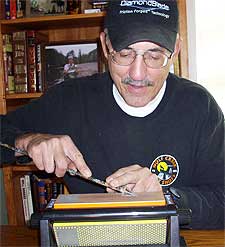

I’ve conducted a million Knife Sharpening seminars, been on Pro-staff or sponsored by at least 10-15 knife companies, written knife product reviews for AmmoLand, helped design knives, and yet I just realized, I’ve never written an article on how to sharpen a knife with a serrated edge.
Serrated edges became popular in the outdoor world. Probably 15 years ago? 20 years ago? They’re popular in the boating/rafting/first responders world because they seem to slice through rope and seatbelts faster in panic situations. They slowly crept in and now have a substantial following.
Upon thinking about serrated edges, a thought hit me. Let’s say you have a 4-inch serrated-bladed knife. If you stretched out the edge you really have maybe a 6-inch cutting surface. Make sense?
But one problem with serrated edges, no one seems to know how to sharpen one so let’s talk about that today. It is definitely harder than sharpening a straight edge, or maybe not harder, just more detailed.
Most serrated knives have a couple of inches of serration, and the front half is a straight edge. I recommend starting off by sharpening the regular edge and then go into sharpening the serrated edge as described below.
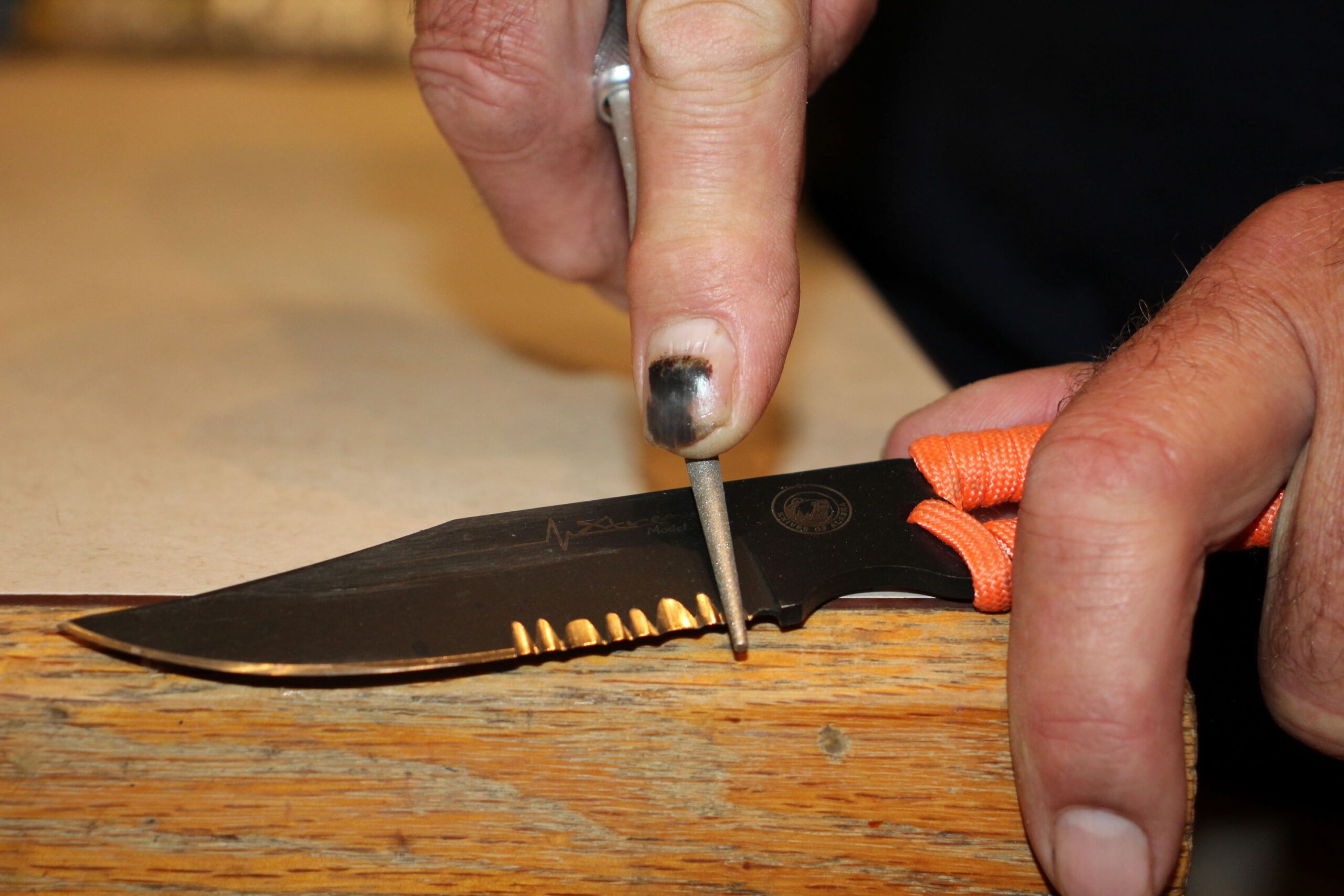
There’s at least two ways that I know of to sharpen one but let’s discuss the best way that I know of. I use a Smith’s Diamond Retractable Sharpener. It is what I’ve nicknamed as a pen sharpener. It has a diamond pen steel that retracts into a pen housing. The steel tapers down to a point.

Sharpening a serrated edge is not really complex.
Lay the knife on the edge of a table, overlapping the edge. Lay the steel in the first divot. Run the steel back and forth probably seven times. Look at the divot. Is the steel laid at the correct angle so it is rubbing the whole surface? If you’re like me I never start off with the steel laid down enough. You can tell if you’re holding it at the correct angle. If it only polished the edge, you need to drop the butt of the pen down further. Work all the way down to the end.
A majority of the serrated knives don’t have divots of the same size. One is rather large followed by four small ones. Repeat. Repeat. It’d be a lot easier to get into a groove if they were all the same size but they’re not. Use the thicker end of the steel on the large divot and then the pointed tip on the next four smaller serrations. It’d be easier if manufacturers made all of the divots the same size.
Live Inventory Price Checker
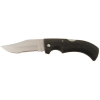
|
Gerber Gator Folding Hunting Knife 3.75" Serrated Stainless Steel Clip Point Blade Rubber Handle Black with Nylon Sheath | MidwayUSA | $ 54.99 |
|
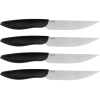
|
Kershaw 4 Piece Serrated Steak Knife Set | MidwayUSA | $ 42.99 |
|
|
|
Templar Knife(R) - SZDTOM521 - Don't Tread On Me(TM) 3" OTF Tanto Part Serrated Yellow Knife | Ammunition Depot | $ 85.49 |
|
|
|
Cold Steel Recon 1 Serrated Folding Knife, Black - CS-27BTH | Palmetto State Armory | $ 148.99 $ 109.99 |
|
When you get done hold the knife and starting on the opposite side of the blade hold your thumb near the spine and slide it to the edge. Since you only ground the blade on one side you will feel a wire lip curled over to the odd side. If you try to cut a piece of paper right now the edge will feel dull because it is in a “J” shape.
So to remove the wire lip (Overhang) lay the knife flat on an Arkansas stone and rub it backwards, leading with the spine edge. This will knock off the wire edge and straighten out the edge. The serrated edge will now be sharp.
Look at the Arkansas stone and it will most likely look like a cat has scratched it. This was caused by removing the wire edge.

To sharpen a gut hook is pretty much the same. It is just one big serration, right? To sharpen, run your Smith’s Diamond Retractable Sharpener on the cutting edge. Some you will have to sharpen on both sides, and some only on one side. If it is only one-sided, then you’ll need to also run the offside on an Arkansas stone just like prescribed above for a normal serrated edge knife.
About Tom Claycomb
Tom Claycomb has been an avid hunter/fisherman throughout his life as well as an outdoors writer with outdoor columns in the magazine Hunt Alaska, Bass Pro Shops, Bowhunter.net and freelances for numerous magazines and newspapers. “To properly skin your animal you will need a sharp knife. I have an e-article on Amazon Kindle titled Knife Sharpening for $.99 if you’re having trouble.”