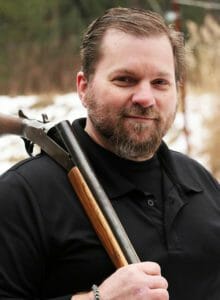
I had a chance to catch up with Phil Journey at the NRA Annual Meetings back in April. He’s quite an interesting man with some long roots in the Second Amendment and with the NRA. He was on the list of four reform candidates last year in 2024. This year, of course, there were 28 reformers that people supported, many of whom got onto the NRA’s Board of Directors. He spends his time telling us about his collection of firearms, how he got into politics and ran for office, and some of the inside dirt on what was going on with NRA leadership.
Phil is from Kansas and grew up with a couple of uncles, one of whom was a gunsmith and the other was an inventor. His father used to hunt and got him into shooting. In law school, he got into competitive shooting and made it to second place in IPSC in Oklahoma. At one point, he spent more time making sure everyone else had the right to keep shooting and owning firearms.
While in law school, he spent three semesters on Constitutional law, one of which was only on the First Amendment. While working on his dissertation, he pointed out that at that time, much of the legal discourse followed the collectivist theory of rights, and the courts reflected that. However, Phil realized that the First Amendment was clearly an individual right. That’s when he decided this was going to be his cross to bear.
Getting out of law school, he started working on some campaigns for the US Senate. He learned a lot in those days, thinking that candidates would read some of the pro-gun literature he would give them. Back then, he started his ties with the NRA as an election volunteer coordinator. He got 5,000 people to come to a city council meeting. This was how he got involved in political action committees.
Phil’s career was as a practicing attorney. He was appointed to the Kansas Senate in 2003. After a handful of years in the state Senate, he was elected to the Judicial District Court. Having these positions did interfere with his business. He also got into other businesses like storage rentals. At one point, he sold several firearms to fund one of his campaigns, so he didn’t have to ask for money. Phil is also into collecting cars as well as guns. We learn about the extensive collection, how he acquired some of the guns and cars.
Back in 1995, Neal Knox helped get him elected to the NRA Board of Directors. Even back then, there were issues with Wayne LaPierre. One is that if there was a contract that was more than $100,000, it had to be in writing and passed by two of the three executive officers. LaPierre would make them oral contracts and not run them by the executives. Journey and Knox did get pushed off the board, but only Phil was able to get back on it.
During the years when he wasn’t on the board, he still kept an eye on the goings on, including what Leticia James was up to in New York. With some help, he was able to get back onto the board in 2020. He noticed that the board meetings were much shorter than they used to be, and he realized that wasn’t quite right. There was a lot of ‘go along to get along’ happening with the BOD. Reading the petition from James, he saw that the things that were wrong in the 1990s were four times worse.
Phil gets into several things that were going on with the NRA and how it needed to be changed. In 2024, he got together with Rocky Marshall, Dennis Fusaro, and Jeff Knox and started a small reform team. They all got elected onto the board to start making changes. This year, there were many more reformers on the ballot, and many were elected. However, he does get into how it was a mess and how much of a mess it was.
Personally, I did vote for the 28 reformers. I have had the new EVP, Doug Hamlin, on the show (episode 213). I do believe we need to keep the NRA and make the changes necessary to maintain our Second Amendment rights. The NRA has been around for over 150 years and wants to see it for another 150 years. With Phil and the new reformers, I think we’re in good hands and onto a better and stronger NRA.
Favorite quotes:
- “What have they not taught me about? And it was the Second Amendment.”
- “The whole legislative process is to keep things from becoming law.”
- “It’s easier to kill legislation than it is to get it passed.”
- “It was a cultural problem inside the organization.”
About Riding Shotgun With Charlie
Riding Shotgun With Charlie isn’t about firearms. It is about having an intimate conversation with 2 people talking. You’re the fly on the rearview mirror. Many of the passengers are involved in the firearm community.
This is a more intimate conversation than a phone, radio, or Skype interview. You get to see the passengers. And you’ll see where the road and the conversation take you!