
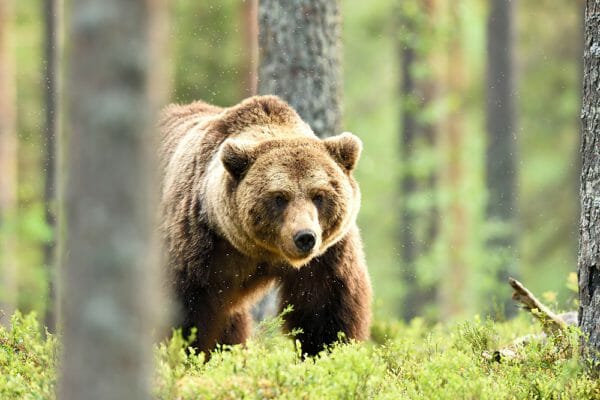
In an article published in Molecular Biology and Evolution, Italian researchers mapped the genetics of European Marsican Brown bears (Ursus arctos). They found evidence indicating the bears had been selected by human hunting pressure to be less aggressive. From yale.edu:
To investigate, Italian researchers mapped the genes of Marsican bears and compared them with the genes of brown bears in Slovakia and the U.S. Their study, published in Molecular Biology and Evolution, found clear evidence that the Marsican bears had been selected for lower aggression.
The study has confirmed what naturalists, ranchers, hunters,, and wildlife managers assumed to be true. Grizzly bears (Ursus arctos) in the lower 48 states of the United States were known as especially aggressive since they became widely known in the Anglosphere after the Lewis and Clark expedition. Lewis and Clark first reported on Ursus arctos as described to them by Indians on the Missouri River.
From the Lewis and Clark Journals, Lewis, April 13, 1805:
… the Indians give a very formidable account of the strengh and ferocity of this anamal, which they never dare to attack but in parties of six eight or ten persons; and are even then frequently defeated with the loss of one or more of their party.
Lewis at first thought the “white” (Ursus arctos) bears were actually wary and shy:
… tho’ we continue to see many tracks of the bear we have seen but very few of them, and those are at a great distance generally runing from us; I thefore presume that they are extreemly ware and shy; the Indian account of them dose not corrispond with our experience so far.
Their experience and opinion of grizzly bears (Ursus arctos) soon changed to concur with what they had heard from the Indians. From Lewis, May 11, 1805:
I must confess that I do not like the gentlemen and had reather fight two Indians than one bear; there is no other chance to conquer them by a single shot but by shooting them through the brains, and this becomes difficult in consequence of two large muscles which cover the sides of the forehead and the sharp projection of the center of the frontal bone, which is also of a pretty good thickness.
Live Inventory Price Checker
|
|
S&W Model 340PD .357 Revolver 1.8" Hammerless - 103061 | Palmetto State Armory | $ 1254.99 $ 1129.99 |
|

|
Colt | PYTHON (4.25") .357 Revolver | PYTHON-SP4WTS | Bear Creek Arsenal | $ 1765.95 |
|

|
Colt | PYTHON (6") .357 Revolver | PYTHON-SP6WTS | Bear Creek Arsenal | $ 1499.99 |
|
|
|
Ruger GP100 Standard .357 Mag Revolver, Stainless w/ Black Rubber Grips - 1705 | Palmetto State Armory | $ 857.99 $ 779.99 |
|
In 100 years of settlement and intense hunting, ursos arctos in the Americas had been selected so only those who fled from humans survived. The last 50 of those years included the development and widespread use of cartridge firearms. One of the last remaining strongholds of the grizzly population in the lower 48 states was in the mountains along the New Mexico-Arizona border. Montague Stevens spent years actively hunting grizzly bears in the area, from 1889 to 1901. In his book, Meet Mr. Grizzly, he says, on page 251:
He will seldom attack a man unless the latter first molests him. As a matter of fact, he would rather run away than fight.
Stephen Herrero believed selection by hunting was the reason black bears seldom attack people. The same logic applies to grizzly bears. From his paper:
It is well known among dog breeders that it is possible to selectively breed for or against aggression. It is highly likely that this selection would also be possible for bears.
The reverse is also true. If humans do not select out aggressive bears, bears which are willing to be aggressive are favored, because they have access to human related food supplies. Grizzly bears in the lower 48 states are much more aggressive than grizzly bears in Alaska, where hunting of ursus arctos is commonly allowed. It only takes a few generations for bears to learn to be aggressive and to reinforce aggression as a viable selection force. In the lower 48 states the federal government has enforced a ban on hunting for roughly 10 generations of grizzly bears (at about 5 years per generation). At the beginning of this vast experiment, the State of Montana Department of Fish and Game submitted a statement pleading for regulated hunting. From the federal register, FR-1975-07-28, p. 31735:
By contrast, a regulated sport hunt, will create an adequate fear of man. In a seasonal sport hunt, bears are exposed to relatively large numbers of humans for a limited time, and consequently learn to avoid all areas where humans are encountered. It is this avoidance of man which will reduce numerous depredations and threats to human safety.
In 1975, the Montana wildlife managers believed a hunting take of 25 bears a year would be sufficient to maintain an aversion to humans by grizzly bears.
The relatively small population of grizzly bears in the lower 48 states now kills more people than 20 times their population does in Alaska. From 1975 to the present, 24 people have been killed by wild Ursus arctos in the lower 48 states. During the same period, 20 people were killed by wild Ursus arctos in Alaska.
About Dean Weingarten:
Dean Weingarten has been a peace officer, a military officer, was on the University of Wisconsin Pistol Team for four years, and was first certified to teach firearms safety in 1973. He taught the Arizona concealed carry course for fifteen years until the goal of Constitutional Carry was attained. He has degrees in meteorology and mining engineering, and retired from the Department of Defense after a 30 year career in Army Research, Development, Testing, and Evaluation.



If a bear makes any sort of threatening move and you don’t consider it aggressive you are risking your life and those who are near by. Everything learns. Easy meals provided by people. Incoming gunfire at first notification of presence. Both are learning experiences for anyone or anything. Education. There are bad bears and there are under fed bears. There was this kid named Treadwell who lived with griz for several summers and some of the bears did seem to get used to him — until the last year when he brought his girlfriend up to the maze. The day… Read more »
Hunters have always known that hunting makes animals wary of those hunting them.