

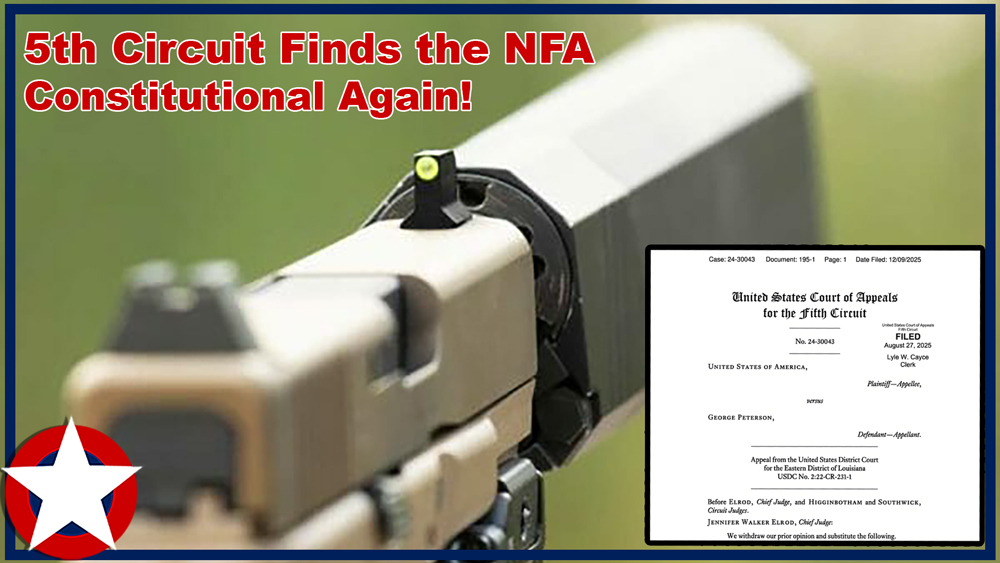
On December 9, 2025, a three-judge panel from the United States Court of Appeals for the Fifth Circuit reissued a significant ruling in the case of United States v. George Peterson, affirming the conviction of George Peterson, a Louisiana firearms dealer, for possessing an unregistered suppressor in violation of the National Firearms Act (NFA). Chief Judge Jennifer Walker Elrod, a George W. Bush appointee, penned the decision.
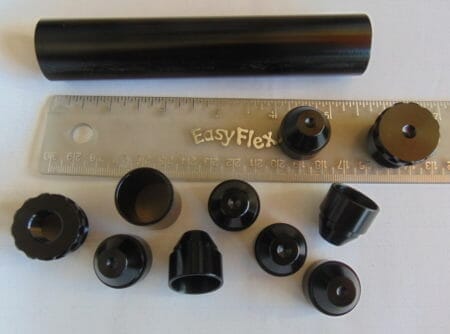
Mr. Peterson’s legal troubles began in the summer of 2022 when federal and state law enforcement officers, led by the Bureau of Alcohol, Tobacco, Firearms and Explosives (ATF), executed a warrant at his home-based business, PDW Solutions, LLC. The investigation, spanning several months, uncovered multiple violations, including unreported firearm sales and a misrepresentation on Peterson’s federal firearms license (FFL) application. During the raid, ATF agents discovered a homemade suppressor in Peterson’s bedroom closet safe, which lacked a serial number and was not registered in the National Firearms Registration and Transfer Record, leading to his indictment.
Peterson pleaded guilty to the charge but reserved the right to appeal the denial of two pretrial motions: a motion to dismiss the indictment on Second Amendment grounds and a motion to suppress evidence on Fourth Amendment grounds. The Fifth Circuit’s ruling, filed on August 27, 2025, and substituted on December 9, 2025, addressed these challenges.
On the Second Amendment front, Peterson argued that the NFA’s registration requirement unconstitutionally burdened his right to bear arms, asserting that suppressors qualify as “Arms” under the amendment. The court assumed, without deciding, that suppressors are protected under the Second Amendment, aligning with arguments from both Peterson and the government. However, it upheld the NFA’s constitutionality by classifying its licensing regime as a “shall-issue” system, which the Fifth Circuit claimed the Supreme Court deemed presumptively lawful in New York State Rifle & Pistol Ass’n v. Bruen. This regime requires the ATF to issue licenses to applicants who meet objective criteria, such as passing background checks and paying a $200 tax, ensuring that only “law-abiding, responsible citizens” possess firearms.
The court noted that Peterson failed to demonstrate that the NFA’s requirements imposed an unconstitutional burden on him. He admitted to forgetting to register the suppressor after making it and, according to the Fifth Circuit, lacked evidence of exorbitant fees or lengthy processing times that might deny his rights. The Fifth Circuit emphasized that Peterson’s as-applied challenge lacked substantiation, reinforcing the presumption of legality of shall-issue regulations established in prior cases such as McRorey v. Garland.
Turning to the Fourth Amendment issue, Peterson challenged the search warrant’s validity, arguing it lacked probable cause. The district court had denied his motion to suppress the suppressor, citing the good-faith exception to the exclusionary rule. This exception allows evidence obtained under a warrant to be admissible if officers reasonably relied on it, even if the warrant is later deemed defective. The Fifth Circuit agreed, finding that the ATF’s affidavit, detailing Peterson’s unreported sales and license misrepresentation, provided sufficient indicia of probable cause to justify the officers’ reliance. The Circuit Court found none of the exceptions to the good-faith rule, such as intentional misrepresentation or a facially deficient warrant, applied, thereby affirming the district court’s decision.
The case has sparked debate among anti-gun groups and Second Amendment advocates. Suppressors, often misnamed “silencers” in popular culture, reduce firearm noise but do not eliminate it, offering benefits like hearing protection for shooters and reduced noise pollution for hunters. Commentators note their infrequent use in crimes, with studies citing only a handful of cases over decades. Yet, opponents argue that suppressors could hinder crime detection, even though the leading gunshot detection system, ShotSpotter, has been shown to be less than effective.
Mr. Peterson’s 24-month prison sentence reflects the seriousness with which federal authorities view NFA violations, even though suppressors do not pose a serious threat to public safety. His appeal highlighted tensions between individual rights and regulatory oversight. The decision leaves open the possibility of future challenges if evidence emerges of abusive application, such as excessive delays or fees, but the panel felt that Peterson’s case met that threshold.
Some anti-gun groups suggest the ruling aligns with a broader trend of upholding shall-issue regimes, as seen in other circuits. Critics argue that this historical context might support future as-applied challenges if a long wait time can be shown. However, the court believed that Peterson failed to pursue this angle, thereby limiting its consideration.
The case has no immediate effect on state laws, as Louisiana does not ban suppressors, unlike at least eight other states. For now, the Fifth Circuit’s decision reinforces the NFA’s framework. Peterson’s legal team has not indicated plans for further appeals but is expected to seek en banc review of the ruling, which the full bench could rehear and vacate the panel’s decision.
About John Crump
Mr. Crump is an NRA instructor and a constitutional activist. John has written about firearms, interviewed people from all walks of life, and on the Constitution. John lives in Northern Virginia with his wife and sons, follow him on X at @crumpyss, or at www.crumpy.com.

Court Rules Suppressors are NOT Protected by the Second Amendment


Fifth
CircuitUpholds the NFA’s ConstitutionalityFifth Circus Upholds the NFA Over Constitution
There. Fixed it.
The NFA is unconstitutional and these judges violated their oath to uphold the Constitution , it’s that simple
What in the 9th Circuit is the 5th Circuit doing?!
I hope the 5th circuit changes their ruling when the en banc review happens. They cover Mississippi and I feel personally responsible about them ruling incorrectly for my area.
HLB
Red Flag Pam’s DOJ proving yet again just how “pro-2A” they are by defending the NFA in court.
1791 – Second Amendment – FINAL WORD!
F the 5th Circus!
F nfa!
Yep, gun owners were heard BIGLY in the last election. And as soon as the voting was over, we were ignored.
Yet another example of bad cases make bad laws. Let’s hope this case goes no further and is not appealed to the Supreme Court. When the crime was committed the $200 tax and registration requirement was in place and remains so until 01 January 2026. We want plaintiffs who in the eyes of the judges have a halo hovering over their heads. We do NOT want defendants who have committed other crimes and claim the Second Amendment protects them from one or more of their misdeeds.
Mr. Peterson is not exactly the poster child for law abiding gun owners, let alone gun dealers with his FFL. Mr. Peterson knew the law, no matter what his opinion of it might be, and was trying to game the system and he got caught. He knew that at the time he made the suppressor that it had to be registered with the ATF, like it or not. As to the constitutionality of the NFA, that is yet to be decided by SCOTUS amid the flurry of legal challenges filed since the repeal of the $200 tax. It was not… Read more »
Evidently there are Judges that cannot understand plain English. Who has a problem understanding “The right to keep and bear arms shall not be infringed”? The NFA is a blatant, unlawful infringement of U.S. Citizens right to keep and bear arms.