
As far as I know, SASS began as a military moniker that stood for Semi-Automatic Sniper System. The first being the Knight’s Armament M110 SASS. PSA has decided to release their version of a SASS, and they call it the Super SASS—more specifically, the PSA Sabre-10A2 Super SASS. I’ve never been much of a precision rifle guy, and most of my .308 experience is behind a bolt gun.
For that reason, this review might not appeal to everyone. I’m writing it from the perspective of a newbie trying to learn, and if the Super SASS offers a value-priced gas gun for someone looking to stretch their effective range.
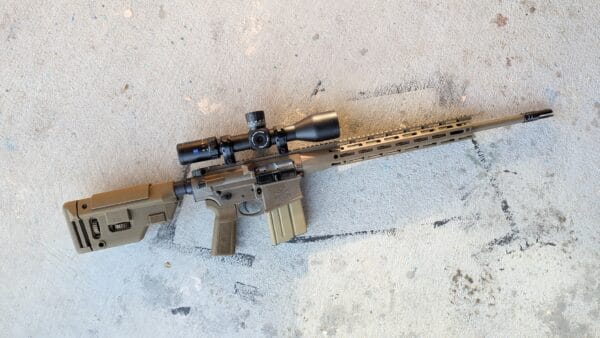
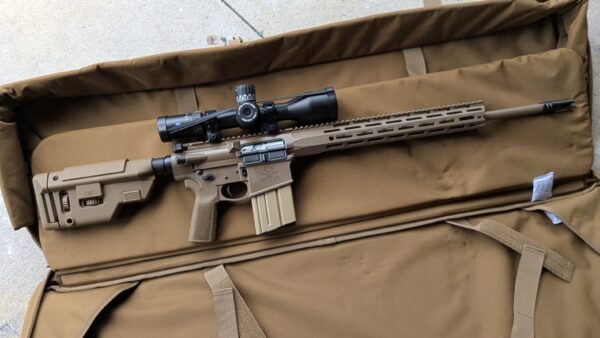
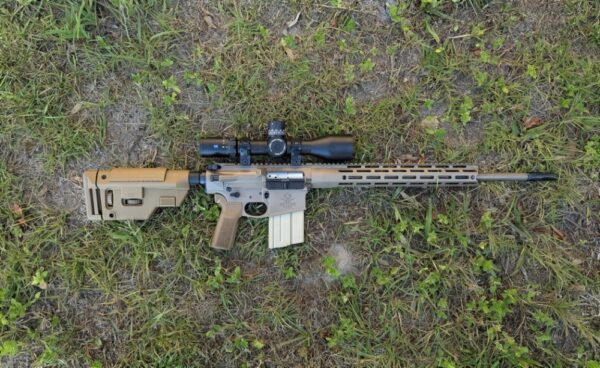
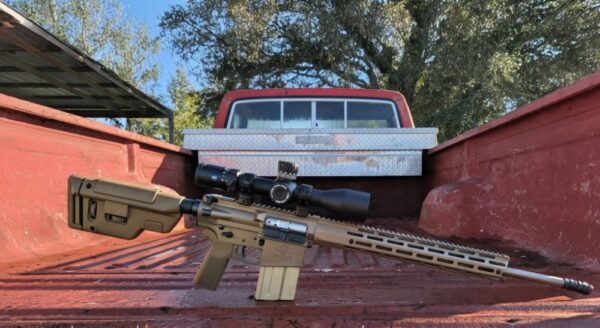
In the search to become a well-rounded shooter and to learn something new, I grabbed the Super SASS. The .308-powered, gas-operated, AR-10-style rifle certainly looks nice, and the price made it appealing. The FDE finish, the precision stock, and the option for a LAW folder make it an attractive option.
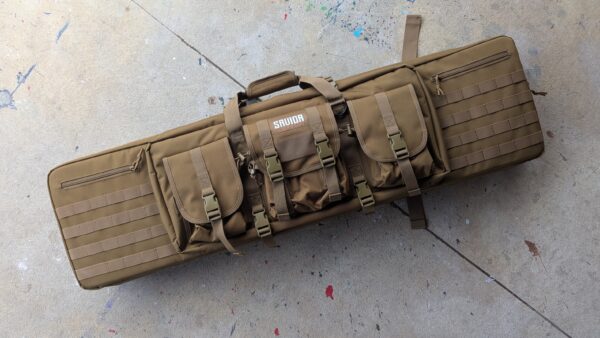
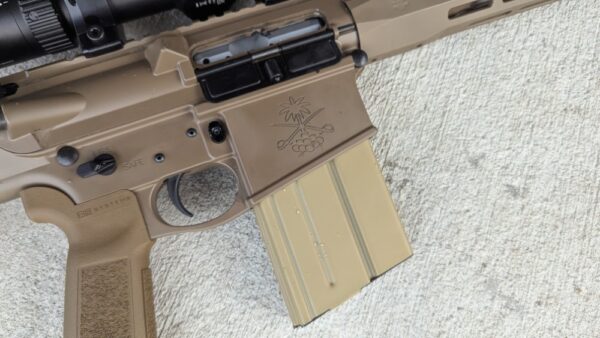
The rail is an M-LOK design, and the gun has an adjustable gas block. The furniture all comes from B5, and the charging handle is a Radian Raptor, and the safety is a Radian Talon 45/90 safety. The gun comes with an awesome Saviour rifle bag and three 20-round Duramag magazines.
PSA went with a 20-inch Faxon Match Grade barrel topped with a Sabre compensator. Internally, the gun has a Sabre two-stage trigger, uses a stainless steel bolt, and comes with a heavy buffer.
The Super SASS In Hand
The Super SASS feels hefty. It doesn’t shy away from weight, but a semi-auto precision rifle isn’t ever going to be carbine light. Adding an optic increased the heft, and I’d imagine a bipod would make you want to hit the gym.
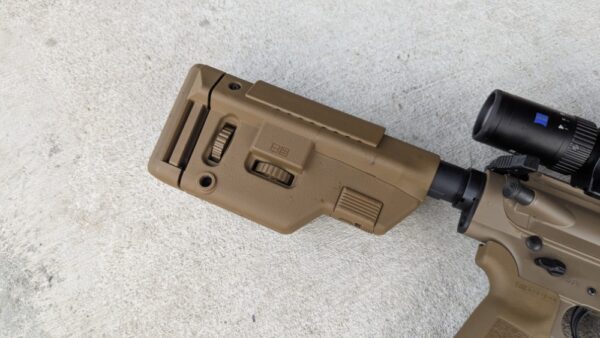
The ergonomics are fantastic. I love the B5 precision stock and all the adjustments I can make. I probably played with the stock longer than necessary. I’d dial the length of pull out, then back in; I’d raise the cheek rest, then lower it. It was a lot of small movements to finally find stock nirvana. The time investment felt well worth it.
The straightish B5 grip feels great on the long rifle and helps my wrist support the weapon’s weight. The 15-inch M-LOK handguard gives you plenty of space to grip. Overall, the rifle feels fantastic with excellent ergonomics for supported shooting.
The Super SASS uses a stiff spring and heavy buffer. The included oversized charging handle was a godsend. You have to pull the hell out of that charging handle to cycle the bolt. I’m an AR-15 guy, so this was a new experience. I certainly couldn’t do the high-speed blade-style charging with the Super SASS.
First Steps With the Super SASS
I’m not much of an AR-10 fella or long-range shooter, but I’m trying something new; I’m learning, and I’m trying to become more well-rounded. In that space is where I think the Super SASS fits well. It’s not overly expensive, but it also comes from the factory with a number of modern features that lean toward precision and long-range shooting.
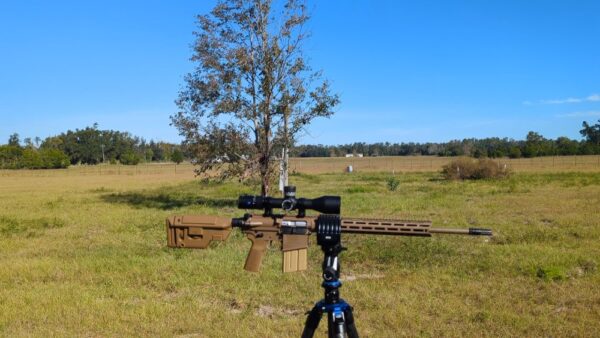
I topped the gun with a Zeiss LRP S3 4-15X50mm optic using Zeiss scope rings. Good glass is a must, and the Zeiss provided powerful magnification with a crystal-clear image. With the optic locked in place, I headed to the range and set the rifle up on a Zeiss Pro Series Heavy Duty tripod to zero the gun.
I’m throwing away the bench for the tripod for zeroing. I joke, but as a tall shooter, I really like the tripod for zeroing. I know with precision guns you are supposed to break in the barrel by shooting one, cleaning, shooting one, cleaning, etc. The Super SASS uses a Faxon 416R barrel with QPQ Nitride.
According to Faxon, you don’t have to break the barrel in, but they provide a method to break in the barrel. I followed their procedure, which went as follows:
- Shoot one round, clean copper out, repeat this twice.
- Shoot five rounds, clean copper out.
- Shoot ten rounds, clean copper out.
After doing that, I zeroed the gun at 100 yards, which was super easy thanks to its inherent accuracy, a tripod, and the well-made optic.
Accuracy and Precision
At 100 yards, with the rifle zeroed, I cleaned the bore again, making sure not to use military-style section rods. A 28-inch polymer rifle rod was today’s hero in more ways than one. I loaded up my last box of Atlanta Arms Classic Match .308. Rest in power, Atlanta Arms; I’ll miss you and your ammo.
I took my time, adjusted the tripod, feeling like I was never happy enough with its placement. I wanted to lock it down on the target and remove some of the human element out of the shooting process. It took some time, I adjusted the stock a few times, and finally took that deep breath and fired a five-round group.
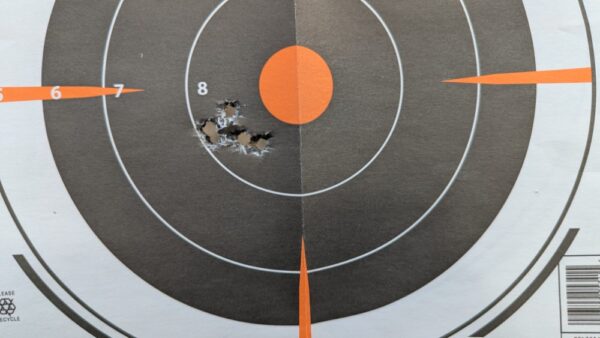
My first group was a hair over 1.5 MOA. I cleaned the barrel, fired again. The second group measured 1.25 MOA. Another group, and another 1.5 MOA group. I fired the last five rounds, and it was around 1.2 MOA. Is this a 1 MOA rifle? Probably, but I’m not a 1 MOA shooter. If I fired three-round groups, I’d likely score 1 MOA groups fairly often, but I’m dedicated to the five-shot group.
The Sabre Two-Stage Black DLC-coated trigger delivers a brilliant experience. It’s so crisp and so nice. It’s extremely short and light. I love it, and I think PSA is getting pretty close to some very high-end trigger companies at a fraction of the price.
Outside of Match Grade
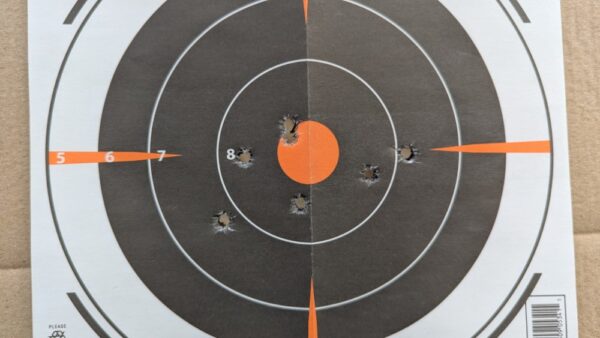
A lot of people aren’t interested in shooting a lot of match-grade ammo, so how does it perform with something like Winchester White Box M80? My groups grew considerably. We climbed to 4 MOA at times. I’ve also grown to despise Winchester M80.

Remember that polymer cleaning rod? It saved the day when I got a squib load—a squib load from factory ammo that costs more than 80 cents a round. In all of my shooting, this is the second squib I’ve ever encountered.
Moving On With the Super SASS
I boxed the rest of my WWB M80 up and whipped out some Federal .308 provided by AmmoToGo for the rest of this review. These 300 rounds made up the majority of my shooting. It needed a slight fix to the zero, and I noticed groups were around 2.5 to 3 MOA.
I climbed off my bipod and practiced shooting offhand at 100 yards. I could hit gongs with ease and do it fairly rapidly. The weapon’s overall weight, combined with the hefty Zeiss optic, makes it tough to shoot any kind of precision group on paper offhand, but I can ring that steel.

At 200 yards, offhand, I had a blast shooting IPSC-sized steel with the Super SASS. It was slower, and I had to break my position down on occasion and reset, but each ding felt well-earned. From the prone at 200 yards, I could hit those same 10- to 8-inch gongs consistently.
Up close, the Super SASS delivers a lot of fun. Shooting failure-to-stop drills at 25 yards was a little tricky with the 4X setting, but it’s fine. I don’t think most targets take two .308s and keep fighting all that often. At 50 yards, I ran some ready-up drills and earned my dings on that steel IPSC target.
Beyond Accuracy
That hefty spring and heavy buffer do wonders to reduce recoil. The 20-inch barrel and rifle-length gas system make it a smooth shooter. Smooth shooting is nice on the shoulder, but it also helps keep the gun stable for faster precision follow-up shots. Compared to the JAKL-10, there is a ton less scope movement between shots.
Outside of the squib load, I had a handful of failures to feed. I swapped the included DuraMags to PMAGs, and bam, problems disappeared. PMAGs stay winning. After swapping to PMAGs, I had no reliability issues.
A Worthy Super SASS
Is the Super SASS as accurate as some other precision AR-10s? Not necessarily. It’s not going to produce those 3/4 inch MOA groups. With that said, it costs $1,549. That’s a chunk of change, but it’s downright affordable. The Geissele Mid-Range Gas Gun is $6,300; the JP Enterprises LRP07 hits the $4,400 mark, and I can go on and on.
For a third of the money, you’re getting a fair bit of performance. It’s not the lightest rifle, but it’s feature-packed and a nice surprise. For someone like me, just dipping their toes into the precision gas gun world, it’s a great place to learn without spending a pile of money up front.
Live Inventory Price Checker
|
|
PSA Sabre AR-10 Rifle Billet 13.7" .308 Mid-Length 13" Sabre Rail w/ B5 Sop-Mod Furniture & JMAC GFHCE-R Pin/Weld | Palmetto State Armory | $ 1319.99 |
|
|
|
PSA Sabre AR-10 Rifle Billet 18" .308 Rifle w/ 15" Knurled Slant Rail & B5 Sop-Mod Stock | Palmetto State Armory | $ 1299.99 |
|
|
|
PSA Sabre AR-10 Rifle Billet 16" .308 Rifle w/ 15" Knurled Slant Rail & B5 Sop-Mod Furniture | Palmetto State Armory | $ 1299.99 |
|
|
|
PSA Sabre AR-10 Rifle Forged 20" .308 w/ 12.5" Quad Rail, A1 Stock, Magpul Bi-Pod, 3 Mags, & Sabre Bag, FDE | Palmetto State Armory | $ 1299.99 |
|


I have a PSA Gen3 .308 with an 18″ barrel, and that’s the longest I want due to the weight. I like the DPMS and Aero Precision platforms for parts availability (I also have an Aero 18″ .308). You save a lot of money getting one of these for under 1k and then upgrading to premium BCG, trigger and barrel later as you go (where you can justify spending more money).
One of my Tees…..”308 because rocks aren’t effective at 700 yards.” The Ruger SFAR is a great choice…..light (16″ 6.8#, 20″ 7.2#), reliable, economical ($1329 MSRP, $1000ish street), good Ruger Elite 452 2stage 4.5lb…..effective at 700 yards. PSA shares no weight spec meaning it is probably a boat anchor. like old DPMS 308s.
I’m not sure why I would spend that kind of money over a Ruger SFAR.