
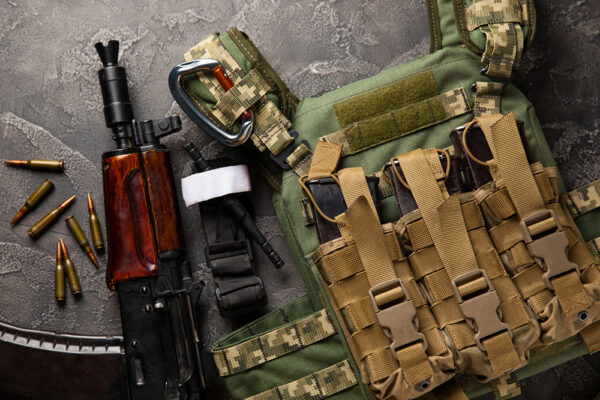
New York’s ban on body armor is now facing a direct constitutional challenge that goes right to the heart of the Second Amendment.
In Heeter v. James, an ongoing 2024 federal lawsuit in the U.S. District Court for the Western District of New York, plaintiffs Heeter and Firearms Policy Coalition are challenging New York’s body armor ban as a violation of the Second Amendment. Plaintiffs argue that the law has criminalized the purchase and acquisition of defensive gear that falls within the plain text of the right to “keep and bear Arms.”
As the motion puts it, “body armor is commonly owned for self-defense and other lawful purposes,” and New York’s law therefore cannot survive under District of Columbia v. Heller and New York State Rifle & Pistol Association v. Bruen.
The filing opens by stating that New York’s law “prohibits the purchase, acquisition, or sale of any ‘protective body covering intended to protect against gunfire,’ by anyone who is not a member of several ‘eligible professions.’” In other words, ordinary law-abiding New Yorkers are barred from buying body armor unless the state has decided their job title is important enough. The plaintiffs say that violates the rights of citizens with “ordinary self-defense needs,” the same kind of language the Supreme Court used in Bruen when it rejected New York’s old carry regime.
The motion leans heavily on Heller’s discussion of the word “arms,” reminding the court that the Supreme Court itself said the term included not only “weapons of offence,” but also “armour of defence.”
From there, the plaintiffs walk through historical dictionaries, legal dictionaries, Blackstone, the Assize of Arms, and the Statute of Winchester to argue that armor has long been understood as part of the class of protected “arms.” The filing says the historical record “confirm[s] that the Supreme Court was correct” and that “‘Arms’ encompasses body armor.” That is the foundation of the whole case. If body armor is an arm, then the Second Amendment is implicated from the start.
According to the plaintiffs, New York expanded the definition of body armor through the Concealed Carry Improvement Act so broadly that it now covers “any product that is a personal protective body covering intended to protect against gunfire,” including steel plates, bulletproof backpacks, and “inconspicuous garments” like bullet-resistant sweatshirts and flannels. This is not a narrow restriction aimed at criminals wearing armor while committing violent felonies. It is a broad ban on defensive products that ordinary people may want for their own protection.
The plaintiffs back that up with real examples. One named plaintiff, Heeter, says he wants to buy body armor for lawful purposes, “including to protect himself in the event of civil unrest similar to the riots of 2020.” Another, Wurtenberg, wants armor for his late-night commute through downtown Rochester and to incorporate into his range gear “to prevent accidental injury.”
Neither man is in one of the state’s favored “eligible professions,” so both are barred from acquiring body armor, even though the motion says they seek it only for lawful self-defense and safety purposes.
The motion also takes aim at the state’s claim that body armor is somehow outside ordinary constitutional protection because criminals have used it. New York reportedly justified the ban in part by pointing to the body armor worn by the Buffalo mass murderer. But the plaintiffs argue that argument collapses under scrutiny. The filing cites FBI data and says that “less than 5% of perpetrators in mass-shooting incidents from 2000 to 2019 wore body armor.” That is a devastating statistic for the state’s narrative.
The plaintiffs then drive the point home by noting that handguns are used in crimes far more often than body armor, yet handguns remain unquestionably protected under the Second Amendment. A criminal misuse argument cannot erase constitutional protection for an item commonly used by law-abiding people.
And that is another major piece of the motion: common use.
The plaintiffs argue that body armor is “in common use for lawful purposes,” which, under Heller and Bruen, is a major constitutional marker. They cite market data showing tens of millions of dollars in civilian body armor sales, a robust civilian market, and more than 70 manufacturers serving that demand. The motion says American civilians spent $41.9 million on body armor in 2022, and cites additional estimates showing civilian expenditures continued rising in 2023, 2024, and 2025. It also stresses that body armor is legal in 49 states, making New York the outlier, not the rule. As the brief puts it, “New York is the first state to ban body armor for law-abiding citizens.” That is exactly the kind of modern outlier status that has become increasingly hard to defend in the post-Bruen world.
The most effective part of the filing may be its treatment of danger. The state’s best chance in a case like this is to argue that body armor can be banned as “dangerous and unusual.” The plaintiffs say that argument fails on both halves.
First, they say body armor is not dangerous. “It is exclusively defensive,” the motion argues. It does not fire a projectile, does not slash, stab, bludgeon, or explode. Its only function is to protect the wearer. The filing even notes that the Transportation Security Administration allows airline passengers to carry body armor in their bags. It cites case law recognizing that “wearing body armor is not an inherently threatening act” and can instead be “an act of self-defense.” That is hard to get around. New York is trying to treat protective equipment as though it were some uniquely menacing weapon, but the plaintiffs’ point is simple and powerful: armor protects, it does not attack.
Second, the plaintiffs argue body armor is not unusual. Quite the opposite. They say it is common historically, common today, common across the country, and common in civilian commerce. The motion points to historical militia laws requiring certain citizens to furnish armor, to widespread availability of bullet-resistant vests by the Civil War era, and to modern ownership and sales trends.
The filing sums it up this way: body armor is “common categorically,” “common numerically,” and “common jurisdictionally.”
The filing also spends time showing that the law is not just some dead statute sitting on the books. According to the motion, New York officials celebrated the ban, state police warned there would be “zero tolerance” for violations, and the law has already been enforced through arrests. The plaintiffs say the legal market for body armor in New York has effectively been wiped out because sellers face both criminal penalties and civil fines if they sell to someone outside the approved professions. That matters because it shows the injury here is concrete and ongoing. This is not a hypothetical challenge brought against a dormant law. It is a live fight over a ban that the state intends to enforce.
At bottom, the plaintiffs are asking the court to apply the Second Amendment the way the Supreme Court said it must be applied. Once conduct falls within the plain text, the burden shifts to the government to prove a historical tradition that justifies the regulation. The motion argues New York cannot do that here because “there exists no American tradition” of banning the purchase, transfer, or possession of defensive armor by ordinary citizens. It says there were “no American legislative body” restrictions of that kind from the Founding through well after Reconstruction, and that no pre-1900 American armor bans existed at all. If that historical claim holds, New York is standing on very thin ice.
The plaintiffs’ conclusion: “the Court should grant judgment in Plaintiffs favor, declare the Body Armor Ban unconstitutional, and enjoin its enforcement.”
New York will almost certainly argue that body armor is different from weapons, that the state has a strong public-safety interest, and that armor can embolden criminals in violent encounters. But this motion is serious, direct, and grounded in the same constitutional framework that has already knocked down a growing list of modern gun-control laws.
If the court accepts the plaintiffs’ central premise that body armor is part of the protected class of “arms,” New York is going to have a very difficult time explaining why ordinary citizens can be barred from buying purely defensive equipment that is legal in the other 49 states.
The next step is now in the hands of the U.S. District Court for the Western District of New York, where the judge will decide whether New York’s body armor ban can survive under Heller and Bruen. After the state files its response, the court will determine whether the law can be struck down on summary judgment or whether the case needs to move further. A win for the plaintiffs would block enforcement of one of the most aggressive body armor laws in the country. A win for New York would only push the constitutional fight into its next round. Either way, Heeter v. James is now a case gun owners and civil-liberties advocates should be watching closely.
FPC, SAF, and Texas Gun Owner Sue Over Carry Ban in National Park Facilities





In the early 2000s the company I worked for, prohibited us from carrying a firearm.
Yet they started to issue body armor to those working at night in certain notorious areas, of Los Angeles and Chicago, among others.
A Company lawyer then pointed out, that doing so was an admission that they were knowingly, placing these employees in a hazardous, life threatening environment.
They quickly withdrew the issued body armor.
It’s not a gun or anything that goes onto a gun so mind your own business!
It’s no different than having a guard on the front of your car or pickup for deer or elk or anything that crosses your path like they have on armored trucks in the cities where those critters don’t live.
More proof that the demonrat line that they are only concerned about our health is Bovine Excrement.
MAGA
The state’s public safety interest is not an argument, as interest balancing has been verboten and it was never a viable excuse. NY hasn’t a leg to stand on, and that is the problem: these authoritarian freedom-hating control freaks who aggregate in government jobs face no accountability or punishment for violating rights and passing unconstitutional laws and regs. That must change. They must be punished.
Body armor must go. NY liberals determine it to be a particular threat to the states “underserved communities”.