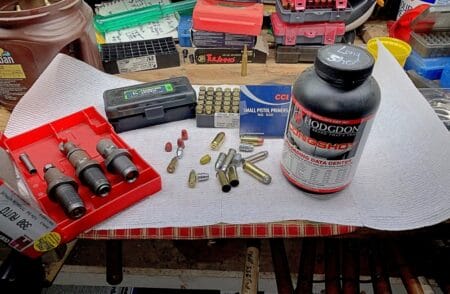
Images provided by rcbs.com unless otherwise noted.
RCBS is, as I have stated in another review of their equipment, the 800-pound gorilla in a room full of reloading equipment. The company has been around since 1943, when founder Fred Huntington started swaging .22 caliber bullets for his use. He went from a back room at his dad’s laundromat in Oroville, California, to eventually needing a large manufacturing facility as his products caught on. I won’t go into further history, other than to say that the company grew, and has been owned by several large companies, but it is owned now by Hodgdon. That’s a good thing… owned by a company that “gets” reloading!
RCBS makes a whole lot of reloading equipment, but for this article, we will concentrate on presses. For a quick look at RCBS case cleaning … tumbling vs. ultrasonic… go here.
Before we get into specific presses they sell, let’s look at the different types of presses so you can ascertain what would work best for you.
Types of Presses
The three basic types of presses are single-stage, turret, and progressive. Here are the differences…
- Single-stage presses do one operation at a time. There is one shell holder. You resize, decap, and re-prime all your cases. Then you change dies, expand the case mouth (pistol cases), and drop powder. Bottleneck cases skip the expansion step. The third die (pistol set) allows bullet seating and crimping. With bottleneck cases, this is the second die. That’s it. Single-stage presses are the simplest of the three types to set up and use.
- Turret presses have a tool head with several spaces to screw in all your dies at once. You still have one shell holder, similar to a single-stage press. You perform one operation, then the turret rotates to the next station, either automatically or by hand. After all the processes are finished, you have a completed cartridge. You still have to perform each process on the case, but you don’t have to screw/unscrew dies in between processes. The dies stay put in the tool head. Remember… you only produce a loaded cartridge after cycling the handle as many times as there are die stations. So, a four-station turret press takes four cycles of the handle to make one loaded round.
- The third type of press is a progressive press. This is the type of press that, with practice, allows you to produce several hundred loaded cartridges per hour. It consists of a tool head similar to that on a turret press (but typically with more die stations).
One difference between progressives and turret presses lies in the shell holder. Instead of only one (like the single-stage and the turret press have), you will have a plate with as many shell holders as you have die stations in the tool head above it. So, once you start case 1 on its journey, when it reaches die #2, a new case is inserted into the shell holder plate, and the process begins again from die #1. Each case moves around the shell holder plate in a cycle, has the next process performed on it, and then is ejected after the final stage into the collection bin.
Once the shell holder plate is fully loaded, a loaded round drops into the collection bin with each handle cycle. That’s where your speed comes from. You just need to keep an eye on priming and powder charging. I’ve had problems with either the press not seating a primer or not dropping the powder charge. There are things you can buy that will check these areas, things like primer sensors and powder check dies.
Progressive presses tend to be more than a beginning reloader needs – they are fairly complex to set up and to run. I do not recommend a progressive press for a beginning reloader. Your concentration is required… You must pay utmost attention to each case after every handle cycle. If the powder doesn’t drop, say, you want to catch it before that case moves on. That’s a lot to put on a new reloader’s plate.
RCBS Reloading Press Options
Let’s look at the presses RCBS sells. I own three of them, so I post photos of those as they sit on the reloading bench. I’ll add photos from the RCBS site for the others. I’ll list them in price order, low to high, with prices rounded to the next dollar. I’ll also list bullet points from each press’s website page, so you can compare them and any comments I think need to be added.
Starting out, we have the Partner press. This press is great for a beginner or as a second, dedicated press for one function.
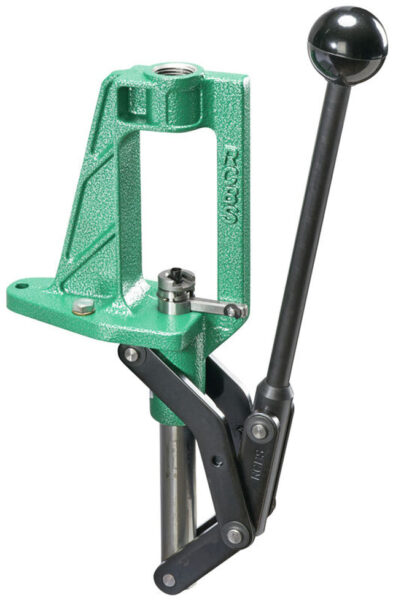
Features:
- Small O-Frame design allows great access and visibility
- Die-cast aluminum frame makes the press lightweight and portable
- 4″ Operating Window 3.5″ Stroke
- Lightweight, compact, and portable
- On-press priming
- Made in the USA
If you are starting out, the Partner press makes a great press upon which to build your skills. It’s inexpensive, strong, and easy to set up.
Moving up, we see the Reloader Special-5 press.
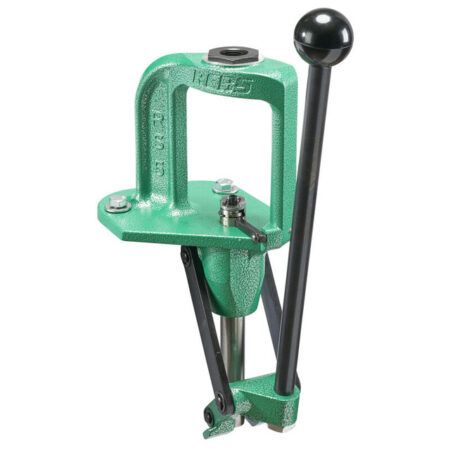
This press is a step up from the Partner. The primer arm is mounted differently than it is on the Partner, and the window is larger. A 30-degree offset allows easy access to the case.
Features
- 4.3-inch operating window with a 30° offset design providing great access and visibility
- O-frame, durable and lightweight die-cast aluminum frame
- Comfortable ball handle and primer arm allows you to prime cases as you resize
- 3.4 inch ram stroke
- On-press priming
- Limited Lifetime Warranty
- Machined and assembled in the USA
- Made in USA
For a second press, or as a beginner’s first press, the Reloader Special-5 works well.
Next up, we have the Rock Chucker Supreme press.
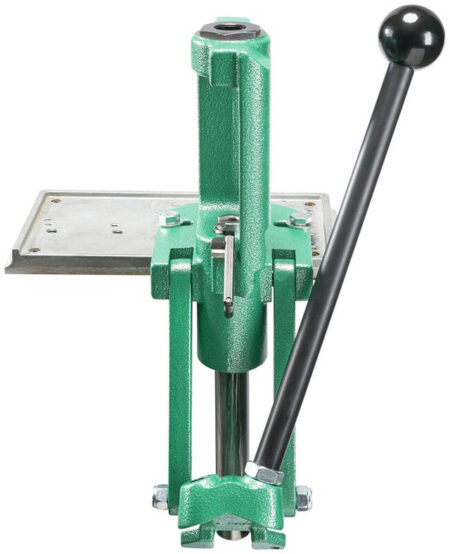
Mounting plate not included.
Coming in at $230, this is a press that will last you a lifetime. I know… I own its great-grandaddy, an RCBS Jr. press that I bought new in 1978. It still works, as does the powder measure and scale that I bought with it. That speaks volumes to me. Even parts from it will work on the new one… I lost the primer cup for the new Supreme and took the one off my Jr. It works fine. This is the first press, as we move up the line, to be built out of cast iron. This is the single-stage press you buy if you want to keep it for decades. I know I love mine.
Here are its features:
- Accepts Standard 7/8″-14 thread dies with bushing, and 1-1/4″-12 without bushing
- 4.25″ Operating Window
- On-Press Priming
- Heavy-Duty Cast Iron Construction
- Ambidextrous
- Zerk fitting for grease
- Backed by Legendary RCBS Warranty
- Made in USA
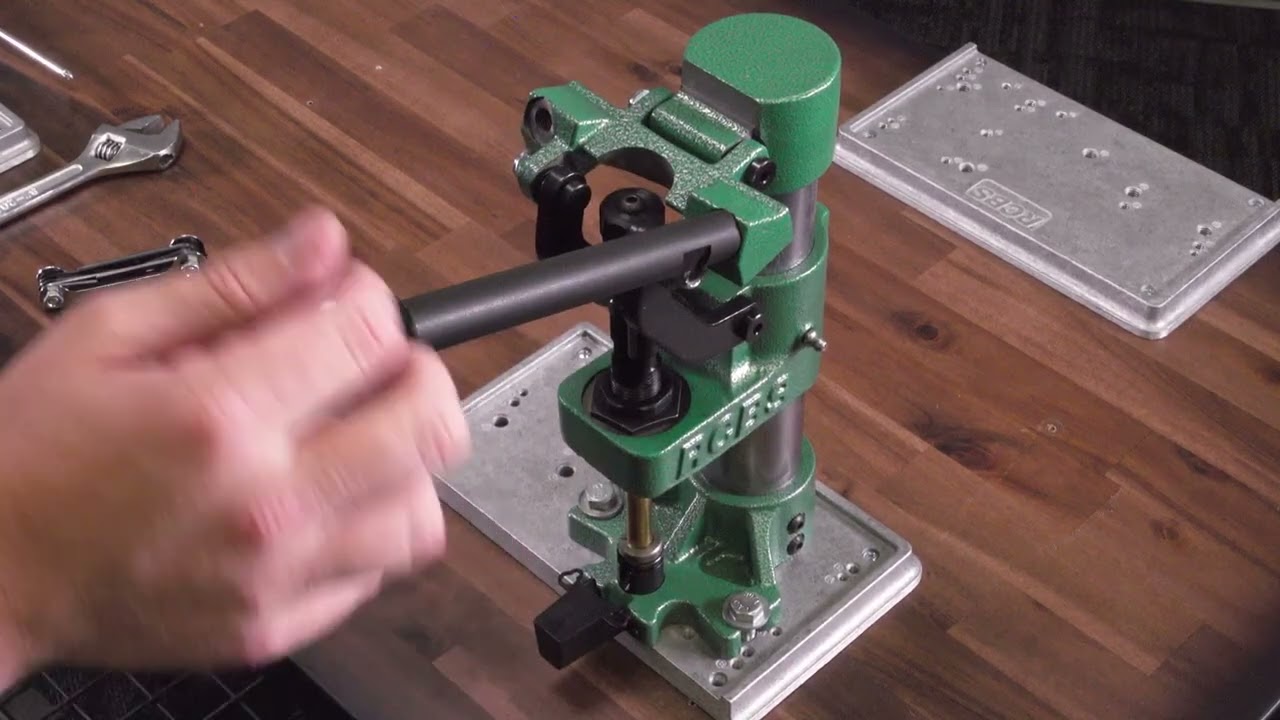
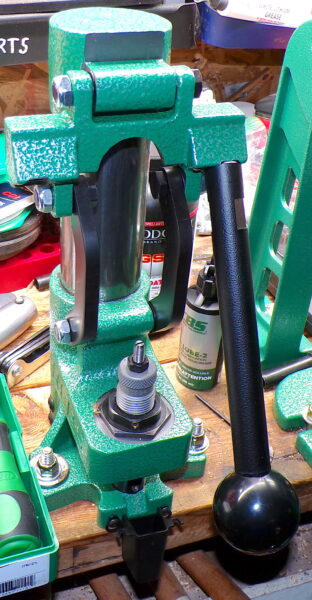
Moving on up in the single-stage line, we have the Summit press. I added this to my press “collection” recently, and it is a doozy.
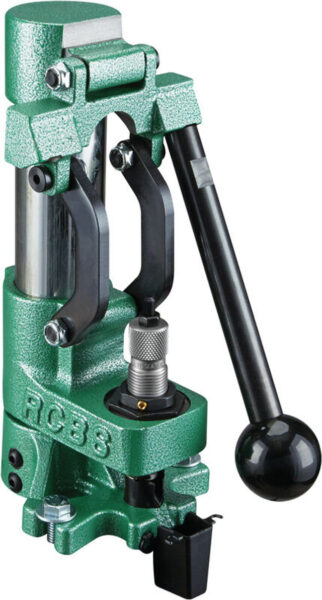
Press is shown with the optional short handle.
This press is unique in that it works “backwards”. Most presses move the case up into the die – the die is stationary. This press pulls the die down over the case. That means that the linkage can be shorter, which allows you to mount it in the middle of your bench, not on the edge. (You do need to buy the $19 short handle to do this.)
Features:
- Massive 2″ Solid Steel Mirror Polished Ram
- Cast Iron Frame, Steel Linkage
- Mount anywhere on your bench
- Zerk fitting for grease
- 4.5″ Opening with unlimited frontal access
- Made in the USA
The Summit will do just about anything you need done on a reloading press. I really like mine, and use it for many different functions.
Now, we get to Turret Press.
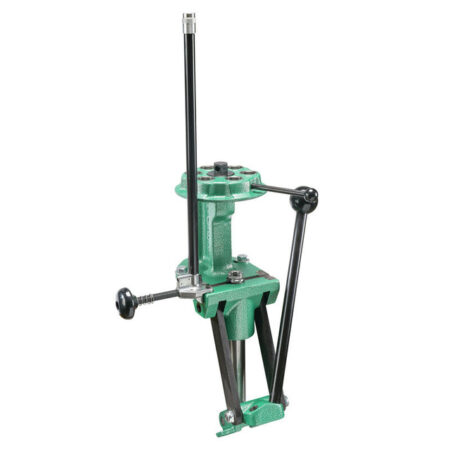
The turret press bridges the gap between single-station and progressive presses. This one retails for $400 and has six die stations, but only one shell holder… that’s the difference between a turret and a progressive.
Here’s what the website has to say about it:
“The RCBS Turret Press offers simple operation—no complex or automated processes. Reloaders have complete control over every step, and the press may be operated in progressive or single-stage mode. In progressive mode, output can be increased from 50 to 200 rounds per hour.
It features a rugged, cast iron frame, toggle block and turret head. The press’s heavy-duty construction minimizes springing and detent on the turret head ensures positive alignment.
Note: RCBS highly recommends the optional Uniflow Powder Measure with Case Activated Linkage Kit for use on the Turret Press (sold separately).”
Priming can be accomplished from either side, and the tough-as-nails turret handle makes indexing the press easy. If you want to move up to the next logical step from single-stage presses, this is a good choice. I do not own this press, but I have another brand of turret, and I can crank out the ammo with it. It does speed up your loading, because you don’t have to stop and unscew/screw your dies. They’re already there.
We have two more presses to look at as we move up the price ladder.
The next press is another single-stage press, the $786 AmmoMaster.
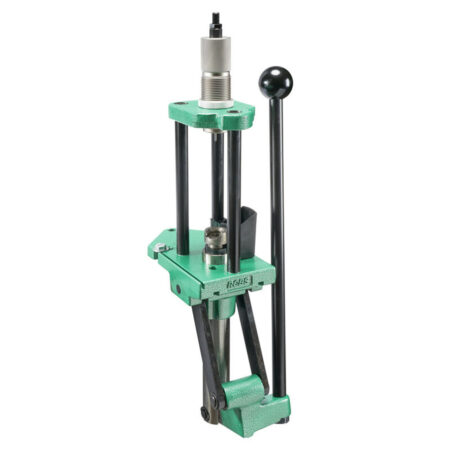
The AmmoMaster is designed to do one thing: load .50BMG. The press is scaled toward that goal. Here are its features:
- Accepts RCBS 1 ½ inch 50 BMG dies
- Massive 1 ½ inch solid steel ram
- Includes the press, Full-Length Sizer, Seater Die, Shell Holder, Ram Priming Unit, and Trim Die
- Made in USA
If you reload .50BMG, you might want to check it out. It is a special press made for a special purpose.
Next up are progressive presses, such as the Pro Chucker 7 progressive press.

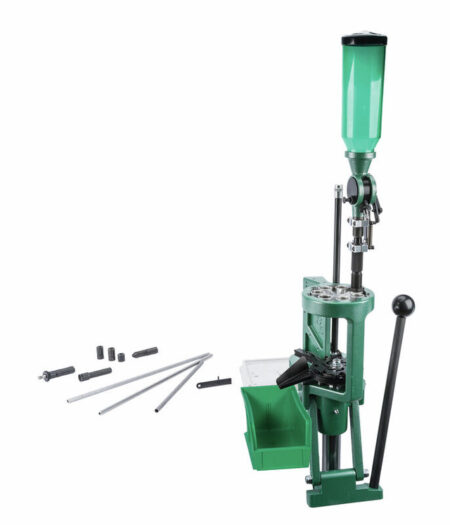
This is the top of the heap for RCBS. Retailing for $1000, this press features a 7-station tool head. I own two other brands of progressive presses, and this one is, arguably, the easiest of the lot to use. I won’t get into specifics here – this is not the place for that – but they make processes easy that other makers complicate.
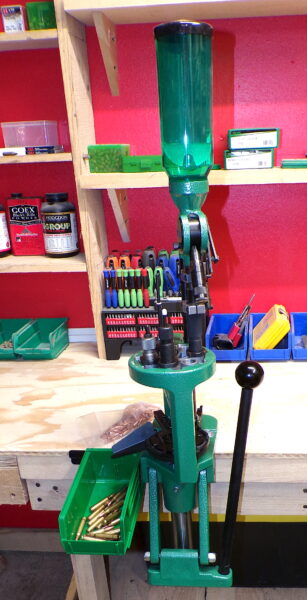
Image: author
Here’s one quick example… if you have to pull a case out of the shell plate in any station other than the first one, some presses make you remove a “plug” that holds the case in. The RCBS press is engineered so that you can easily remove a case without having to pull something off the press to do so.
Having seven die stations allows you to add things that other presses with fewer locations might have trouble doing. For example, if you are using a 4-die pistol set, you are still able to add a powder checker die, a case feed die, and a pistol bullet feed die. These last two are on the list to be added to my press.
Speaking of the powder check die, I’ve used both this brand and another one. I like the RCBS because it has two rods… the usual floating rod that all such dies have, and a stationary check rod that you measure the floater against.
Production with the Pro Chucker can be prodigious. Loading something simple like 9mm or .223, you could conceivably hit 400-500 rounds per hour. After getting my progressive presses, it was brought home to me why some gun clubs have these set up for members to use. You become an ammo factory, and the RCBS Pro Chucker 7 is priced towards the low end of the scale, but it works very well.
So, Now What…?
Alrighty. Now, where do we go from here? I have basically given you information you could find online, with the exception of my (golden?) memories and experiences. Well, maybe not golden, but there has been a lot of water under my reloading bridge for almost 50 years. I know what works and what doesn’t.
Let’s look at a few reloading scenarios and pick a press or two from the list that might work for you.
Beginning Reloader.
The rookie reloader is a special case. We want to add members to the reloading club, so to speak, so we want to get you all enrolled. Suppose you have always been curious about reloading and have decided to take the plunge. You’ve heard about RCBS from other shooters and friends, and are looking to get into the game.
I have one word for you: kits.
Kits? Sure. RCBS has foreseen your need and has put together all the equipment you’ll need to start out minus dies and a shell holder, and discounted the collection. Here are a couple of them to consider…
Partner Reloading Kit
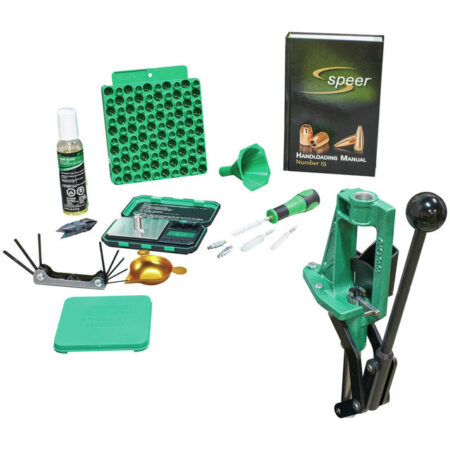
For $270, you can get this and start your journey into reloading. It’s a bare-bones kit that includes everything you need to get going, except the dies and shell holder, and possibly a powder measure. The included Speer manual ($45 if ordered separately) is truly a Godsend because not only does it show “recipes” for loads for tons of calibers, but it has chapters on related issues. You can get set up and going for around $300, after buying components and the above-mentioned items. Not a bad deal!
What if you want to bypass the lowest-priced kit and maybe end up with something a little “more?”
There’s the Rock Chucker Supreme kit. For $500, you get this:
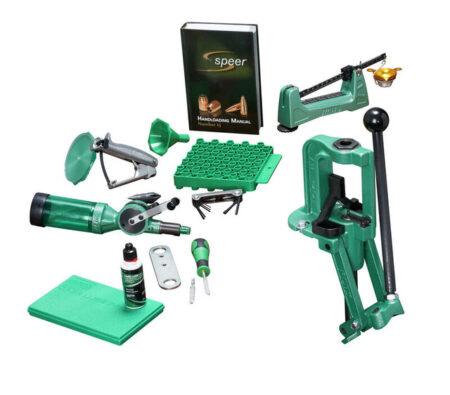
The components are a step up from the Partner kit, with the star of the show being the Rock Chucker Supreme press. I have this kit and it is a doozy. It allows you to choose whether to prime on or off the press, as it includes equipment to do both. It also includes an M500 mechanical powder scale. I will offer unsolicited advice on this item. It works great – I have 4 mechanical scales – but you might want to consider ordering a digital scale or a digital powder dispenser/scale instead. Why? The wait time. Using a balance beam is a practice in patience. After adding the powder, you must wait for the scale to stop oscillating, even with magnetic damping, which can take some time. RCBS makes digital scales starting at $35. It’s something to consider. (If you are going to be loading any type of precision load, do yourself a favor and jump to the powder dispenser/scale link. Those things will not only weigh out but will dispense the prescribed, exact weight of powder for each load, each and every time.)
Continuing on…
Competitive Rifle Reloader.
You are a breed apart. You will need precision, from case handling and prep to loading. I would recommend either the Rock Chucker Supreme or the Summit press for you. I own both, and each does a great job in terms of precisely working with your cases. Add in a micrometer bullet seating die, a MatchMaster powder dispenser, and the proper components, and you should be good to go. I might shy away from the progressive press because you are not about seeing how many rounds you can load per hour, but are into making sure every loaded cartridge is identical to all the others. Consistency is the name of the game. Progressives can be very precise, but in my experience, long-distance rifle shooters tend to go with a good single-station press.
Pistol Competitor.
I guess I need to define what I mean by pistol competitor. I’m not talking the long-range realm of the T/C Contender in a rifle caliber. I’m talking about those who shoot 500 – 600 rounds per week in Steel Challenges or other competitions with high round counts.
Here, we look at the Pro Chucker 7. RCBS’s progressive press would serve whatever need you have… from 9mm up. Putting together 600 rounds for the week’s practice and competition is one thing. Putting together 600 ACCURATE and RELIABLE rounds is another. The Pro Chucker is up to that task, believe me. With the optional Powder Checker and Bullet Feed die kits, you are off to the races. My experience tells me that not having to wonder if the right powder charge dropped or not having to manually place a bullet in the case mouth saves time.
Could you use a single-stage or turret press? Of course! The Rock Chucker Supreme or the Summit would be great in this role. It’s just that the Pro Chucker 7 is built to shine where this type of reloading is needed.
Casual Reloader
For the person who wants to load ammo for a couple of hours at the range, any of the presses would work. Bear in mind that the more you spend at the outset, the less likely you’ll be to need to upgrade in the future. I mentioned my RCBS Jr. press and how it still works. That’s great, but if I really wanted to up my game, I’d likely need to upgrade the press, which I did over the years by buying additional presses. The Rock Chucker Supreme or the Summit presses are both upgrades. Of course, the Pro Chucker 7 solves the issue if you want to make lots of ammo in a little amount of time.
Even so, a single-stage or turret press would fill this need. It just depends on how many rounds you want to load and how fast you want to load them.
Conclusion
Getting into reloading is not rocket surgery, as I’ve heard it put. You do need to decide what you are trying to accomplish by reloading – more range ammo, hunting ammo, competition, etc, – and then go from there. If you are starting out, keep it simple and go with a single-stage press. Already a grizzled veteran? Pick up a turret or a progressive press to add to your collection. Need something a bit esoteric, like a .50 BMG loader? Go with the AmmoMaster.
RCBS has just about whatever you need in order to “roll your own” ammo. The quality is there, at a fair price. I guess I’m a walking billboard for the longevity of the equipment, since my original pieces are pushing a half-century in age and all still work. There are other brands out there, of course, and for the most part, they make really decent equipment. I keep coming back to the Big Green Machine. I don’t think you can beat it!
RCBS Summit Single-Stage Reloading Press | Reloaders Need to See This!
About Mike Hardesty
With experience spanning over 45 years, Mike Hardesty has long enjoyed shooting and reloading. An inveterate reloader, he casts bullets and reloads for a diverse array of firearms, each handled with long-practiced precision. Living in rural Indiana, his homestead boasts a personal 100-yard range where he shares his love for guns to his four sons, their wives, and eleven grandchildren. As a recognized author, his writings have been featured in notable platforms like Sniper Country, Bear Creek Arsenal Blog, Pew Pew Tactical, TTAG, Dillon Precision’s Blue Press, and Gun Made, revealing his ongoing passion for firearms.