
Graham Baates weighs in on the age-old debate of 9mm v. 380 ACP ammo. With a bonus VIDEO review.
U.S.A. –-(AmmoLand.com)- Caliber arguments seldom result in anything definitive as they tend to drift off into, “what if” and, “I heard” arguments generally fueled by participants defending what they own. Not looking to self-rationalize we wanted to be as fair as possible and look at a classic debate that has quieted somewhat since the advent of the “wonder nines”. The American, Browning-designed .380 ACP against the German, Luger-designed 9mm. There is only two millimeters’ difference between the two calibers’ case lengths; .380 ACP being 9x17mm and 9mm being 9x19mm.
What are those two millimeters worth?
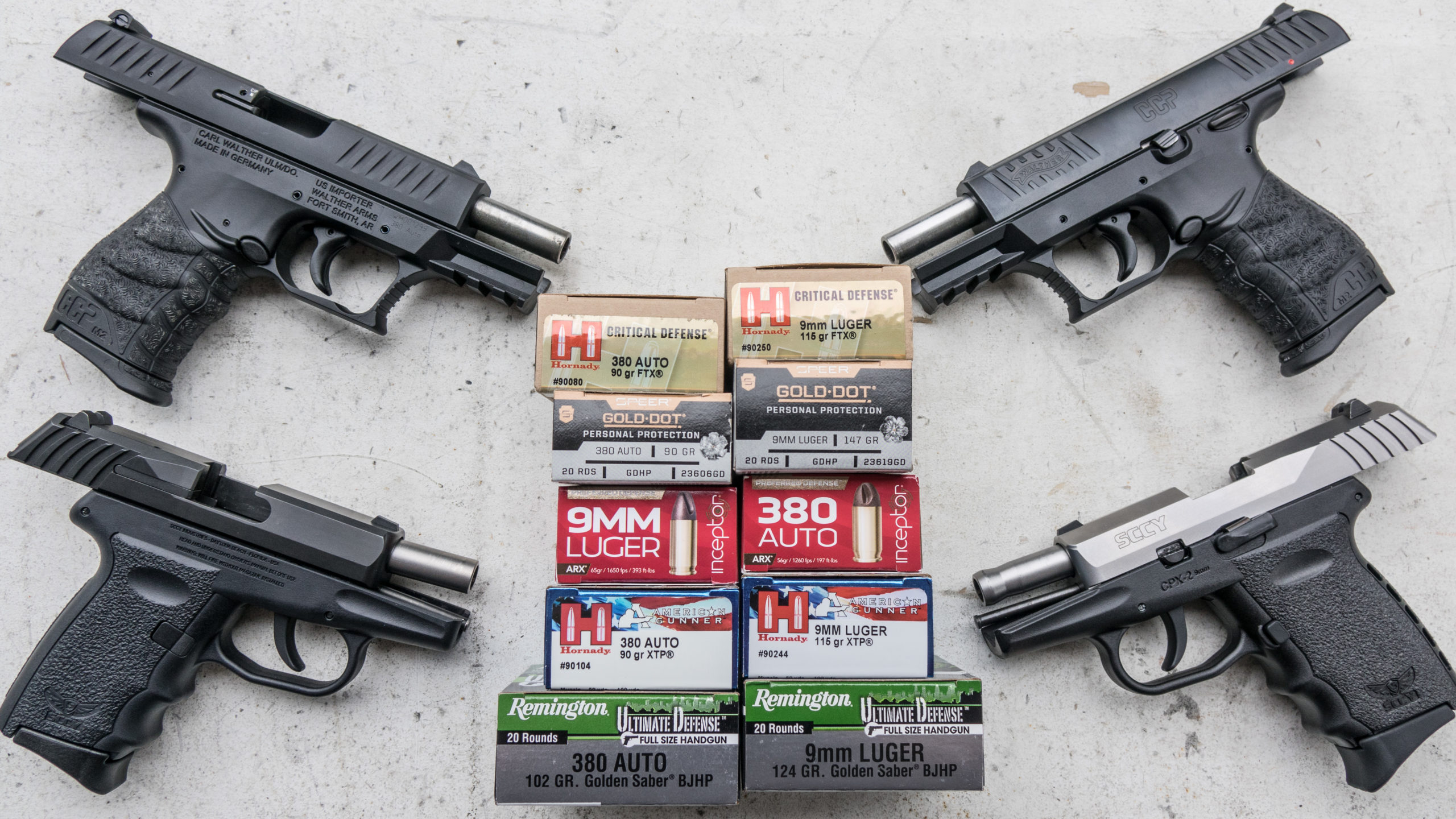
To test this is not as easily done as one might expect. Sure, there are hundreds of handguns out there chambered in either caliber, but few true pairs. To test not only for muzzle energy but also for perceived recoil and handling we needed to find a true pair of pistols. The same locking mechanism, barrel length, grip size, and operator mechanics. Furthermore, we needed to test ammunition that was intended to have similar performance in each caliber.
9mm v. 380 ACP Ammunition
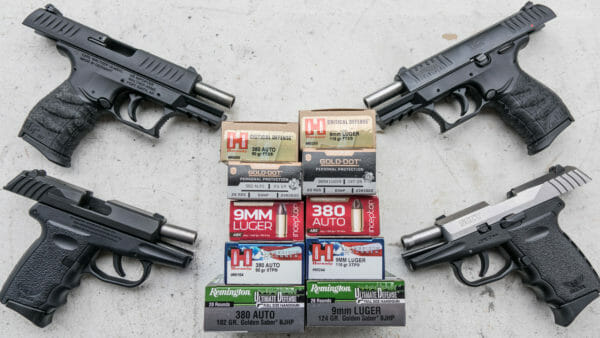
Fortunately, both SCCY and Walther have handguns that meet the criteria in the SCCY CPX-2 and CPX-3 and Walther CCP in .380 and 9mm. Not only were did these two pairs meet the above criteria, but Walther’s roughly half inch-longer longer barrel provided us a chance to see what speed could be gained and in turn how much extra muzzle energy. This was particularly interesting with .380 ACP as the caliber is generally relegated to smaller direct-blowback pistols. The next step proved particularly challenging in a market that is enduring its now fourth in a row month of ammo panic buying, finding matching pairs of defensive ammunition instock. The ammunition found for this test is listed below with their advertised and measured muzzle velocities. All calculations were from an average of five shots through a Caldwell Ballistic Chronograph.
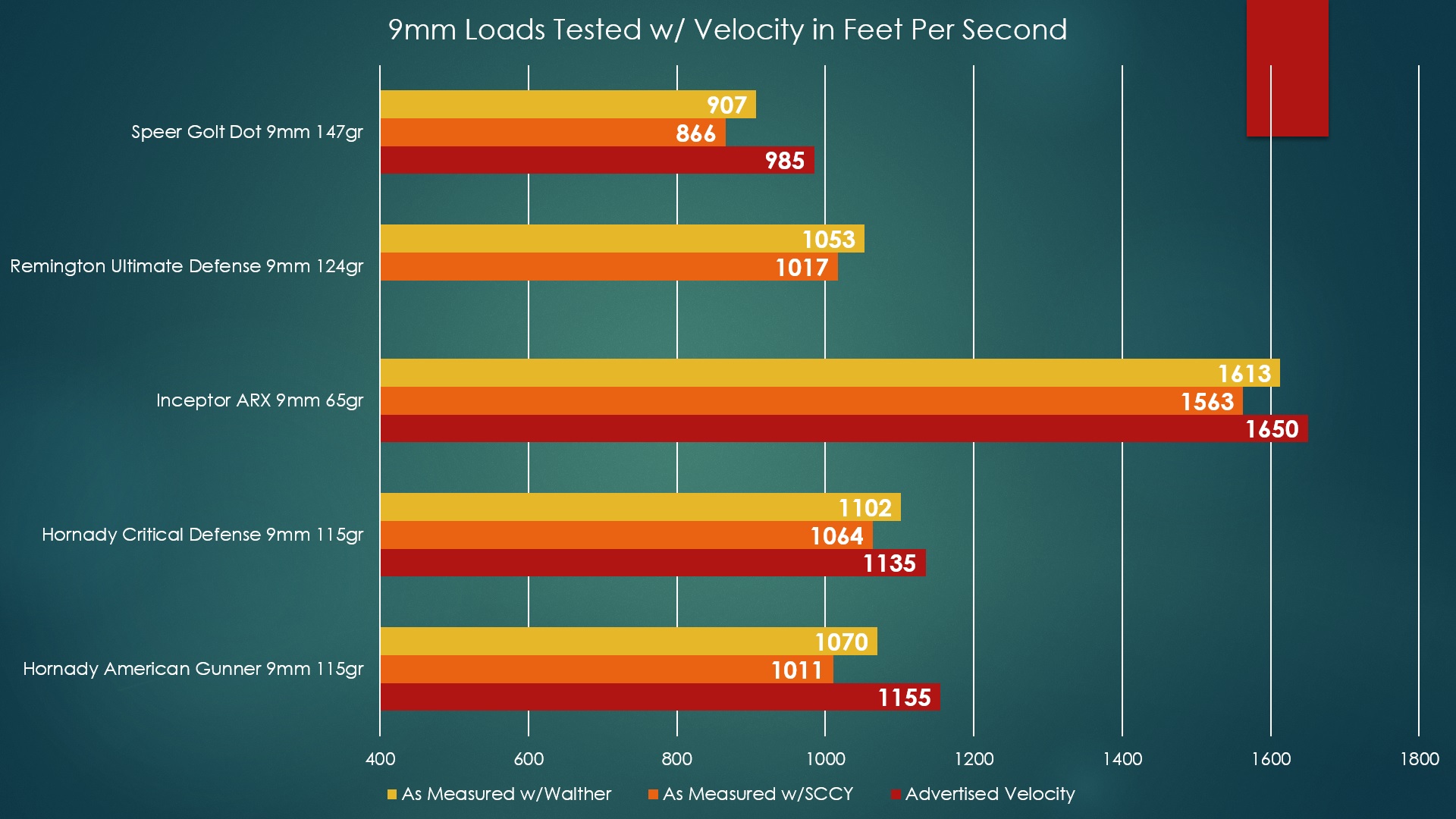
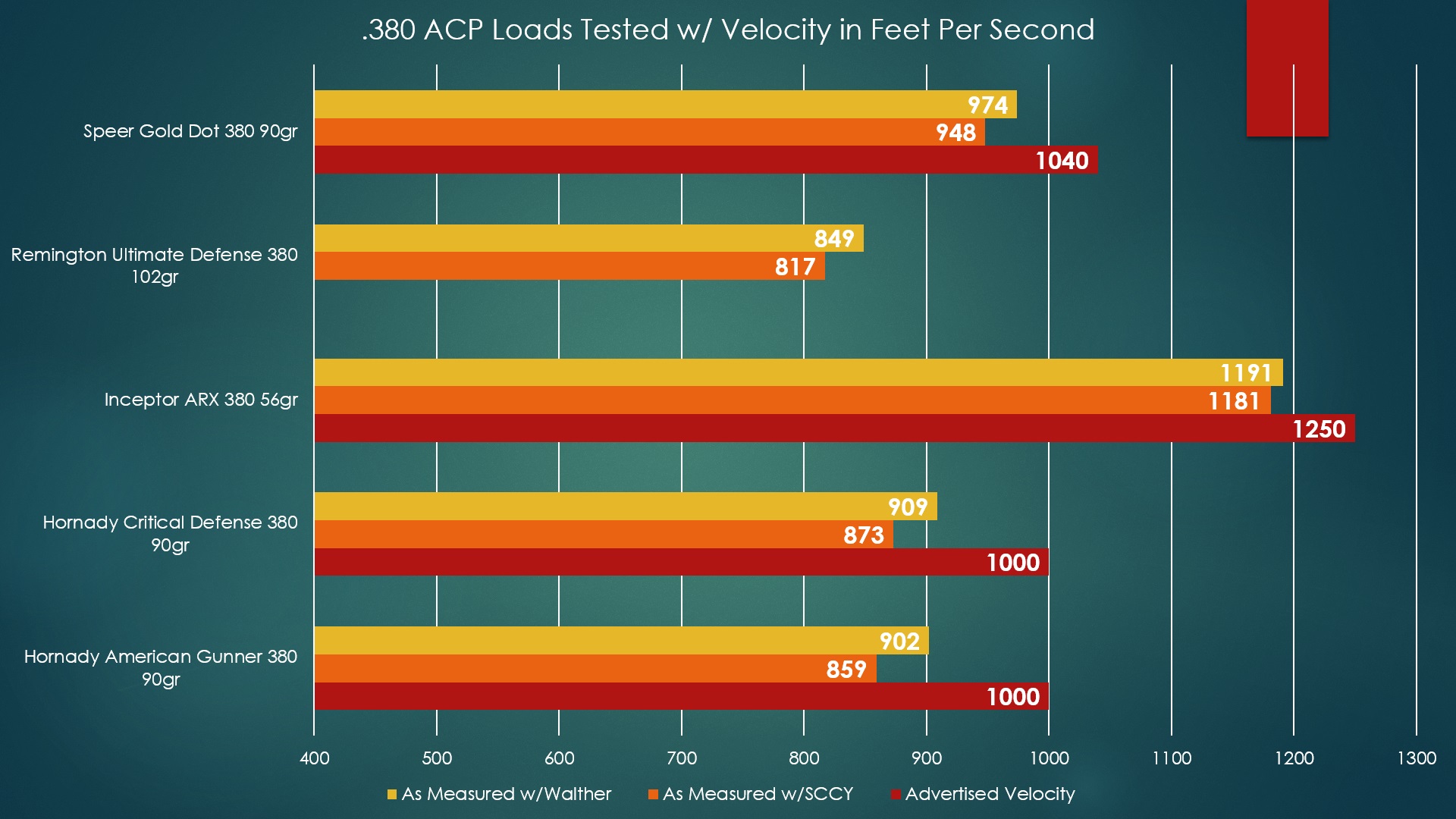
We’ve come to expect advertised ammunition velocities to not match the end-user experience. Barrel length, rifling type, operating system, and even ambient temperature and atmospheric pressures can cause one velocity test to have different results than another. Fortunately, we were able to eliminate most of those variables by shooting paired firearms and conducting all ammunition testing on the same day.
So what do those velocities mean? We used the classic calculation of:
Muzzle Energy in Foot Pounds = 0.5 x Projectile Mass x Projectile Velocity squared / 1000
This tells us how much energy the bullet has when it leaves the barrel. In our test of 9mm v. 380 ACP the Caldwell chronograph was placed ten feet in front of the muzzle so as to represent how hard the bullet would strike a target at that distance. The results were very interesting and show us not only how much more energy is to be gained with 9mm over .380 ACP, but also what the difference between a 3.1″ and 3.54″ barrel can make with these particular loads.
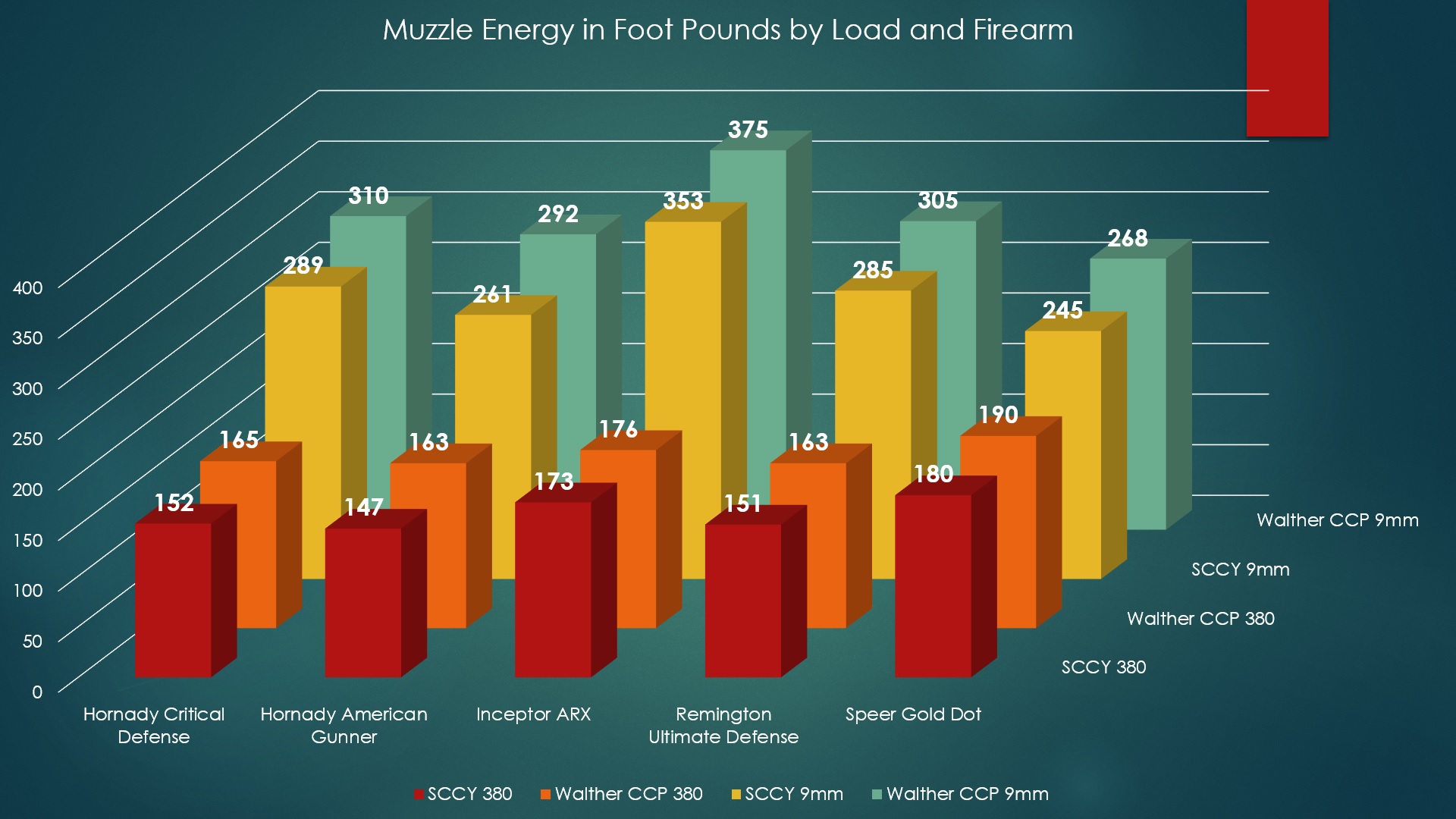
That’s a lot to digest so we’ll break it download by load:
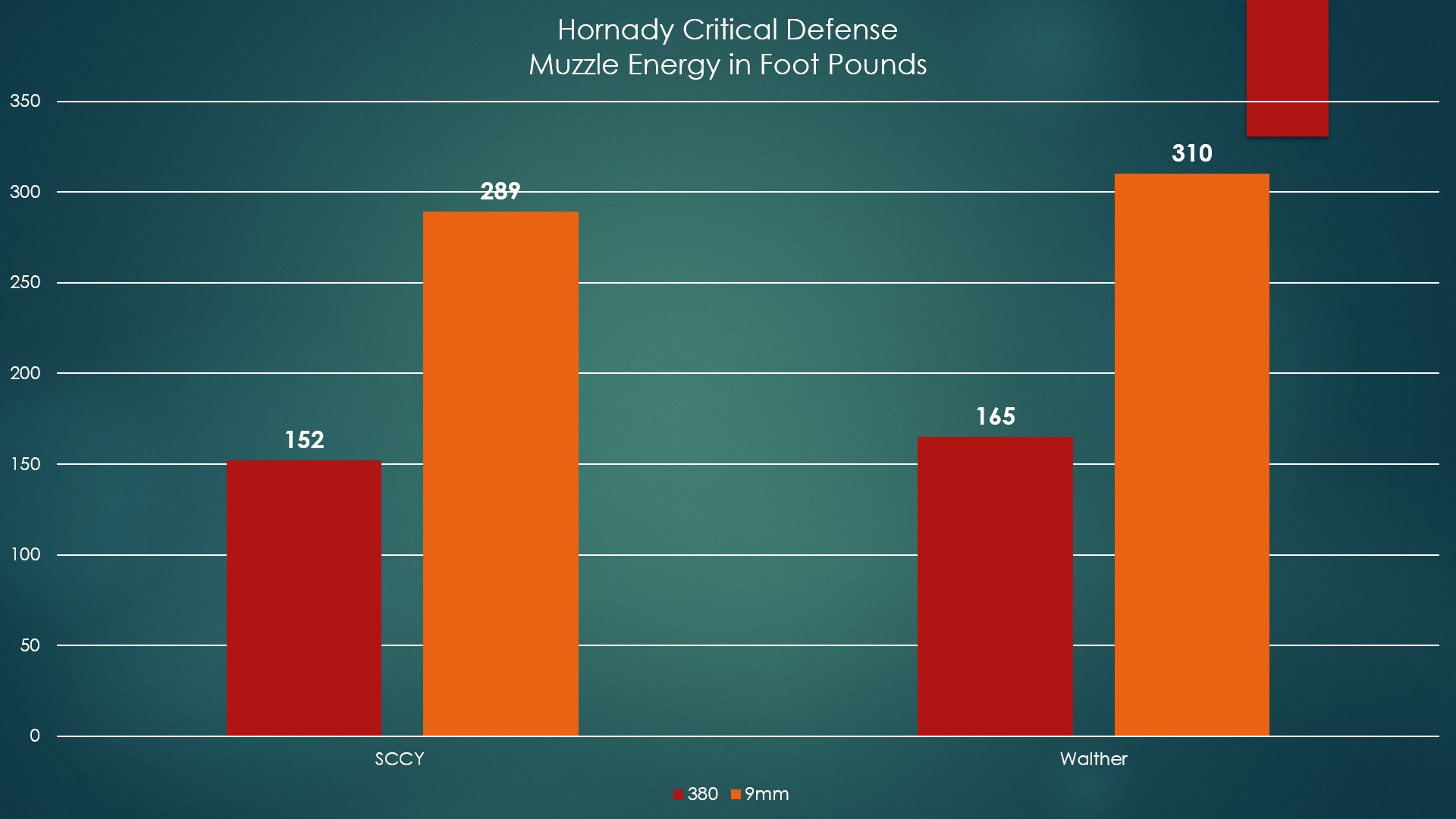
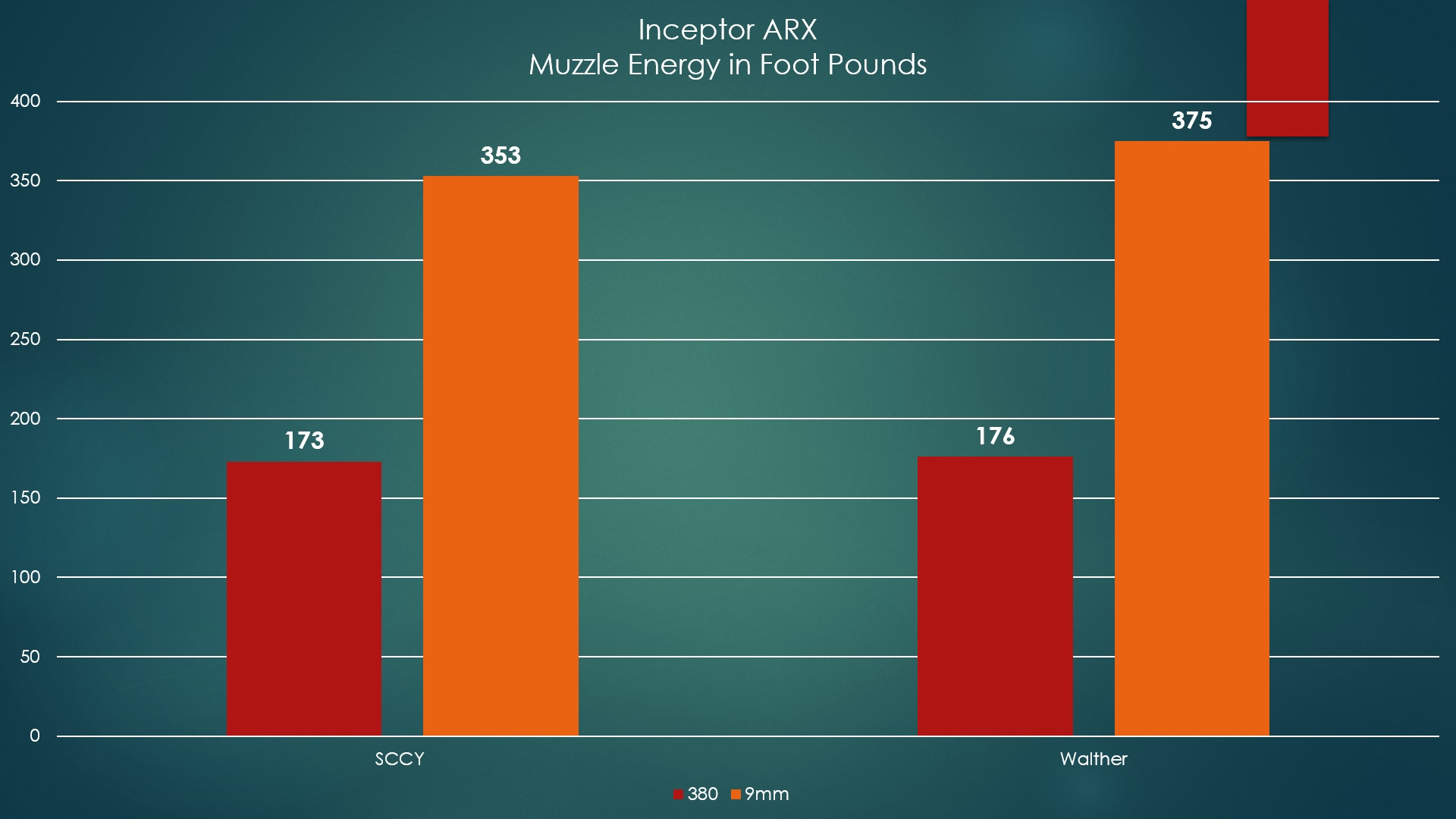
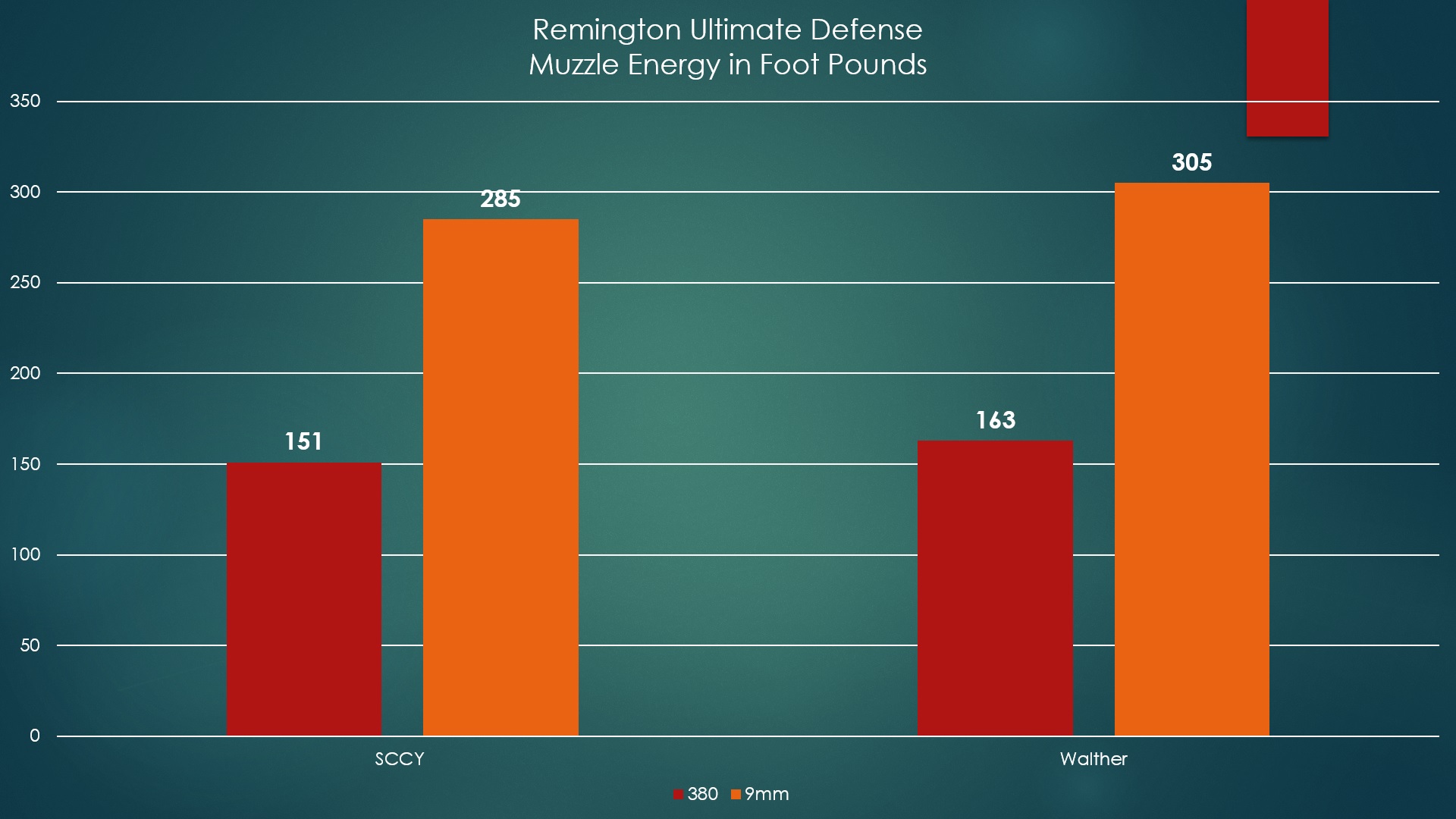

The debate over which 9mm v. 380 caliber provides more energy was settled long ago, but to answer one of our original questions as to how much more: that depends on the load and the barrel length. The difference between .380 ACP and 9mm was as little as 65 ft-lbs or as much as 199 ft-lbs with an average across the ten combinations tested of 129 ft-lbs. To put that in perspective that’s nearly as much energy as a single shot of .380 ACP Hornady American Gunner through SCCY’s 3.1″ barrel; effectively equating a hotter 9mm load to a second shot of softer .380. Some crime statistics show us that bullet size matters in lethality while others do not. They are probably both right as statistics are easily manipulated, so what about shoot-ability?
Generally speaking pistols in .380 tend to be smaller because they can be. The round produces less energy and lends well to the simplicity and compactness of direct blowback operations. Our test used a locked-breech mechanism and so it was larger than most 380 pistols, resembling 9mm pistols in size. Regardless, in the footage at the top, you will see both the heaviest and lightest-recoiling loads fired by an experienced shooter of smaller stature and hand size and give her opinion on the control-ability of one round versus the other.
So what have we learned in the 9mm v. 380 debate?
The energy difference in 9mm v. 380 ACP, in general, is considerable. What could not be measured is the real-world terminal performance of these rounds (no volunteers were found). Variables of their effectiveness would include shot placement and the target’s mental and physical resistance to wounds sustained. For ammunition, the largest variable that keeps this argument alive for some will come from the combination of powder burn rate and barrel length as it certainly can make a difference. Finding those pairings, however, would more likely be an exception than the rule. We also discovered that it seems ammunition manufacturers either can’t or haven’t loaded Browning’s baby, .45 ACP, to take advantage of longer barrels the way 9mm can. In most tests, I’ve seen 9mm doesn’t top out on speed until somewhere around the 10″ barrel length. That being said the SCCY’s 3.1″ and Walther’s 3.54″ barrels aren’t exceptionally long, but our data seems to indicate that the loads tested weren’t going to get much more out of anything longer than 3″.
9mm is certainly more powerful than .380 ACP, but that doesn’t mean that 380 isn’t powerful enough, especially if you can shoot better with a .380. I foresee this debate to be continued.
About Graham Baates
“Graham Baates” is a pen name used by a 15-year active Army veteran who spent most of his time in the tactical side of the Intelligence community including tours in Afghanistan and Iraq. Post-Army Graham spent some time in the local 3-Gun circuit before becoming a full-time NRA Certified defensive handgun instructor and now works as an industry writer while curating a YouTube channel on the side. Visit Graham on Youtube.

What matters is where the hole is — not how big it is. A .22-caliber hole in the assailant is far more effective than a .45-caliber hole in in the neighbor’s house behind the assailant. Carry what you can shoot well — no more, no less.
I carry both, 380 in front pocket and 9mm IWB. The 380 is always with me, and the 9mm is a lot also. Once in awhile I carry my 45, carry what you like.
Good data but nothing earth shattering. 9mm is more powerful than .380. The end.
carry what suits ya as long as you actually carry
Each has its place, but isn’t comparing the 380 to a 9mm like comparing a 22 lr to a 22 short?
I wouldn’t want to get shot with any of them.
What it shows, is that John Browning was very Conservative when it came to Cartridge Development. He didn’t push pressures simply because he was designing strictly for simple Blowback systems. This is why the Small Three, .25, .32, and .380 ACP’s are rather wimpy in comparison to the 9 x 19 Luger. Why Browning didn’t consider other system types, was probably due to efforts at cost control (the simpler you can make it the cheaper you can sell it). I’ve always found it interesting that though the fans of the 1911 consider it the peak of his genius, yet his… Read more »
For my money it’s 9 mm,everytime however you are welcome to chose and carry what ever you perfer.
I far prefer 9mm for power, and bullet weight.BUT, for pocket carry were it’s a 100*+ every day OWB’s and IWB holsters are just a PITA,because of weight/ being concealable.(printing)
Latest stats on one shot sops between the two(Torso COM hits),show not much difference between the two.So, I do not like carrying a .380, but given the climate and comfort, I have no choice.
We have open carry, but the LE will be all over you if you Open carry even while it’s legal.I don;t need the hassle of arguing with Cops.(it seems they don’t know the laws)
Probably the single biggest eye opener for me – something that runs entirely counter to what you might intuitively suppose – in the ongoing adventure of learning to custom load my own ammo, was very well documented on video by a certain “ShootingTheBull410” channel over on YouTube, who did an excellent “Ammo Quest 9mm” series. What was different from the norm was his perspective, being specifically from the point of using subcompact / micro 9mm handguns with little 3 inch barrels, such as many people prefer to more easily carry concealed. Shorter barrels tend to net lower velocities, so he… Read more »
Follow up shots maybe be needed. Choose a caliber and ammo you can control for this.
Come on guys, when you’re using graphs to compare make sure they’re the same scale. The velocity graphs make it look like the .380 is the same as the 9mm, if not faster. I’m curious how the Makarov 9x18mm compares, I have a P-64 and it kicks a lot harder than my S&W M&P Shield Performance Center 9mm