
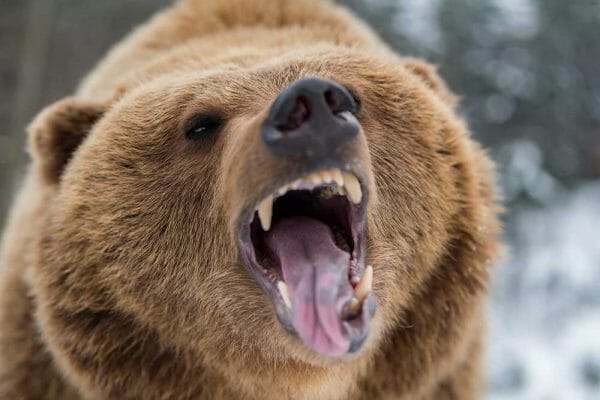
U.S.A. –-(AmmoLand.com)- The information about this incident was found in response to a Freedom of Information Act (FOIA) request. This correspondent has not found any other media coverage.
The incident is confirmed by the investigation noted in the Interagency Grizzly Bear Study Team report for 2016, Table 16, incident 201414. In the report, the sow bear was counted as probable mortality.
On 9 September 2014, a bow hunter was calling and stalking elk in Montana. He was in the Gallatin National Forest, up Indian Creek, in the vicinity of Shedhorn Ridge, at dusk. The hunter was about three miles, as the crow flies, from their hunting camp. He was in the North West quarter of section 11, in Range 2E, Township 9S. It is a remote area. There is no cell phone coverage.

The hunter was on an upper elevation bench with a rock face on one side and a tree line on the other. A prominent game trail led to the area.
The hunter spotted a bull elk and moved closer. As he was stalking, he heard some brush move. He came to a full draw with the bow and blew on his cow elk call a couple of times. He saw some movement in the brush about 35 to 40 yards away. He blew the cow call one more time. A bear erupted from the brush, into the open, and stood on its hind legs.
The bowhunter yelled at the bear. Instead of running, the bear dropped to all fours and charged at the hunter. The bowhunter loosed his shaft at the charging bear, aiming for the chest when the bear had come within 20 yards. The arrow struck the bear in the skull, on the snout. The arrow impact caused the bear to veer to the side, then retreat.
The bowhunter had a defensive firearm holstered, with him, a .40 caliber Taurus 24/7. He dropped the bow and drew the pistol, chambered a round, and fired about five shots at the wounded bear as it fled with a yearling cub of the previous year. The cub was estimated to weigh about 130 – 140 lbs. The hunter believed he heard bear noises from what was probably a second yearling cub in the brush.

In a few seconds, the sow charged out of the trees again, with a cub following her.
The bowhunter noticed the arrow had been broken off. He estimated the arrow had penetrated about 3 inches.
As the bear charged at him for the second time, the bow hunter fired his .40 caliber Taurus, hitting the bear in the chest with the first shot, at about 20- 25 yards.
This disrupted the charge as the bear spun in reaction to the shot. The hunter fired again as the bear spun. He believing he hit the bear with the second shot.
The bear continued to close the distance, as the bowhunter fired several more rounds, emptying the magazine on the Taurus. He believed he had hit the bear 3-4 more times, with the subsequent shots from 15-20 yards.
When he had emptied the magazine, the bear was still alive but stopped. As he retrieved his bow, to nock another arrow, the bear got up and fled out of sight, over the hill.
The Taurus 24/7 .40 caliber has a standard magazine capacity of 15 rounds. As the hunter stated he “chambered a round”, he probably had 15 or fewer rounds in the magazine before he started firing. Information about the ammunition used was not included in the FOIA response.
On 10 September the attacked hunter was able to make a call with a satellite phone to report the bear attack and subsequent events to Montana Fish, Wildlife, and Parks (FWP).
A Montana Fish, Wildlife, and Parks Sgt contacted the US Fish and Wildlife Service (F&W). A plan was developed to travel to the area and investigate the incident on 14 September 2014. There was a party of four, two Montana FWP wardens, the US F&W Service Special Agent, and a US Forest Service Officer. They traveled by horseback to reach the remote area. They were able to reach the hunting camp at about 2 p.m.
When the hunter was interviewed, the officers learned he had experienced several false charges in different encounters, in different areas.
He believed this was not a false charge. He thought the bear might have mistaken him for an elk the first time it charged, but the second time was in retaliation. He believed the bear was going to kill him, or he would succeed in killing the bear. He was sure the sow was a grizzly and that it was about 300 to 350 pounds. The arrow he had used was described as an Easton Torch, tipped with an Ulmer edge broadhead.
The hunter described the area where the incident had occurred. The bear had emerged from a stand of small spruce which was about 16-18 feet tall. He did not believe bear spray would have helped. He was hunting alone, miles from any help, with no working communication devices. He had intended to spend the night in the hunting area. The area where the incident occurred was about 3 miles away from the camp, as the crow flies.
With the information they learned, the officers decided not to go looking for the bear at the incident site. They decided it was too dangerous to do so, as they did not know if the sow had been killed. A large boar grizzly was known to be in the area and had recently been able to shed its radio-tracking collar.
The combination of a possibly wounded sow, two large cubs of the former year, and a large boar grizzly in the area made the effort to investigate too dangerous to go to the incident location.
They believed the dangers outweighed any benefit from doing so.
About Dean Weingarten:
Dean Weingarten has been a peace officer, a military officer, was on the University of Wisconsin Pistol Team for four years, and was first certified to teach firearms safety in 1973. He taught the Arizona concealed carry course for fifteen years until the goal of Constitutional Carry was attained. He has degrees in meteorology and mining engineering, and retired from the Department of Defense after a 30 year career in Army Research, Development, Testing, and Evaluation.
With a team of four armed professionals, law enforcement decided it was too dangerous to risk encountering a bear. Yet somehow we mere mortals are supposed to feel safe going where law enforcement fears to tread, with just a can of seasoning sauce for protection.
Handguns over time have been proven to be very effective in saving ones life.
He dropped the bow and drew the pistol, chambered a round. TSK TSK TSK
You
re supposed to drop to all fours and speak softly to the bear while petting its nose. (actual liberals advice) I have not heard any first hand account of how well this works. We need more liberal studies.It would be great if law enforcement officials would document the ammo used. It’s not a minor detail. They noted the arrow and broadhead, but not the ammo for the gun. It sounds like the hunter was quite knowledgeable and likely had some proper stuff in his gun, but it would be nice to know.
I do not think I would trust my life to a taurus. I have had to much trouble with them. RUGER 454 CASULL REDHAWK. Colt 45-6 gun or a Big smith, IMO the least I would go in the bush with
I carry to protect myself from two-legged predators. I’ve been robbed before, and they strike from a much closer distance than this bear. There isn’t enough time to chamber a round, especially if you’re in a situation where only one hand is available. However, it’s your life, carry as you choose. “I’d rather have pockets full of rocks than an unloaded gun.” – Frank “Pistol Pete” Eaton
I have found that ones person success one time.
Doesn’t always make it a good idea all the time.
And yes I have shot several bears with a handgun. Carried one more then 50 years. In dangerous circumstances.
I am a firm believer in carrying with a round in the chamber.
To those who are upset that he’s carrying is Railey style empty chamber and has to rack the gun.
He was able to stop a bear attack with 15 rounds in the magazine.
he used to hand select the slide, and did not fumble the process
So, you can complain all you want that he’s not carrying with your preferred carry style.
he was able to stop a bear attack with a pistol and a bow.
While you armchair commandos have not done anything.
i’m going to copy this guy and continue to carry empty chamber.