
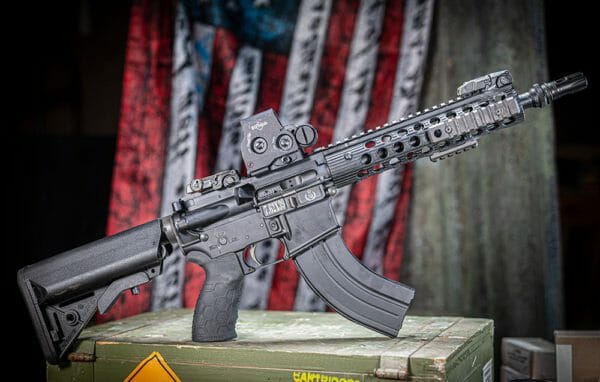
A facial challenge to the federal requirement for registration and paying a tax in order to possess short-barreled rifles has made its way to the Supreme Court. A facial challenge is a direct challenge to the statute, claiming the statute itself is unconstitutional.
The case of Jamond M. Rush v. United States started in February 2022 in the Southern District of Illinois. Rush was charged with being a felon in possession of a firearm, an Anderson Manufacturing AR-15 .223 rifle. The court suppressed the original charge.
A superseding indictment, substituting a new charge for the old charge, was issued on August 16, 2022. The latest indictment was for the possession of an unregistered firearm, under the National Firearms Act (NFA), presumably for the same Anderson Arms AR-15 type rifle with a 7.5″ barrel.
Rush entered a conditional guilty plea to possessing the rifle under the National Firearms Act (NFA), with the proviso that the case could be appealed on the basis of the law being unconstitutional under the Second Amendment and the Bruen decision. The Seventh Circuit upheld the Circuit Court decision, primarily using the 1934 Miller case, which failed to find the 1934 National Firearms Act unconstitutional. For many reasons, Miller was not a clear statement on the Second Amendment and had many flaws.
Rush then asked the Supreme Court to grant a writ of certiorari, which would allow the case to be appealed before the Supreme Court. On June 13, 2025, writing for the United States Government, the US Solicitor General, D. John Sauer, waived its right to file a response to the petition for a writ of certiorari.
On July 31, 2025, the Supreme Court requested (ordered) the US Government to file a response to the petition. Mark W. Smith, the noted AmmoLand contributor, attorney, expert on Second Amendment law, and popular commentator on his YouTube channel, the Four Boxes Dinner, notes this shows a significant interest in the case by the Supreme Court. The United States Department of Justice has submitted this statement in the Peterson case in the Fifth Circuit, as footnote 9 on page 8:
Because ordinary firearms, unlike suppressors, are not peculiarly susceptible of criminal misuse, registration laws or taxes targeting such firearms likely would not serve or be proportionate to any legitimate public-safety purpose. See, e.g., Heller v. District of Columbia, 670 F.3d 1244, 1291 (D.C. Cir. 2011) (Kavanaugh, J., dissenting) (“requir[ing] registration of individual guns” generally does not serve any legitimate purpose and is usually “aimed at deterring gun ownership”). In addition, a law regulating or taxing the firearm itself would impose a more severe burden on the right to keep and bear arms than regulations on useful but non-essential accessories such as suppressors.
Apply this statement to the Rush case, and it could influence the Supreme Court to grant a writ of certiorari (take the case on appeal).
The case is a straightforward possession case against the registration and tax requirements of the NFA. The federal government has recently reduced the tax requirement to zero, going into effect on January 1, 2026. The question may devolve as to whether registration of firearms, by the federal government, commonly possessed for lawful purposes, is allowable under the Second Amendment. There is no historical precedent in the law which shows registration of firearms was commonly required in the founding era.
Over a million short-barreled firearms are already registered in the United States under the NFA. Nearly 900,00 are rifles. That should easily be sufficient to indicate common use for lawful purposes.
Supreme Court justices read the news and listen to the political debate. They know short-barreled firearms only remain in the National Firearms Act because the Senate Parliamentarian ruled they could not be removed as part of the reconciliation bill.
It will be very interesting to see how the DOJ responds to the Supreme Court’s request (order). The DOJ has until September 2nd to submit its reply.
About Dean Weingarten:
Dean Weingarten has been a peace officer, a military officer, was on the University of Wisconsin Pistol Team for four years, and was first certified to teach firearms safety in 1973. He taught the Arizona concealed carry course for fifteen years until the goal of Constitutional Carry was attained. He has degrees in meteorology and mining engineering, and retired from the Department of Defense after a 30 year career in Army Research, Development, Testing, and Evaluation.




Machine guns, SBR’s, and suppressors are all in common use, owned in excess of the 240,000 limit set in Caetano for stun guns in common use, so all must be removed from the NFA, which applies to DANGEROUS AND UNUSUAL weapons. Besides, NFA is unconstitutional garbage.
I have more faith in gas station sushi than I do the DOJ to do “the right thing” here. Especially when it comes to unconstitutional “taxes” levied on a right backed by our founding documents.
I have very little faith that the DOJ and SCrOTUS are going to do anything 2A positive when it comes to the NFA.
The NFA is unconstitutional. ANY infringements on the second amendment is/are unconstitutional. Every free, un incarserated, American citizen has the right to keep and bear arms per the constitution. Wither or not the SCOTUS or the Justice department has the testicular or mamory fortitude to live up to the constitution and their oath to defend it remains to be seen. That being said, we have seen improvements over the past 7 months. We still have a long way to go. When people would tell my grandmother, that, “They will be back”, she would always answer them, “I’ll see you when… Read more »
F DoJ. F SCROTUS.
SCOTUS will kick the can down the road or to someone else.
A USDOJ responce to Rush’s petition would be a perfect opportunity for main justice to express that they think the NFA is unconstitutional and a fraud on the American people from the very beginning. This will be interesting to follow.
A request for a response is not a court order. The government can refuse to file a response to the request, and there is nothing SCOTUS can or will do about it.
This is absolutely false from Dean Weingarten, “Supreme Court justices read the news and listen to the political debate. They know short-barreled firearms only remain in the National Firearms Act because the Senate Parliamentarian ruled they could not be removed as part of the reconciliation bill.” The Senate Parliamentarian is an advisory position. The Senate Majority Leader does NOT have to listen to the advice. And the Parliamentarian serves at the pleasure of the Senate Majority Leader, meaning John Thune (R) can fire her whenever he wants, for any reason he wants. But instead, Thune not only chose NOT to fire her,… Read more »
And given the make up of the Supreme Court, what if they rule the WRONG way, should they take up the case?….