
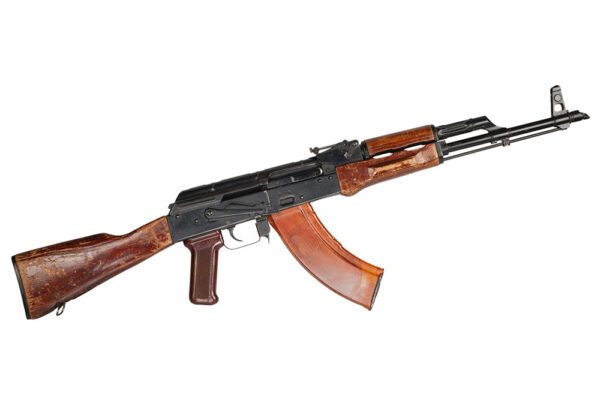
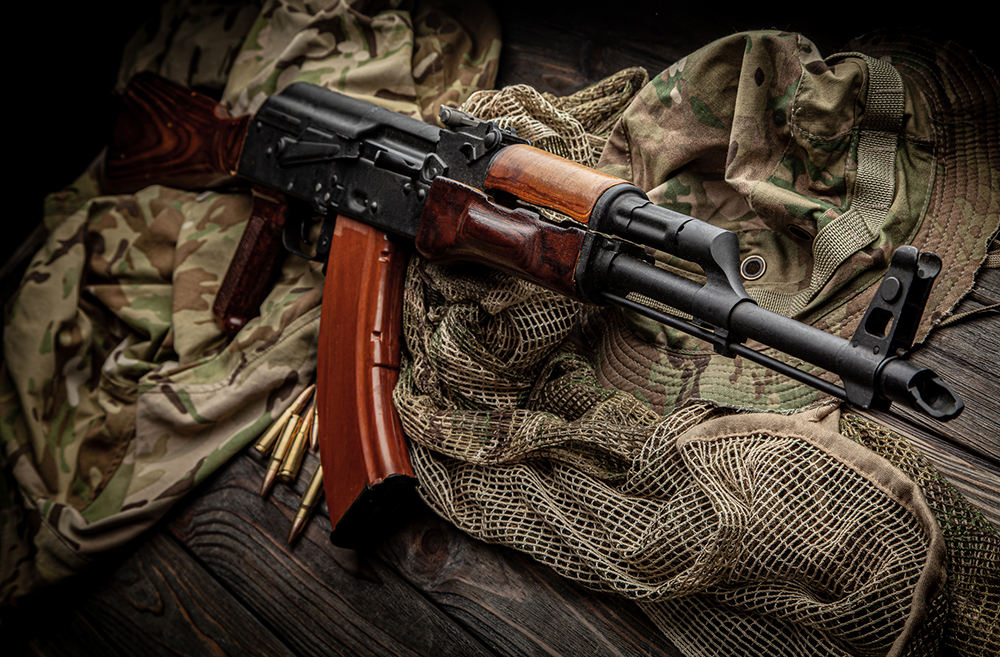
Firearms that have reshaped history share a common trait—they solved a problem. Whether it was the need for a more powerful cartridge, faster production, increased reliability, or easier field maintenance, these guns aimed to be the pinnacle of their design. Among them, one rifle stands out as the most widespread, recognizable, and culturally significant: the AK-47.
But how did this rifle transform 20th-century warfare, and why does it remain relevant today?
Live Inventory Price Checker
|
|
PSA AK-47 GF3 Classic Forged Rifle with Shark Fin and Cheese Grater Upper Hand Guard Rifle, Redwood | Palmetto State Armory | $ 849.99 |
|
|
|
PSA AK-47 GF3 Forged Classic Polymer Rifle, Black | Palmetto State Armory | $ 749.99 |
|
|
|
PSA AK-47 GF3 Forged "MOEkov" Rifle, ODG | Palmetto State Armory | $ 759.99 |
|
|
|
PSA AK-47 GF3 Forged "MOEkov" Rifle, Plum | Palmetto State Armory | $ 779.99 |
|
A Rifle Born from War
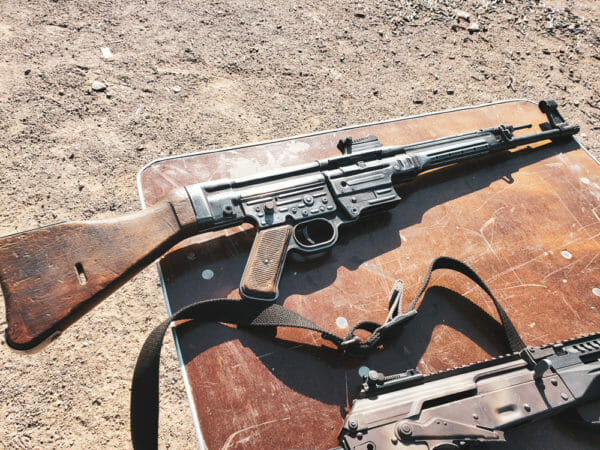
The story of the AK-47 begins with two pivotal moments in World War II. The first was the introduction of the first truly successful “assault rifle,” the Sturmgewehr 44 (StG 44). Before its development, German infantry carried a mix of bolt-action rifles and submachine guns—each effective in its role, but neither ideal for modern combat. Full-power rifles offered range and velocity but were slow and often overpowered for typical engagement distances. Submachine guns gave mobility and fire rate but lacked accuracy and range. The German solution combined an intermediate cartridge (7.92×33mm Kurz) with a select-fire rifle, allowing controllable automatic fire at practical range.
The Germans produced the StG 44, and the Soviets captured examples during and after the war. These rifles showed them the potential of the intermediate-cartridge concept, prompting development of their own version.
The second key moment occurred on the Soviet side. Mikhail Kalashnikov, a young tank commander, was wounded during the German invasion in 1941. During recovery, he focused on improving the small arms issued to Soviet troops. Kalashnikov was part of a broader Soviet design system, but he distinguished himself by prioritizing function over refinement. He aimed for a rifle that was simple, reliable, easy to manufacture, and chambered in an intermediate cartridge.
The Soviet-designed 7.62x39mm cartridge, first used in the SKS carbine and RPD light machine gun, proved ideal. It balanced recoil, range, and reliability in a select-fire platform. After years of development and trials against competing designs, Kalashnikov’s rifle was selected.
Officially introduced in 1947 as the Avtomat Kalashnikova, it simply became known as the AK-47.
Built to Work
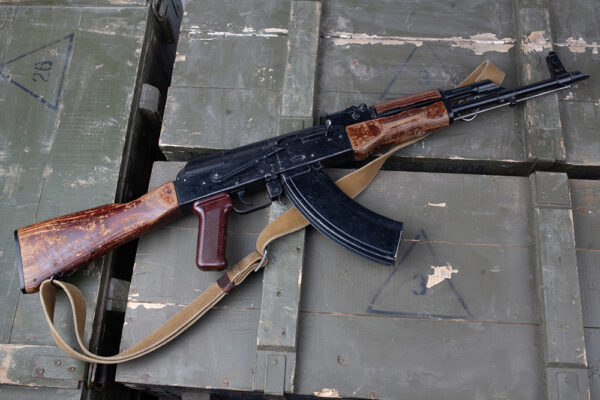
The qualities that set the AK-47 apart then are the same that drive its global dominance today. Kalashnikov’s philosophy emphasized simplicity and durability. Using a long-stroke gas piston with generous internal clearances, the AK-47 runs reliably under extreme conditions. Dirt, debris, fouling, water, or mud—where finely machined rifles might fail, the AK continues to function. It does not rely on ideal conditions or meticulous maintenance. When maintenance is needed, the rifle field-strips into just eight core components. Soldiers can do this without tools, and even an inexperienced user can learn quickly. The AK demands little from its operator—and that’s exactly why it works.
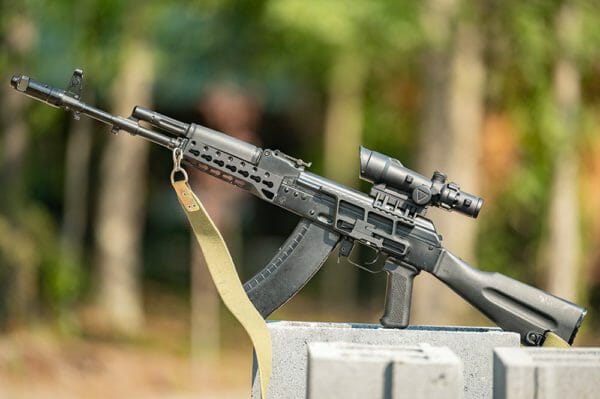
Early production models of the AK-47 had milled receivers. Later evolutions, like the AKM and AK-74, switched to stamped receivers. This change lowered cost and simplified mass production without sacrificing reliability.
Cold War Icon
World War II gave birth to the AK-47, but the Cold War elevated it to global prominence. The Soviet Union and its allies saw widespread armament as essential. The AK-47 proved ideal. Millions were produced and distributed to communist allies, including China, North Korea, and Warsaw Pact nations. The Soviets shared manufacturing specifications, allowing these countries to produce their own variants. Its simple design let even nations with limited industrial capacity manufacture AK-pattern rifles, fueling massive proliferation.
The Vietnam War further cemented the AK-47’s reputation. U.S. forces carried the M16 rifle, which initially struggled in the harsh jungle. It required consistent cleaning and maintenance. In contrast, AK-47s kept functioning with minimal upkeep. That contrast reinforced the AK’s legendary reliability.

Global Spread and Symbolism
In later decades, the AK continued to spread. During the Soviet-Afghan War, both sides used the rifle. After the Soviet Union collapsed, massive stockpiles of arms—many of which were AKs—were lost, sold, or redistributed. These rifles flowed into Africa, the Middle East, and Southeast Asia, adopted by militaries, militias, and insurgent groups. Over time, the AK-47 became more than a weapon—it became a symbol of revolution, even appearing on Mozambique’s national flag.
Perfectly Imperfect
The AK-47 remains one of the most relevant firearm designs in the world. Modern platforms like the AR-15 excel in accuracy, modularity, and ergonomics, but the AK’s core principles endure. With over 100 million rifles and variants produced, it still sees active use worldwide.
The AK prioritizes reliability and ease of manufacturing over precision. It wasn’t designed to be perfect—it was designed to work, and to keep working under harsh conditions. That mindset still shapes modern firearms, especially military and defensive rifles where durability and simplicity are benchmarks. The AK-47 didn’t just change how rifles were used—it changed how they were built.
For the modern shooter, the AK-47 is both a historical artifact and a practical tool. Its unmistakable profile, mechanical simplicity, and legendary reliability make it one of the most recognizable and widely used rifles ever created. Even today, it’s what many picture when they think of a rifle. The AK-47 didn’t become the most widespread rifle because it was the most advanced—it did so because it was the most practical. Decades later, that practicality is exactly why it still matters.

About Ryan Hodges
Ryan is an outdoorsman and firearms enthusiast with over a decade of experience in the industry. He holds a B.A. in History with a concentration in Public History from Roanoke College and was an intern at the Cody Firearms Museum in Cody, Wyoming where he contributed to exhibit development and public education initiatives. He later worked with Taylor’s & Co. in Winchester, Virginia for 9 years, building expertise in historical and reproduction firearms.
An avid hunter and shooter based in Northern Virginia and the West Virginia panhandle, Ryan has a deep appreciation for the intersection of history, firearms, and the natural world. His primary area of focus is 19th-century American firearms, particularly those used during the Civil War and the era of westward expansion. Through his writing, he aims to educate and engage readers by connecting the historical significance of firearms with their enduring legacy in the field today.




Well, they do run. They are reliable. The newer ones are decently accurate even with the sights they have. They do recoil more than needed because they are over gassed. Scope mounts are available for them. These days they come in many calibers. It is a good platform for what it was designed to do. Most of the time they would just stick them out the ports of a BTR-60P and hose things down as they went by. On the ground they are heavy, the ammo is heavy. If you ever get to watch a slow mo of one being… Read more »
I can appreciate the merits of the AK design. I just hate that they are so expensive now, combined with the higher cost of Russian ammo, thanks to OBiden.
Bear Creek Arsenal, which makes the cheapest ARs on the market, just introduced their new AKs. Their ARs start at $349, but their AKs start at $899 – over 2.5x the price of the AR!
The German STG-44 was designed with constant recoil to be very accurate on full auto. The Russians dropped the ball on this with the AK.The AK was a well developed and thought out assault rifle for it’s day. It is still the most rugged, simplistic assault rifle to this day. That said, it is not perfect and will lose to the AR platform in mud test, accuracy test and suppressor adaptability. The AK is not modular like the AR and is hamstrung by its 1940’s stamp receiver/ design. The AK (will) malfunction if not maintained. When captured AK”s were examined… Read more »
Yawn
Frankly, AK’s are quite ugly in appearance. But leave this country in any direction and these rifles are everywhere!
Having fired the AK47 while on active duty, we found them to be reliable, easy to maintain and accurate out to 200 and 300 yards.
It’s so easy, a chimp can operate one.
Bing Videos