
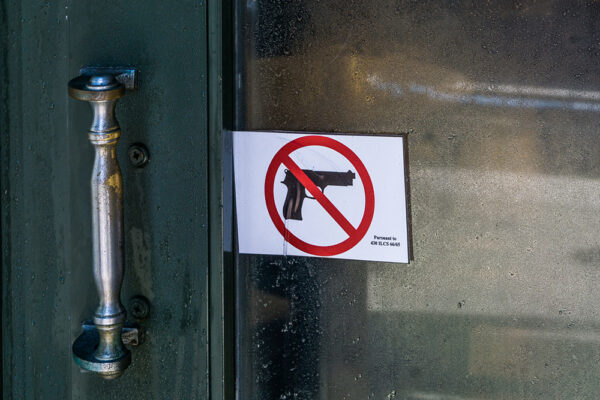
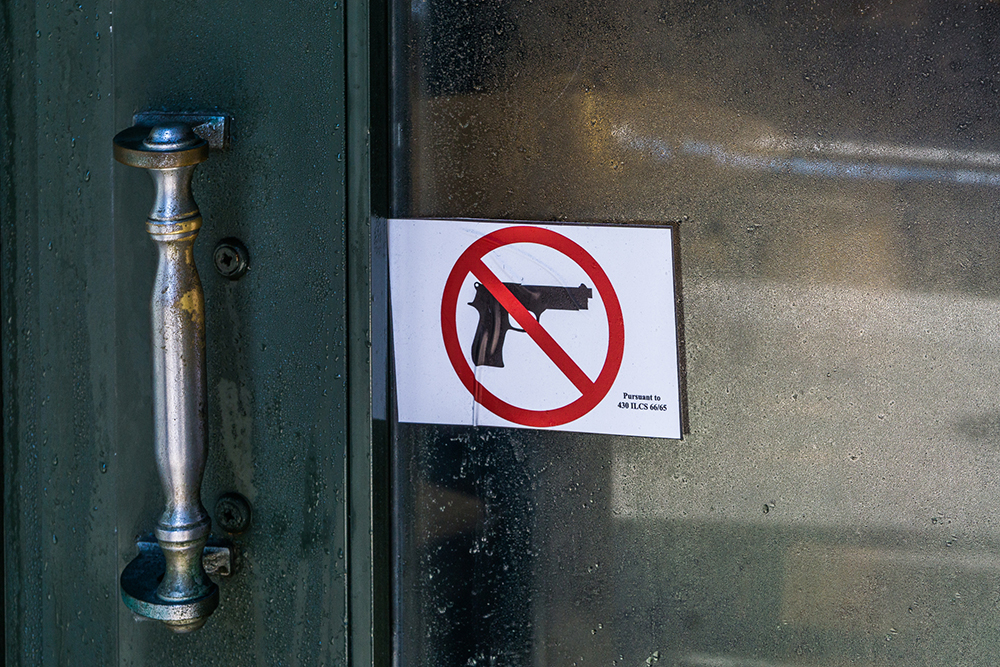
The U.S. Supreme Court on Monday denied certiorari in Schoenthal v. Raoul, leaving in place a Seventh Circuit ruling that upheld Illinois’ ban on carrying firearms on public transportation. The denial appeared on the Court’s April 6, 2026, order list, where No. 25-541, Schoenthal, Benjamin, et al. v. Raoul, Att’y Gen. of IL, et al. was listed under “CERTIORARI DENIED.”
That means the Seventh Circuit’s September 2025 opinion remains controlling law in Illinois, at least for now. And the real problem here is not just the result in one state. It is the reasoning the lower court used to get there. The Seventh Circuit said Illinois’ public-transit carry ban is “comfortably situated in a centuries-old practice of limiting firearms in sensitive and crowded, confined places,” then went a step further and held that regulations in “crowded and confined places are ensconced in our nation’s history and tradition.”
Once a court starts treating “crowded” and “confined” as the metric for creating a “sensitive place” ban, anti-gun states are going to try to apply that logic everywhere they can.
If carry can be banned in a place because it is busy, enclosed, or hard to exit, the list of so-called sensitive places will never stop growing. Today, it is buses and trains. Tomorrow, it is train stations, public parks, entertainment districts, events, and any other place politicians decide feel is too populated for ordinary citizens to exercise a right. That is exactly the kind of interest balancing that Bruen was supposed to stop.
To be clear, the Seventh Circuit did acknowledge that the Second Amendment’s plain text covers the conduct at issue here. The panel said “everyone agrees” the Amendment covers the plaintiffs’ desire to ride public transit while carrying a licensed concealed firearm for self-defense. So this was not a case where the court claimed the right simply did not apply. Instead, the judges upheld the ban by concluding the state had carried its burden under Bruen’s historical-tradition test.
The court’s reasoning leaned heavily on the physical characteristics of public transit. It described trains and buses as “discrete, confined spaces” where it is difficult to avoid someone wielding a firearm. The panel said the risk of stray rounds hitting innocent people is high, noted that escape is generally impossible when vehicles are moving, and stressed that a driver distracted, injured, or killed by gunfire could endanger everyone onboard and even people outside the vehicle. The opinion also emphasized the challenge first responders face in confronting violence inside “crowded and confined metal tubes.”
However, Bruen analysis does not ask whether judges think a law is sensible in modern life. It asks whether the government can prove a modern restriction is consistent with this nation’s historical tradition of firearm regulation.
When the Supreme Court discussed sensitive places in Bruen, it did so in narrow terms, not as a blank check for states to disarm people anywhere officials see crowds. The Court said modern regulations may be upheld by analogy to “longstanding” laws barring firearms in “sensitive places such as schools and government buildings.” It then stressed that the historical record revealed only “relatively few” such places, giving examples like “legislative assemblies, polling places, and courthouses.”
Just as important, the Supreme Court also drew a clear limiting line. In rejecting New York’s attempt to defend its carry regime by pointing to crowded urban conditions, the Court said there was “no historical basis” for New York to effectively declare Manhattan a sensitive place simply because it is crowded and generally protected by police. The justices warned that expanding the category of sensitive places to all places of public congregation “would in effect exempt cities from the Second Amendment” and “would eviscerate the general right to publicly carry arms for self-defense.”
That warning should have been the guardrail. Instead, the Seventh Circuit treated “crowded and confined places” as a constitutionally meaningful category of its own. The panel said there is an “unbroken chain of regulations in crowded and confined spaces,” cited railroad-era restrictions as corroborating evidence, and concluded that this additional history “removes any doubt” that Illinois’ public-transit restriction falls within the tradition.
The court not only upheld a ban but also blessed a framework that future courts will use to justify additional location-based prohibitions.
For ordinary gun owners, the real-world burden is obvious. A commuter who depends on buses or trains may effectively be disarmed for major portions of the day. It means the ability to exercise a constitutional right can turn on whether you own a car. In cities where crime is concentrated around transit stops, platforms, and late-night routes, that burden is not theoretical. The people hit hardest by rules like this are often the very people most likely to need a means of self-defense. That practical disparity flows directly from the type of prohibition the Seventh Circuit upheld.
None of this means the Supreme Court endorsed the Seventh Circuit’s reasoning on the merits. A cert denial is not a ruling that the lower court got it right. It simply means the justices declined to hear the case. But for gun owners living under the law, the practical effect is the same: the ruling stands, the ban stays in force, and lower courts now have one more appellate opinion they can cite when expanding the sensitive-places doctrine beyond the narrow historical examples recognized in Bruen.
If the Supreme Court wants to keep Bruen from being hollowed out by creative analogies, it is eventually going to have to step in and draw firmer lines. If sensitive places expand to include “crowded” and “confined” as enough justification for disarmament, the right to bear arms in public starts shrinking fast.
Once that exception grows large enough, what remains is not a right that ordinary citizens can count on. It is a right that exists only where the government decides conditions are calm, spacious, and convenient enough to tolerate it.
That is not what Bruen promised, and it is not a result the Court can ignore forever.
New Filing in Yukutake v. Lopez Accuses Hawaii of Rewriting Gun Laws to Dodge Defeat
About Duncan Johnson:
Duncan Johnson is a lifelong firearms enthusiast and unwavering defender of the Second Amendment—where “shall not be infringed” means exactly what it says. A graduate of George Mason University, he enjoys competing in local USPSA and multi-gun competitions whenever he’s not covering the latest in gun rights and firearm policy. Duncan is a regular contributor to AmmoLand News and serves as part of the editorial team responsible for AmmoLand’s daily gun-rights reporting and industry coverage.



“…busy, enclosed, or hard to exit” — This is EXACTLY where a madman would victimize several soft targets. One sheepdog could minimize or completely prevent carnage. “discrete, confined spaces” where it is difficult to avoid someone wielding a firearm. The panel said the risk of stray rounds hitting innocent people is high, noted that escape is generally impossible when vehicles are moving, and stressed that a driver distracted, injured, or killed by gunfire could endanger everyone onboard and even people outside the vehicle. Again, if the fear in these settings is collateral damage, I’d much rather take my chances with… Read more »