
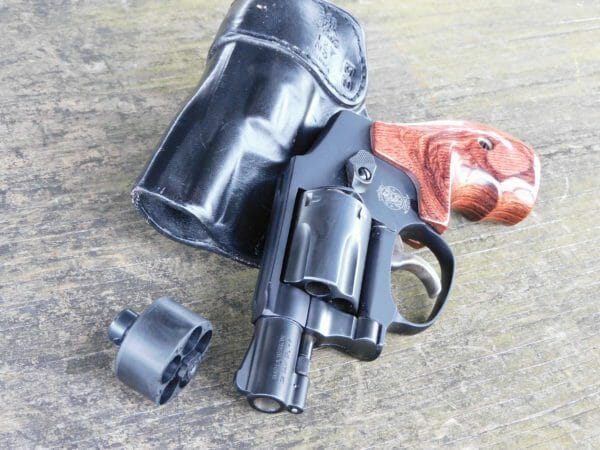
U.S.A. –-(AmmoLand.com)- Last I checked my calendar, we are in 2022. With the COVID pandemic and an uptick of civil unrest, gun ownership is up in a rapidly evolving gun market. The rule of the day is higher-capacity micro 9mm pistols–small polymer pistols little larger than pocket-sized 380s, but with more hitting power, double the capacity to ten rounds or more, and optic options to boot.
Despite all of these options, Smith & Wesson sells more five-shot snubnose revolvers than they should; yet they are also some of the most available guns during times of shortages when the latest and greatest options are the picked clean form the shelf. I bought my first snubnose revolvers back in the Great Ammo Crunch of 2012-2014. (Historians are not great at naming events.) After dabbling with the platform off and on since then, I decided to get one dedicated for carry. In 2021, my local shops had plenty of Taurus 856s and a smattering of 22 caliber pistols, along with a case of hammerless Smith & Wesson Airweights. I chose an Airweight Model 442 from the latter display.
After a year of living in a front pocket and a thousand rounds in the dirt, I still have that 442 and it has given me no issues. It would be a review largely unchanged from the perspective of someone writing in the 1990s when the gun first came out. The design is largely unchanged and Smith & Wesson revolvers have a deserved reputation for dependability. Rather, I felt it would be more useful to contextualize the old standard Airweight 38 in a market saturated by lighter and more powerful snubnosed revolvers as well as an autoloading market operating in times where sentinel events became an everyday likelihood. In a word: why would anyone consciously buy one in the 2020s?
Features
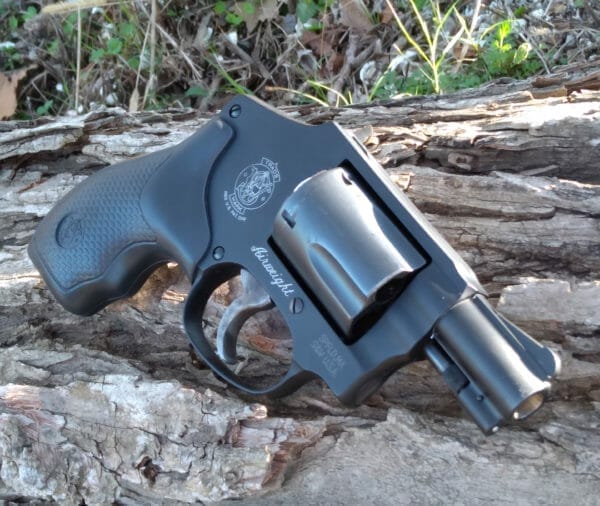
The Model 442’s linage dates back to 1952 when Smith & Wesson launched the Airweight Centennial, a hammerless aluminum-framed version of the firm’s famous Chief’s Special–itself a small-framed five-shot 38 Special revolver marketed as a concealed carry handgun to law enforcement personnel and the everyday Joe. The aluminum frame shaved off much-needed ounces when carrying in the pocket or on the waist, while the hammer is enclosed inside the frame, keeping it free of lint and allowing for an easy snag-free draw, but the hammer could no longer be reached to cock the hammer in a conventional manner for a light trigger pull.
Instead, the only way to shoot the revolver was by pressing the trigger all the way through for each shot. This was something of a radical departure, given the gun culture of the day that espoused treating revolvers as a slow-cocking and aiming proposition with rapid double-action firing only to be done in emergencies. The Centennial, or Model 42, as it became known, gave us only that latter choice with its advantages and disadvantages. The type proved popular enough to be reborn in the Model 442 and 642 in the 1990s–the former a near carbon copy of the Model 42 with a black anodized aluminum frame and the latter, a matte stainless version.
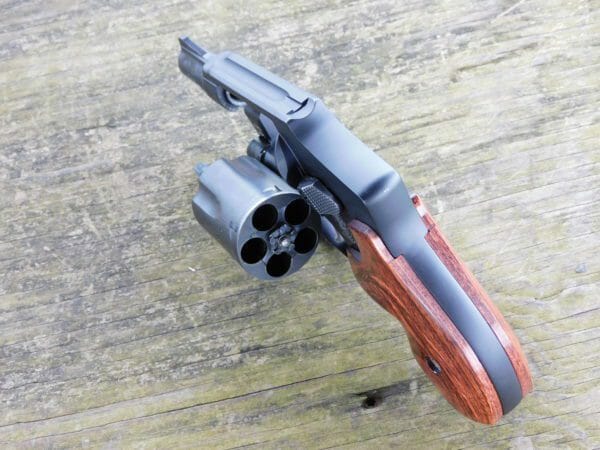
The 442 is not nearly as exciting of a handgun today as its predecessors when dinosaurs roamed the Earth, but it is a testament to a design that works–at least for a pocket pistol.
Fully loaded, the 442 weighs in at 16 ounces even. In a gun culture obsessed with packing as much value into a lightweight format, that is still nothing to scoff at. The only handguns that can touch small Airweight revolvers in terms of size are small pocket autos chambered in less-powerful rounds like 380 ACP but they do offer a few more rounds of ammunition. The 442 only holds five. The debate between having more rounds instead of fewer rounds of a more powerful cartridge that is played out in larger, higher capacity fighting handguns is still one for guns like the S&W Airweight, the Ruger LCP, and other guns that excel in the thankless task of being forgettable in a pocket.
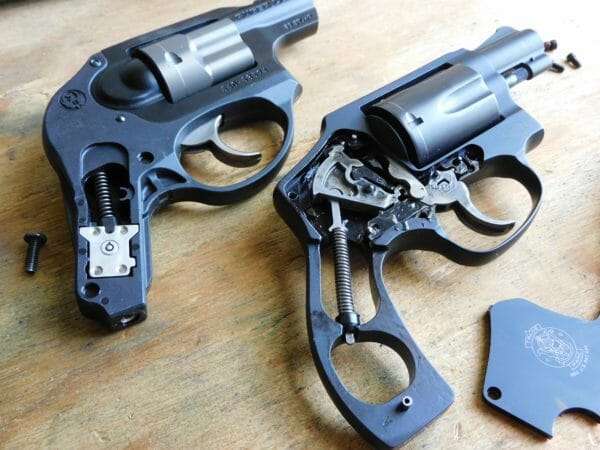
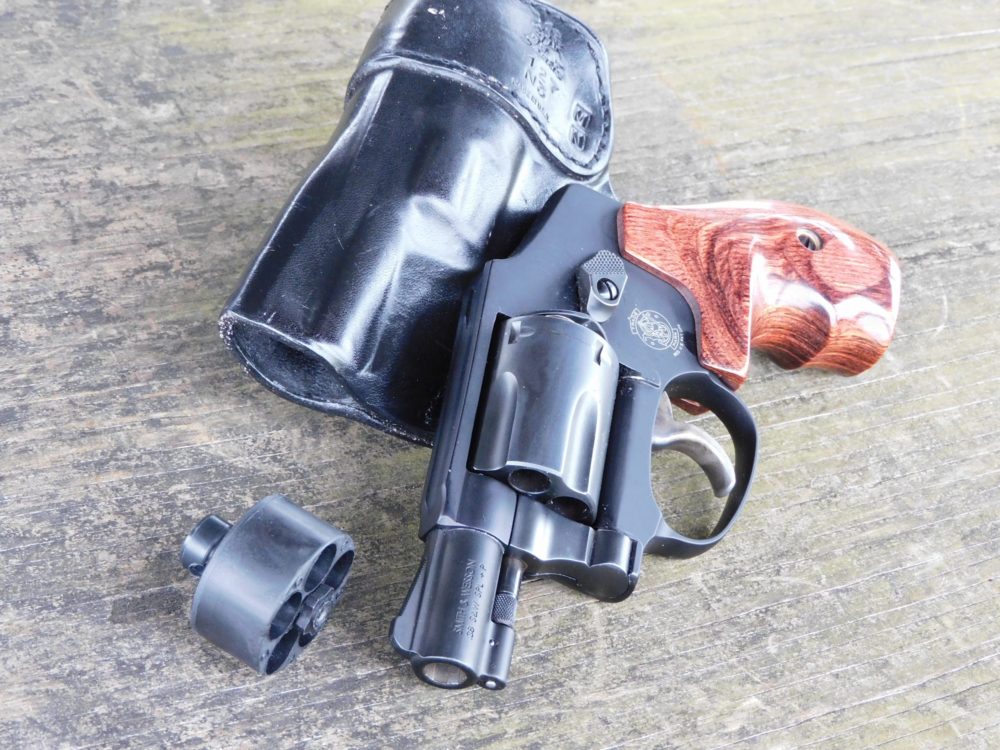
Speaking of forgettable in the pocket, the 442 is nicely sealed up to ward off the elements. The anodized aluminum frame and stainless steel barrel are rust proof, though the carbon steel cylinder does require some care. There are also not any massive openings for lint and debris to get into–at least when put into the proper holster. The enclosed hammer and the lack of a manual safety on the 442 shares some similarities with more modern striker fired pistols as there is no open spaces for ingress to accumulate.
Otherwise, the 442 operates as a conventional revolver should. There are no safeties to remember to engage or disengage to fire the pistol. What we have instead is a long, double action trigger pull to set it off. The only controls to speak of are the push-forward style cylinder release and an ejector rod to dump out your empty brass. Likewise, the sights are a fixed front ramp and a rear notch milled into the top strap of the frame. The 442 is as snag and ingress free as one could hope for in a pocket gun, but it isn’t the lightest or highest capacity option out there.
On The Range
Every time I took the 442 out for a burn session, it always started with an appreciation for how much these little guns appeal to new shooters given the gear selection, ammo choices, and the ease-of-use of the platform.
The latest and greatest in discreet concealed carry offer plenty of accessorizing, but with a track record of some seventy years, the J frame is hard to beat when finding holsters, grips, parts, and loading devices on the cheap and stocked in big box stores. Likewise, ammo selection can vary. The 442 will handle anything from pleasant standard pressure loads to more powerful 38 Special +P defensive loads. Little revolvers are known for being snappy but you do have the option of playing with the ammunition to find what works best. If 38 Special ammunition is not available, the odd box of 38 Short Colt or 38 Long Colt will work!
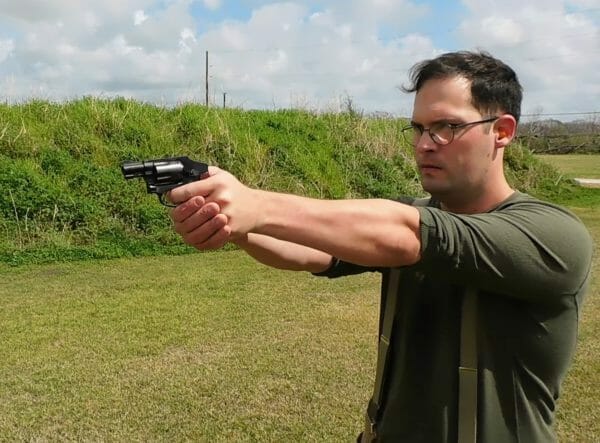
Loading and shooting the 442 is a mix of easy and difficult–easy to understand and shoot, difficult to master.
The revolver is loaded by pushing forward on the cylinder release on the left side of the frame, and pushing the cylinder through the window to expose the chambers. Drop five rounds into the chambers, close the cylinder, and you are ready to shoot by simply lining up the sights and pressing the trigger.
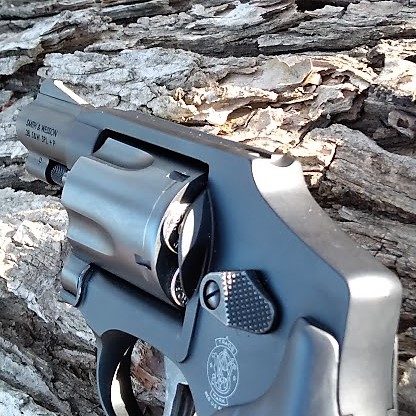
The sights aren’t impressive to look down. The milled rear notch and front ramp are blacked out and fixed and there is little one can do about them except put a bit of orange nail polish on the front sight for easily pick it up on the fly. Inside seven yards, these sights were still easy to pick up unmodified for quick shots using a gross sight picture. Further out, more care had to be taken. Some care also has to be taken to select a load that will shoot to the point of aim with these sights. From the factory, my 442 shoots standard 158 grain loads easily. Light-for-caliber 110-135 grain loads shot a few inches low. To give these stock snubby sights some justice, they can stack any of those loads into a respectable group, given that the petite front sight does not cover up small targets like higher visibility sights on larger guns would.
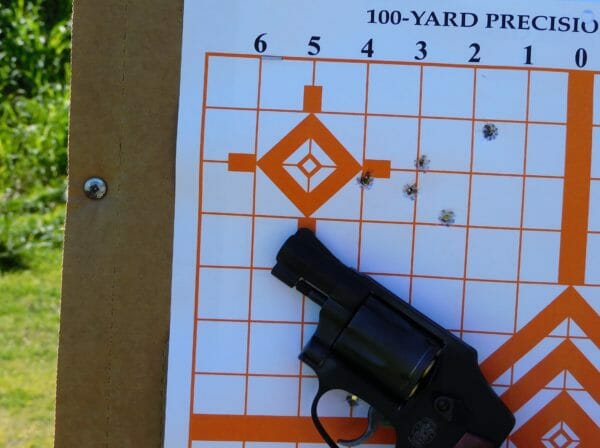
Although punching groups on bullseye targets might seem onerous given that snub’s intended mission as a close-range personal defense handgun, knowing what the pistol is capable even on the square range is helpful. In my part of town, I am just as likely to run into a feral dog as a feral person intent on harm. Further, threats do occur beyond arm’s reach and good clusters up close can, at the very least, mean some good hits further out. After a few boxes of rounds, I was able to reliably hit eight inch steel plates at fifteen and twenty yards–but no further.
Perhaps the biggest struggle to getting good, quick hits on target is the trigger, which in my view is the single biggest hurdle to shooting small revolvers. The trigger pull does a lot of work. Raising the hammer and indexing the cylinder to a new round, then dropping the hammer at the end of its travel. All that work requires leverage and it is translated into a long, heavy trigger pull that makes the gun very safe to carry but very hard to shoot well. Out of the box, the pull is smooth but breaks at about ten pounds–ten times heavier than the gun itself. With a few range sessions, the trigger pull had lightened to eight pounds five ounces. But for a shooter accustomed to lighter, shorter triggers, it can be a handicap. It is a greater handicap for shooters who gravitate toward a revolver due to a lack of “hand strength” needed to manipulate the slide of an autoloading pistol. This is really a lack of dexterity on the fingers that may not be up to the task of running a double action revolver.
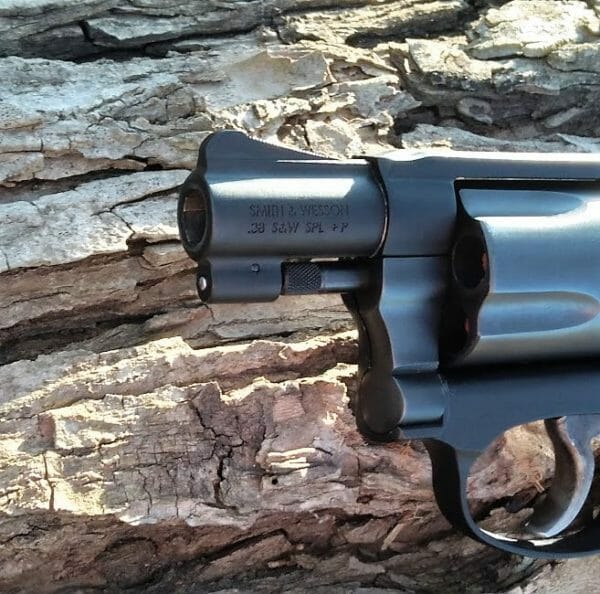
While the sights are better than what one would expect, the trigger pull is a hurdle that can only be mastered with practice or perhaps a spring kit. Recoil, on the other hand, is something easier to control. There is no getting around the fact that you are in for some recoil when you touch off a service-caliber cartridge out of a small, lightweight handgun. Paired with a 1 7/8 inch barrel, you are in for some blast. Sticking to standard-pressure 38 Special loads help greatly for practice and comfort and it was not hard to get through one hundred rounds in a given range session before the web of my hand started to get hot. Loaded with 148 grain wadcutters or the old school Federal 158 grain lead round nosed offering, the 442 shoots close to the point of aim to the fixed sights and there is little muzzle flip, allowing you to get off those five rounds fast. Lighter 110 grain Hornady Critical Defense hollow-point loads had a little more sting in the hand, but little compared to cranking out more typical +P loadings. I shot several boxes of Remington 125 grain Golden Sabers, Speer Gold Dot 135 grain Short Barrel hollow points, and Federal 158 grain +P lead hollowpoints. Recoil was stiff, especially with the latter and I was feeling the burn after five to ten rounds. Reloading with these higher pressure loads is also a bit more of a challenge. The short ejector rod only partially clears the cases with a push on the rod. Brass from standard loads fall readily to the ground, but +Ps have a tendency to fireform into the chambers and require a sharp rap on the rod to knock the cases clear of the gun.
Reloading a small revolver with some speed takes some trying but developing a technique to clear all those empty cases is probably the greatest hurdle. The lesser hurdle is finding a way to carry spare ammunition. In any event, the grips that come stock on these Airweights snubnose revolvers can be an aid and an obstacle. The synthetic grips that come on the 442 do not interfere with empty cases falling free, but they are bulbous enough to prevent a round speed loader from releasing fresh rounds into the cylinder. Bianchi speed strips also work to carry more rounds and fit easily into a pocket but they are slower. A few minutes with a rasp or a Dremel can fix those grips to work with loaders. I instead opted for more stylish Altamont boot grips that class up the gun, does not catch on clothing on the draw, and allows me to punch in Safariland Comp I speed loaders with relative ease. But there is little doubt that only the best of circumstances, gear, and ammo can make the little 442 Airweight a simple gun to shoot–or atleast–to shoot well, despite its advantages out of the pocket.
Parting Shots
The Smith & Wesson 442–and its other aluminum framed cousins–occupy an interesting grey zone in concealed carry. The micro 380 and 9mm autoloader can be had lighter and with more rounds to boot, while Smith & Wesson and other makers have perfected even more powerful five-shooters made even lighter through the use of polymer, scandium, and titanium. While it is increasingly hard to justify choosing a larger, rounds-limited duty revolver over a higher capacity duty-sized autoloader for concealed carry, once the guns shrink for the purposes of everyday carry, the picture is complicated.

I shot the 442 alongside other competing options to include the Ruger LCP, the LCP Max, and a Smith & Wesson 340 PD. My faithful six-shot LCP is lighter than the 442 is not pleasant and it runs perfectly…with a textbook firing grip and brass cased ammunition. An awkward grip, steel-cased ammo, or any halfhearted manipulation of the slide can produce an ill-timed malfunction. The Max holds ten rounds of 380, offers a better grip out of the pocket, and is slightly more pleasant to shoot, but I have no qualms that Murphy’s Law will come into play. Revolvers on the other hand aren’t as sensitive. The 340 PD is another ultralight Centennial that only holds five rounds, but it is four ounces lighter than the 442 and chambered in the potent 357 Magnum. It was insensitive to shooting technique or ammunition, but it was obnoxious to shoot and harder to control with the same 38 Special loads the plain-Jane 442 handled with relative ease. Despite its shortcomings relative to other designs, the Smith & Wesson Airweight is still one of the best in a field of guns you may not want to dare shoot let alone depend on.
About Terril Hebert
Terril Hebert is a firearm writer native to south Louisiana. Under his motto-Guns, Never Politics-he tackles firearm and reloading topics both in print and on his Mark3smle YouTube channel, where he got his start. Terril has a soft spot for ballistics testing, pocket pistols, and French rifles. When he is not burning ammo, he is indulging his unhealthy wildlife photography obsession or working on his latest novel. Scourge of God, published in 2017. See more from Terril on youtube under Mark3smle.
It’s an eminently viable choice for 90 something percent of civilian concealed carriers. All these mini and micro-nines are fun, and I do own a few which I do carry occasionally, but for durability and dependability, it’s still hard to beat a five shot J-Frame Smith. They can be sit alone for years collecting dust (not that I recommend this) and fire when needed. They can be fired from inside clothing, and unlike even the smallest 9mms, can be comfortably carried in a front trouser pocket.
I have carried a Airweight Bodyguard since 1971 when I graduated from the L. A. Police academy. In accordance it was neutered to double action only. I retired in 1994 from injuries incurred in a shooting. While working I carried Remington 200 grain Super Police loads, once I retired I switched to Glasers. Never shot anyone, although I did display it a couple of times to discourage those with hostile intentions. Have a bunch of holsters, probably the one I use most is an upside-down shoulder holster. Convenient, easy to use and I have never felt undergunned. Yes, I have… Read more »
I have two 442’s. The first one, purchased new in 2013 or 2014, is accurate to 25 yards and beyond. At 25 yards, it will put a nice group into the center of a B-27 or similar target. After running hundreds of rounds of (mostly +P) ammo through it, the cylinder lockup is becoming a little loose. About four years ago, I bought a spare for when the day comes that the original must be repaired or replaced. At 10-25 yards, this gun shot extremely to my left, putting most rounds into the target’s right shoulder area, on white paper,… Read more »
Short barreled revolver can be shot quite accurately.
Takes good eyes.
Best shot I made with one was a coyote at 32 yards while I was a mile into a 4 mile run.
99% of the time, mine was a BUG to a Glock, either 10mm, .40, or 9mm. Also, as it was carried cross draw under my shirt, it offered the possibility to draw when seated without telegraphing so early to a potential assailant.
I find it interesting that this was purchased in 2021 yet it doesn’t have the Hillary hole.
Convert to png & keep below 2mb.
It’s plenty big when you click on the pic. The one that shows before clicking on it is like a thumbnail.