
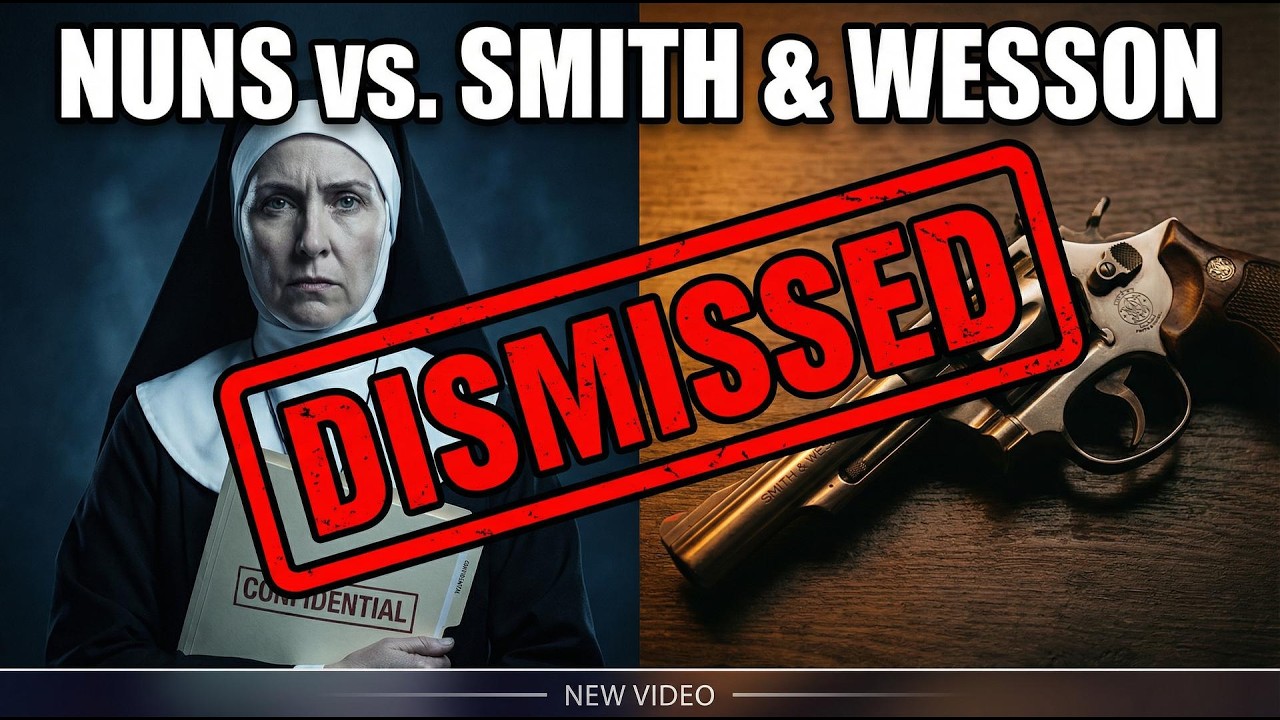
In a significant victory for Smith & Wesson Brands, Inc., and a setback for shareholder activism targeting the firearms industry, the U.S. District Court for the District of Nevada issued an order on March 23, 2026, granting the company’s motion to dismiss a derivative lawsuit brought by four congregations of Catholic nuns. The case, Adrian Dominican Sisters et al. v. Smith & Wesson Brands, Inc. et al., illustrates the high bar plaintiffs face when attempting to use corporate fiduciary-duty claims to challenge a company’s core business operations, particularly in a politically charged sector like gun manufacturing.
The plaintiffs, Adrian Dominican Sisters, Sisters of Bon Secours USA, Sisters of St. Francis of Philadelphia, and Sisters of the Holy Names of Jesus & Mary, U.S.-Ontario Province, own shares in Smith & Wesson and filed the suit derivatively on the company’s behalf.
Their core allegation: the board of directors and senior officers breached fiduciary duties of loyalty and care by “knowingly” allowing the company to manufacture, market, and sell AR-15-style semi-automatic rifles in ways that allegedly violate federal, state, and local laws.
This exposure, they claimed, subjected Smith & Wesson to massive potential liability from mass shootings in which the company’s products were used. A fourth claim alleged violations of Section 14(a) of the Securities Exchange Act of 1934, asserting that the 2024 proxy statement contained false and misleading statements about the board’s oversight of these risks.
The suit was not the plaintiffs’ first attempt. In December 2023, the same nun congregations filed an almost identical derivative action in the Nevada state court.
That complaint, drafted with assistance from Newman Ferrara LLP, painted a striking picture of alleged corporate misconduct. It cited Smith & Wesson’s continued promotion of its rifles despite their repeated appearance in high-profile mass shootings, arguing that the board ignored red flags dating back to a 2000 settlement agreement with the U.S. government and internal monitoring reports. The nuns contended that short-term profit goals trumped long-term risk management, violating the directors’ duty to protect stockholder value.
Nevada’s Eighth Judicial District Court quickly pushed back. In March 2024, it granted the defendants’ motion requiring the plaintiffs to post a $500,000 security bond under Nevada Revised Statute § 41.520. The statute allows courts to demand such bonds in derivative actions if there is “no reasonable possibility” the suit will benefit the corporation or its security holders. Finding the claims lacked merit and were more driven by social policy than by corporate welfare, the state court set a deadline of April 23, 2024. When the plaintiffs declined to post the bond, regarding it as an insurmountable barrier, the case was dismissed without prejudice. Undeterred, they refiled in federal court in February 2025, adding the federal securities claim to invoke diversity and federal-question jurisdiction.
U.S. District Judge Gloria M. Navarro’s March 23, 2026, order closely examines why the federal version fared no better.
Applying Federal Rule of Civil Procedure 23.1, which governs derivative suits, the court first addressed standing. Plaintiffs must (1) own shares contemporaneously with the alleged wrongdoing and (2) adequately represent the interests of similarly situated shareholders. While the nuns cleared the ownership hurdle, the court expressed serious doubts concerning the adequacy of representation.
Citing Nevada precedent like Cotter v. Kane, Judge Navarro weighed eight factors and found the plaintiffs’ “narrow personal interests in social change over financial gain” had a considerable impact against them. Stockholder proposals on related issues had garnered only 26–40.6% support, suggesting the wider shareholder base did not share the plaintiffs’ priorities. The court distinguished this from cases like the Starbucks activism litigation, noting that here the nuns appeared to oppose the company’s fundamental firearms business rather than seek governance improvements.
The decisive blow, however, came on demand futility. Under Nevada law, applicable because Smith & Wesson is a Nevada corporation, shareholders must either make a pre-suit demand on the board or plead with particularity why such a demand would be futile.
The plaintiffs chose the latter, alleging the entire board was interested or lacked independence due to ties to the gun industry and knowledge of the alleged violations. Judge Navarro rejected these arguments as conclusory. She took judicial notice of the 2000 settlement agreement (which explicitly disclaimed any admission of wrongdoing), monitoring reports, and the 2024 proxy. None, she ruled, established actual knowledge of illegal conduct or substantial liability risk. Mere “threats” of lawsuits or public criticism were insufficient to overcome the business judgment rule, codified in Nevada Revised Statutes § 78.138(3). The directors’ alleged commercial connections (e.g., one serving on a related board) were deemed too tangential to rebut the independence requirement.
For the Section 14(a) claim, the analysis was similar: no particularized facts showed directors were personally interested or that proxy statements contained material misstatements tied to actionable wrongdoing.
Critically, the court applied collateral estoppel to the bond issue. Because the state court had already litigated and decided the “no reasonable possibility of benefit” question under the identical statute, and the parties were in privity, the federal court required the same $500,000 security. Plaintiffs have 14 days to post it or face dismissal without prejudice. They also received 21 days to file an amended complaint, though the order strongly signaled reservations about their ability to cure the deficiencies.
This ruling carries wider implications. First, it reinforces the protective shield Nevada law provides corporate boards, especially in industries facing ESG-style pressure campaigns. Derivative suits are meant to remedy harm to the corporation, not to advance external policy agendas. Courts increasingly scrutinize whether plaintiffs truly represent stockholder interests or merely use their shares as a platform for activism. Second, it affirms the lasting strength of the business judgment rule.
Absent concrete evidence of self-dealing or conscious disregard of known legal violations, directors receive wide latitude, even when their company’s products are politically controversial. Smith & Wesson benefits from the federal Protection of Lawful Commerce in Arms Act (PLCAA), which generally shields manufacturers from liability for third-party misuse of firearms, a point implicitly bolstering the board’s position.
For the gun industry, the decision is a clear win. Smith & Wesson, which relocated its headquarters from Massachusetts to Tennessee in recent years to escape stricter regulatory conditions, can continue to emphasize its core business without the distraction of protracted litigation. The nuns’ attorneys have framed the suit as a novel attempt to hold boards accountable for “assault rifle” marketing, but courts have repeatedly declined to let derivative actions operate as vehicles for gun-control policy.
Yet the story is not entirely over. The plaintiffs may amend, and similar activist efforts, often backed by socially responsible investment funds or faith-based groups, continue across corporate America. The case also spotlights the growing use of shareholder proposals and derivative suits to push environmental, social, and governance (ESG) agendas. While some view this as legitimate stewardship, others see it as an improper weaponization of corporate law against lawful businesses.
In the end, Judge Navarro’s order reaffirms a fundamental principle: boards exist to maximize stockholder value within the bounds of law, not to bend to every social cause.
For the Adrian Dominican Sisters and their fellow plaintiffs, the way forward now requires either posting the bond, drafting a far more particularized amended complaint, or accepting that their vision of corporate responsibility may not align with Nevada law or Smith & Wesson’s shareholders. The firearms industry, meanwhile, receives another judicial indication that courts will not lightly second-guess lawful commerce, even when it involves controversial products.
About John Crump
Mr. Crump is an NRA instructor and a constitutional activist. John has written about firearms, interviewed people from all walks of life, and on the Constitution. John lives in Northern Virginia with his wife and sons, follow him on X at @crumpyss, or at www.crumpy.com.





Time for the church to eiter stay in their lane,or start paying taxes
The Catholics bought a lot of S&W stock in their attempt to gain standing in court. I don’t think the nuns did it on their own. Maybe this goes as high as the pope himself. The church has also been instrumental in our illegal immigrant problems. The church arranged to have food and water waiting for illegals wanting to invade our country, as well as maps to tell them where to find it. It is ironic and hypocritical that the catholic church would seriously work to disarm us, and at the same time guard the vatican with walls and the… Read more »
I guess the misguided Sisters forgot what our Lord and Savior admonished his disciples to do in Luke 22:35! Shame on them!
I know people who went to Catholic schools. Nuns may hate guns, but they LOVE beating children.
Gun grabbing nuns? Damn!
The last few popes, I’m sorry to say, have had their heads up their asses, which is why attendance is falling (IMO); especially when we see them openly criticizing the USA for wanting to keep illegal aliens out of our country. Tell you what, Mr. Pope, take them under your wing if you’re so concerned about their welfare! That said, historically, the Catholic Church has always recognized self defense (lethal force) as justifiable (i.e. not a mortal sin, nor any kind of sin). The nuns I grew up with (i.e. teachers) understood that, as did the clergy; and it should… Read more »
Maybe it’s time to make separation of church and state laws. Stick to teaching people about God and spreading the word and let us handle taking care of handling guns and protecting America because obviously, you don’t know how to handle both.
I pray to God, not alah or mother mary.
Who’da guessed a buncha nuns could be such sidewinders? Not me. Takes all kinds to make a world.
Imagine the holier than thou Sistas of Pedophilia suing for mis-organizational behavior. Only in America…. S&W should sue the Sistas to lose their tax exemptions on all their properties. Catholic church ain’t in the savin’ souls biz. They’re in the real estate and fish fry biz.
People who have trust in GOD, those who live by the WORD of GOD, should know that self defense is righteous, defense of others is righteous, defense of home and property is righteous. See the laws of Moses. JESUS HIMSELF says, “If a man has no sword ( the assault weapon of the day) he is to sell his cloak ( his outer garments) and buy one”. Luke 22:36b. Our constitution is based on sound Judeo Christian commandments, precepts and principals. I will not be disarmed by a bunch of misguided women. See the garden of Eden and the fall… Read more »