
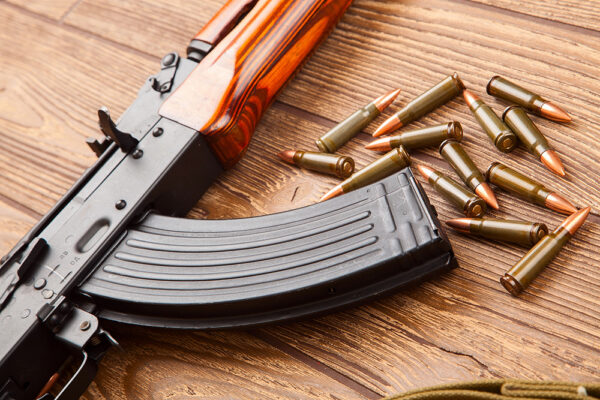
In a rare bit of good news from the Bureau of Alcohol, Tobacco, Firearms and Explosives, the agency has proposed rolling back outdated import restrictions that have blocked firearms and ammunition from several former Soviet countries for nearly three decades.
The proposed rule, published in the Federal Register on May 6, 2026, would update ATF’s list of “proscribed countries” for import restrictions and bring the agency’s regulations in line with the State Department’s current foreign policy list. More importantly for gun owners, collectors, importers, and the firearms industry, the rule would remove several former Soviet countries from ATF’s automatic denial list for permanent firearm and ammunition imports.
Those countries are Georgia, Kazakhstan, Kyrgyzstan, Moldova, Turkmenistan, Ukraine, and Uzbekistan.
The Russian Federation would remain restricted.
ATF is proposing updates to its import rules under the Arms Export Control Act. The plan would replace ATF’s fixed list of proscribed countries with a dynamic reference to the State Department’s list, keeping restrictions automatically aligned with State’s designations. It would… pic.twitter.com/OX1yQ0zuF9
— ATF HQ (@ATFHQ) June 4, 2026
This is still a proposed rule. Importers would still have to go through ATF’s process, and the firearms would still have to satisfy the rest of the federal import scheme, including America’s long-abused “sporting purposes” restrictions. But the change would end a blanket ban that treated several countries as off-limits solely because of an old policy dating back to the 1990s.
For decades, American gun owners have watched the federal government use import law as a backdoor form of gun control. Instead of Congress voting to ban a firearm, bureaucrats can simply decide that a firearm does not meet an import test, comes from the wrong place, has the wrong configuration, or does not fit some made-up sporting-purpose standard that has nothing to do with the Second Amendment.
The Second Amendment does not say anything about “sporting purposes.” It protects the right of the people to keep and bear arms. If I remember correctly, I believe it also says “shall not infringe.” But Washington has never let constitutional text get in the way of regulating gun owners.
This proposed rule does not fix all of that. Not even close. But it does chip away at one outdated import barrier.
According to ATF, the current list traces back to a 1997 policy adopted after the United States entered into a Voluntary Restraint Agreement with the Russian Federation in 1996. That list included Russia and several former Soviet countries. ATF is now acknowledging that, nearly 30 years later, the policy reflects outdated trade and security concerns.
Under the proposed change, ATF would move away from automatically denying import applications for most firearms and ammunition from the listed former Soviet countries. Instead, applications could be reviewed on a case-by-case basis. That would give licensed importers more flexibility and could eventually give American consumers more choices.
Imports have long played a major role in the American firearms market. From surplus rifles to AK-pattern guns, shotguns, pistols, ammunition, magazines, and parts, imported firearms have helped fuel the collecting, training, hunting, and self-defense markets in the United States. Many American gun owners got their start with affordable imports. Many collectors built entire collections around military surplus firearms that would be much harder, or impossible, to obtain under today’s regulatory climate.
Every time the government blocks lawful imports, the market gets smaller. Prices go up. Availability goes down. Collectors lose access to history. Shooters lose options. Small importers lose business opportunities. And once again, lawful gun owners pay the price for decisions made by people who are rarely affected by their own rules.
ATF’s proposal would also remove its outdated country list for broader defense articles and instead point to the State Department’s current list. The agency says that would reduce confusion and keep the government’s import restrictions aligned across departments. That part is mostly regulatory housekeeping, but the firearm and ammunition provision is the part gun owners will care about most.
Unfortunately for the AK purists, Russia remains restricted under the proposal. The terms of the Russian agreement remain in effect. Russian firearms and ammunition will continue to be treated differently. That means anyone hoping this rule brings back the glory days of cheap Russian ammo should pump the brakes.
For gun owners, the most realistic impact would not be a sudden flood of cheap AKs or ammunition. The proposed rule would give importers a chance to seek approval for firearms and ammunition that have been locked out under an outdated policy. Importers could bring in surplus Soviet-era firearms from these countries after they cleared ATF review.
Importing could also include Ukrainian-made Fort-500 pump-action shotguns, Fort pistols, Zbroyar sporting and precision rifles, and possibly civilian-configured Malyuk K-01 or K-02 rifles. Ammunition from these former Soviet countries, such as Kazakhstan or Uzbekistan, may be another possibility.
None of that means these products are automatically coming to American gun stores, but it would at least give importers a door to knock on instead of a federal “no” before the paperwork is even reviewed.
The comment period is open until July 6, 2026. Anyone who cares about firearm imports, ammunition availability, historical arms, and rolling back unnecessary federal restrictions should consider weighing in.
This proposed rule is not the end of the fight. It is one small move in the right direction.
After years of the federal government using every excuse imaginable to tighten the screws on gun owners, even a small step toward undoing bad policy is worth watching.
About Duncan Johnson:
Duncan Johnson is a lifelong firearms enthusiast and unwavering defender of the Second Amendment—where “shall not be infringed” means exactly what it says. A graduate of George Mason University, he enjoys competing in local USPSA and multi-gun competitions whenever he’s not covering the latest in gun rights and firearm policy. Duncan is a regular contributor to AmmoLand News and serves as part of the editorial team responsible for AmmoLand’s daily gun-rights reporting and industry coverage.



They need to get rid of the “sporting purposes” B.S., 922(r), and the requirement to destroy or damage the guns before importing them. Imagine if you got ahold of a 1972 Ferrari Daytona Coupe but in order to import it you had to torch-cut the chassis into 3 pieces and in order to rebuild it you had to find American replacement parts for half the drivetrain and put a restrictor on it so that it couldn’t exceed 75 MPH. Or imagine you bought a Picasso in Spain but in order to import it you had to burn into the canvass… Read more »
On this day in 1837, the Texas legislature officially incorporated Houston as a city—just one year after the Allen brothers founded it along Buffalo Bayou.
I’ve never been interested in many of the foreign weapons but would like to see all of the M1 Garand, M1 Carbine and our 1911 pistols repatriated from South Korea and other countries, along with their stockpiles of parts, equipment and ammunition etc.
This is good but the ATF shouldn’t be allowed to propose “rules”. That’s the job of Congress. Unfortunately, niether are known for acting within the bounds of the constitution.
The Bush import ban could be eliminated immediately via executive order.
ALL allies to Russia currently