
By Jeff Knox : Opinion
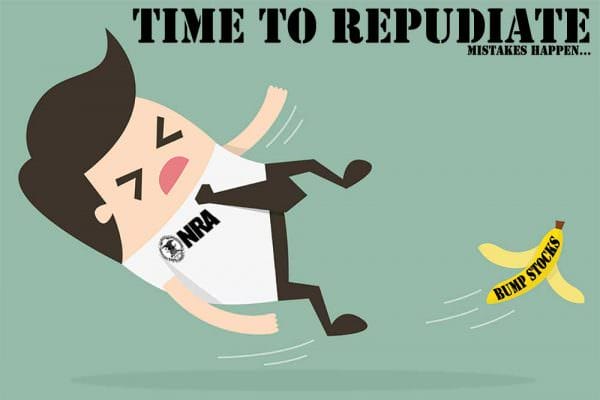

Buckeye, AZ –-(Ammoland.com)- The Executive Vice President of the NRA, Wayne LaPierre, and Chris Cox, the Executive Director of NRA-ILA, the association’s lobbying arm, issued a joint statement in response to the horrific atrocity perpetrated last week in Las Vegas.
The bulk of the statement was practical and reasonable, sounding a balanced tone between concern for the victims and determination to not let the acts of a mad man be used to undercut the rights of Americans. It also showed a willingness to at least discuss whether some action related to guns might be warranted.
There is nothing wrong with them being willing to talk, as long as they stick to core principles, and refuse to allow blame for the tragedy to be dumped on responsible gun owners.
Unfortunately LaPierre and Cox didn’t stick to principles. Instead of just calling for regulatory review, they declared – in the name of NRA – an opinion on what that review should conclude, and it’s not an opinion that The Firearms Coalition can begin to agree with.
Here’s the part of what LaPierre and Cox said that we have a problem with:
“The NRA believes that devices designed to allow semi-automatic rifles to function like fully-automatic rifles should be subject to additional regulations.”
The theories from NRA supporters all suggest that the statement was part of a delay and diversion tactic to buy some time for the heated emotions dredged up by the Las Vegas attack to simmer down, so that the discussion can then proceed in a rational and logical manner, and keep that debate within regulatory channels, rather than Congress. The suggestion is, that by putting the ball in the court of the Bureau of Alcohol, Tobacco, Firearms, and Explosives, NRA is trying to keep Congress out of it. A BATFE review will take some time, and if BATFE rules that they made a mistake when they concluded that bump-fire stocks were not restricted devices under the definitions of the National Firearms Act, and places them in one of the restricted categories, that would take the wind out of Feinstein (D-CA) and Schumer’s (D-NY) sails. If the review concluded that the BATFE doesn’t have the authority to regulate the simple devices, the hope would be that the focus would be pretty firmly shifted onto these novelty devices, rather than the guns they are attached to.
That might actually be the strategy, but unfortunately it falls flat with the inclusion of the above sentence.
By stating that NRA believes the devices “should be subject to additional regulations,” they are not only abandoning bump-fire stocks and trigger-cranks – which is a pretty stupid move in our opinion – but they are conceding the notion that these devices, and full-auto firearms, are too dangerous for average Americans to own. LaPierre and Cox have since doubled down on the statement, saying on Sunday talk shows that
NRA supports the restrictions of the NFA, and thinks that rapid-fire devices should fall under the purview of that law.
This is really troubling, as it abandons the critical, core principle that you cannot control criminal behavior by regulating inanimate objects.
While it’s possible that pitching this issue to the BATFE might cause some delays, and give some politicians an excuse to sit on their hands while BATFE is conducting their review – if they conduct a review – Feinstein, Schumer, and their media pals are already calling out the NRA position as a political ploy, and are pushing all the harder for immediate congressional action. With NRA already conceding on the issue of bump-fire stocks, they have surrendered any reasonable grounds for objecting to quick congressional action. And since a ban on bump-stocks is now a given, the anti-rights zealots will set their sights on additional targets like limiting magazine capacity and expanding background checks, along with yet another run at an “assault weapon” ban, which they might use as a bargaining chip.
With NRA “leaders” having conceded that bump-stocks should be regulated, and with that concession, also abandoning the notion that restricting tools is never the answer to controlling crime, any arguments they offer against expanding background checks or restricting magazine capacity, will be pounced upon as specious and in contradiction to this stated position. After all, “if it saves just one life…”
The values expressed in that one sentence of LaPierre and Cox’s statement, represent a major shift in NRA policy, and we’re pretty sure that this shift was not approved by the NRA’s Board of Directors, which is supposed to be responsible for establishing all policies for the organization. At least we hope that the board would not have approved such a damaging policy shift.
And this is not the first time that LaPierre has shot the organization in the foot. In a speech shortly after the Columbine atrocity, LaPierre declared;
”We believe in absolutely gun-free, zero-tolerance, totally safe schools.”
A dozen years later, in response to the terror at Sandy Hook, LaPierre was singing a different tune, calling for police and armed citizens in schools, a much more sensible approach.
In 1999, testifying in a congressional hearing, LaPierre declared;
“We think it’s reasonable to provide mandatory, instant criminal background checks for every sale at every gun show. No loopholes anywhere for anyone.”
Like his gun-free schools statement, LaPierre’s position on gun shows didn’t sit well with many NRA members and the official position was quietly shifted back to a harder line. Still, as late as 2005, candidate questionnaires were still stating that NRA supported mandatory background checks at gun shows. The questionnaires were only corrected to reflect NRA’s actual policy, opposing mandatory background checks for private transfers, after The Firearms Coalition pointed out the discrepancy and demanded the correction.
Now LaPierre has again shot a hole in his own foot – and the NRA’s boat he’s standing in – with his misguided statements about rapid-fire devices for semi-auto rifles. The difference is that this time the contrary statement has the potential to sink the whole boat. If full-auto is so dangerous that it must be tightly regulated, and devices that make it easier to make semi-auto’s “function like fully-automatic” firearms are so dangerous that they must also be tightly regulated, it is a very short step to demands that all semi-auto firearms be tightly regulated since any semi-auto can be made to “function like fully-automatic” firearms with a simple improvised device, or no device at all with a little practice.
When anti-rights politicians and the media make that demand, what defense can LaPierre offer?
We at The Firearms Coalition feel that this was a serious faux pa on the part of LaPierre and Cox, and we see only one way for the mistake to be corrected.
The NRA Board of Directors must immediately issue a statement declaring the true position of the National Rifle Association, and that the statement from LaPierre and Cox did not accurately reflect that position.
They must make it clear that the NRA policy opposes any efforts to restrict or regulate any firearm, ammunition, or accessory under the false premise that such regulation will prevent the illegal acts of criminals and lunatics.
Political gamesmanship is one thing. Abandoning core principles as part of that gamesmanship is totally unacceptable.

About Jeff Knox:
Jeff Knox is a second-generation political activist and director of The Firearms Coalition. His father Neal Knox led many of the early gun rights battles for your right to keep and bear arms. Read Neal Knox – The Gun Rights War.
The Firearms Coalition is a loose-knit coalition of individual Second Amendment activists, clubs and civil rights organizations. Founded by Neal Knox in 1984, the organization provides support to grassroots activists in the form of education, analysis of current issues, and with a historical perspective of the gun rights movement. The Firearms Coalition has offices in Buckeye, Arizona and Manassas, VA. Visit: www.FirearmsCoalition.



I’ve renewed my membership in Gun Owners of America.
(along with a large – for me – contribution)
I will not renew NRA,
It is way past time for a course correction for NRA. Follow this line and the final question; We have laws in every State against rape, robbery, assault and murder and enhancements when any weapon is used, be it a screwdriver, foot, knife or gun. Since we already have these laws any further laws are simply “pile on” and irrelevant. Given that and the fact that firearms are the only object that is singled out for additional restrictions, the question I want to see NRA answer is: Do you support a complete repeal of ALL firearms laws? If the answer… Read more »
Unfortunately, I just paid my membership fee but I doubt I will next year unless they get rid of LaPerre and Cox as well as Grover, what ever his name is, is an anti gun proponent and he is on the board. We were sold down the river once again.
On one hand, I understand that we have lost rights incrementally, and we’ll likely have to get them back “one lawsuit at a time” (to quote SAF) – mostly because no politician can be persuaded to vote to ‘give domestic abusers guns’ (repeal Lautenburg amendment) or ‘legalize machine guns’ (repeal Hughes amendment). If we can get them back legislatively great, if not, use the courts – one step at a time. On the other hand, despite not being argued, and being bad law, Miller IS precedent. History says the 2nd Amendment is to allow “the people” the tools to resist… Read more »
“Mistakes happen”??
This was NOT a mistake. The NRA, like Rahm Emmanuel, doesn’t let a good crisis go to waste. The NRA NEEDS gun control, a constant flow of Pelosi-Schumer, to keep the membership in a froth and busily writing checks.
Stop writing checks. You’ll just encourage them.
Bump stocks have been around for a number of years ( at least eight). This is the first recorded use of one in a crime. The Dems and their lapdog media must immediately leap on the attempt to ban them because – “You never let a serious crisis go to waste. And what I mean by that it’s an opportunity to do things you think you could not do before.” – Rahm Emanuel.
As an NRA member, I’m appalled at LaPierre’ s and Cox’ s recent statement about more gun restrictions. Just what we need…..snakes in the grass! My decision to renew my membership is at best …”shaky”. I’m also tired of the constant deluge of NRA mail requesting more and more financial contributions. No more from me! These mailing costs must be in the hundreds of thousands. If the NRA was a corporation for profit, heads would roll for excessive mailing costs. Do your jobs Wayne and Chris….DISCOURAGE and fight more gun restrictions……not ENCOURAGE it. Don’t make Feinstein and Schumer proud!
It is time to change the leadership of the NRA! Don’t get me wrong as I’ve been a supporting member for decades, but when we got a republican congress and a republican president and the NRA failed to move legislation forward to repeal NFA , 68 GCA or any other infringement law they illustrated they appear to feed on firearms controversies to extract more funds from members & recruit more members as well. If you look at their finacial statements over the years they support this. The NRA needs a new business plan that will provide a stable financial state.… Read more »
Anyone whom is planing to kill and then take his own life is NOT concerned about breaking gun laws. NO law can protect us from this type of insanity. We must protect our self’s. We must not accept any laws that restrict our ability to defend our self and our loved ones!
Any support of more regulations on firearms, any firearm, or firearm parts is a slap in the face of firearm owners and a disgrace on the part of the NRA and shows their true colors under the dictatorship of LaPierre.