
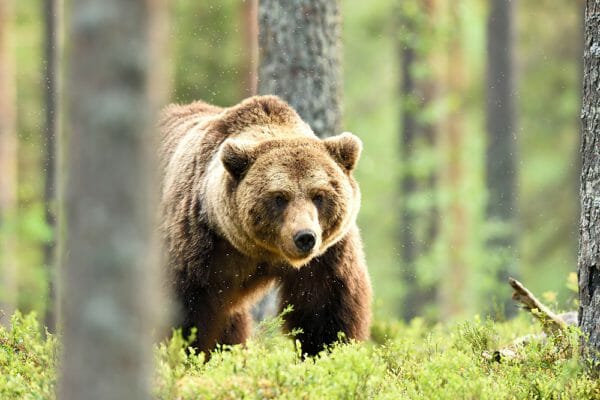
One theory about defending against bear attacks is this: Defenders must be careful not to shoot a bear without immediately killing it, because wounded bears are more likely to attack. The theory has been put forward for many decades. One of those who put the theory up for consideration was Stephen Herrero in his book, “Bear Attacks: Their Causes and Avoidance“. On page 241 of the 1985 edition, Herrero writes:
Of course, if an aggressive bear actually attacks you or a companion, a firearm may be a lifesaver, or it may cause a wounded bear to intensify its attack.
Herrero puts forward the theory. He does not appear to have data to determine how common such reactions may be. His speculation has been shared by numerous others.
With over 200 documented incidents where a handgun was fired in defense against bears, this correspondent has numbers that indicate 21% of bears continue to attack after they are shot.
Of 175 incidents in which bears were shot, bears stopped attacking in 138 cases and persisted in 37 cases. Warning shots were effective in 23 of 44 cases. In 8 of the 23 cases, the positive effect of the warning shot(s) was temporary. In four cases, it could not be determined whether the bears were wounded or whether the shots were effective. Of the 175 incidents where bears were shot, 29 were shot after a person was already injured by the bear. Of the 146 incidents where the bear was shot before a person was injured, the bears persisted after being shot in 31 cases, also 21%.
Bear attacks are often complicated. Some incidents fall into multiple categories.
For example, two experienced outdoorsmen were archery hunting in Montana in 2019. A grizzly bear attacked without provocation in dense cover. One of the hunters was being mauled before any shots were fired. The other hunter fired a shot from his 9mm and drove off the bear, wounding it. The bear persisted in coming back twice, and the mauled hunter fired his 9mm, driving the bear away. Those shots probably missed, but stopped the persistent attack. In some cases, shooting can precipitate an attack.
In cases where bears persisted after being shot, over half the attacks were stopped before a person was injured. In the cases of persistence, the defense was successful in stopping the attack in all cases, even after a human was injured, except for one, the case of the .22 rimfire defense against a polar bear. To put it another way, when you only look at cases where the bear was shot, the success rate rises to 1 failure in 175 cases, or over 99%.
In the three other failures of handguns fired in defense against bears, it seems likely the bears were not shot. One was a failure of warning shots fired to drive off a polar bear. No humans or bears were injured. In the other two cases, it seems likely the bear was not wounded. Extreme speed and accuracy are not required for a successful defense in most cases.
Bears do not like to be shot. Most bears stop attacking when shot or killed.
Most bears that persist in attacking after being shot are killed. One of the societal advantages of killing these aggressive bears is that their genes are removed from the gene pool. Bears in their generation learn that attacking humans is dangerous. The site where a human killed a bear is like a scent version of a neon billboard in the woods. As the erudite Valerious Geist has written, this is a valuable outcome that protects everyone who uses wildlands in bear country.
It must be noted that hunting bears is different from defending against bears. Hunters who wound bears are morally bound to follow the wounded bear to finish it off. Defenders are not so bound. A wounded bear is more likely to attack a hunter who is following it after it has been wounded. This is different from a wounded bear continuing to attack after the bear initiated the attack.
Bear spray has been widely touted as more effective than firearms. The studies used to compare the two were not designed for such a comparison. The studies have serious selection bias, as acknowledged by the authors.
A better comparison is the number of people who have been killed when bear spray was sprayed against a bear compared to the number of people killed when a handgun has been fired in defense against a bear. These incidents tend to be widely reported, reducing or eliminating selection bias.
In my research, I’ve found eight documented cases where people were killed by bears, in which bear spray was used during the attack. This correspondent has found one documented case where one person was killed by a bear, where a handgun was used during the attack, the polar bear incident with the .22 rimfire handgun in the Svalbard archipelago.
Warning shots can work. In one-third of instances, their effect is temporary. They buy time for the defenders. Seconds can be precious in preparing a more effective defense.
About Dean Weingarten:
Dean Weingarten has been a peace officer, a military officer, was on the University of Wisconsin Pistol Team for four years, and was first certified to teach firearms safety in 1973. He taught the Arizona concealed carry course for fifteen years until the goal of Constitutional Carry was attained. He has degrees in meteorology and mining engineering, and retired from the Department of Defense after a 30 year career in Army Research, Development, Testing, and Evaluation.



Love these Bear Articles Dean.
Pain is a deterant, common to all animal life.
Having never been pepper sprayed or shot, I don’t know first hand which is more painful.
Firearms have an obvious advantage in range, accuracy, noise and are often quicker to draw aim and shoot. Firearms are also less affected by wind or rain.
All things considered I’d put pepper spray well below firearms, and just above throwing rocks.
Quote from Dean: Most bears stop attacking when shot or killed.
It’s those bears that keep attacking after they’ve been killed that are the most dangerous.
I once scared off a Grizzly by simply opening a noisy balcony door, but I’ve determined that carrying such a door with me in the field is impractical.
When I see a bear article here by Dean, It’s always the first thing I read. I live in black bear country, have baited them for bear hunters for the past 20 years, and have had the ‘pleasure’ of tracking 5 wounded bears in the dark, after the shot by the hunter didn’t drop them where they stood. We found 4, all were dead. I bought a thermal imager just for this fun endeavor, after the first 2 situations where we were mere yards away from finding the bear. That might’ve turned out differently if they were still alive. What’s… Read more »
These are important articles for many reasons. First, for those of us who live or play in bear country. Second, for public policy and the need for self-defense laws against wild animals. Re: Herrero. Dr. Herrero was an academic. Many academics spend their pre-doctoral research time in the field for six months. Then they write about it for the rest of their careers. Clinicians, or woodsmen, spend their time in the bush. One such bushman was James Gary Shelton who lived in Bella Coola, BC, for almost 50 years. Bella Coola is grizzly and black bear country and residents live… Read more »
Great article, great information Dean.
Concur with EOD, these articles are informative and remind us there are things out in the woods, that would eat us, if given the opportunity. Whenever I’m out in the woods, I’m careful anytime I encounter any wild animal. I give them all the space needed to clear out of my vicinity when passing through. I’ve encountered black bears, but once it knew I was there, it took off and didn’t slow down leaving the area. I never go into the woods without being armed and prefer to be ready should an encounter with an aggressive animal require lethal force.
The Polar Bear 22cal Location: Pyramiden, a settlement in the Svalbard archipelago, Norway. The weapon was a rifle Not Pistol The man, a worker, attempted to scare the bear with shots, but it charged, forcing him to drop the weapon, jump on a snowmobile, and flee to safety. https://www.youtube.com/watch?v=NtmoeER9scQ https://www.tiktok.com/@abcnews/video/7498694369482935583?lang=en Gun vs Bear Spray To many variable’s for a correct answer to have something is better than nothing. Education in bear country for the experienced outdoors person or the novice could not be more important. Those folks who think wildlife is not dangerous stepping out of their car van SUV or… Read more »
Correction: “Most bears stop attacking when shot or killed.”Should be “Most bears stop attacking when shot or they are killed.”
Has anyone done any testing or evaluation of the effectiveness of 9MM hardball vs self defense ammo vs lead hard-cast against bears or in ballistic gel? It’s my understanding that penetration is king against bears, with accuracy/shot placement still being critical.