
By Sean Maloney, Esq.

In the recently published decision of United States v. Alsenat (2026), the Eleventh Circuit Court of Appeals affirmed a conviction involving Machine Gun Conversion Devices (MCDs), specifically “Glock switches.” The panel rested its holding on the claim that machineguns are not protected arms in common lawful use. However, the district court also accepted the government’s fallback theory that unattached conversion devices are mere “accessories” or “accoutrements,” not protected “Arms.”
That accessory framing should alarm gun owners.
To the casual observer, this may seem like a minor semantic point. To a firearm attorney, it is a transparent attempt to deconstruct the Second Amendment by its parts.
As one of the attorneys who represented the Buckeye Firearms Association in our successful suit against the City of Cincinnati regarding their bump stock ban, I have seen this “accessory gambit” before. It failed in Ohio, and it should fail in the federal courts as well.
Lessons from Buckeye Firearms Association v. City of Cincinnati
When Cincinnati attempted to bypass Ohio’s firearm preemption law (R.C. 9.68) to ban bump stocks, their primary legal tactic was to argue that a bump stock was a mere “accessory” and not a “component” or “part” of a firearm. They believed that by changing the label, they could evade the state’s “uniform laws” mandate.
Our legal team challenged this head-on. We argued that a device that interacts with the fire-control group to enable a specific cycle of fire is, by definition, part of the firearm. The Court of Common Pleas agreed, and the First District affirmed, providing a definitive rebuke to the City’s logic. The court recognized a fundamental truth: you cannot regulate the function of an arm by arbitrarily declaring its internal timing and fire-control components to be “accessories.” The ruling stated clearly that components like a bump stock are included within the definition of “firearms.”
The Mechanical Truth of the Glock Switch
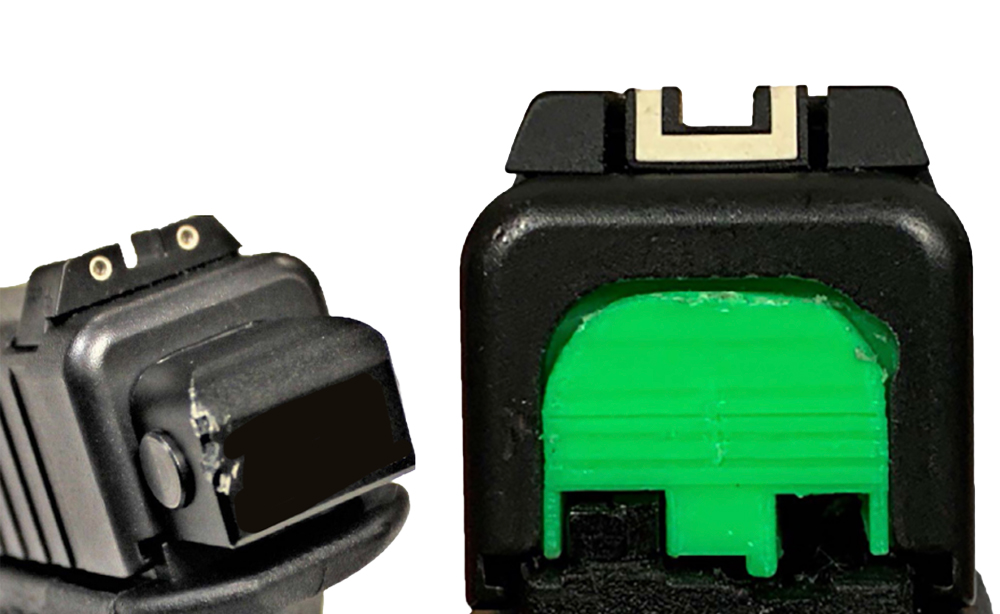
The Alsenat court pretends a machinegun conversion device is a bolt-on trinket, leaving the base pistol untouched. That’s fiction in engineering; function defines firearm components. The switch replaces the factory slide cover plate, a static cover in stock form. Once installed, it transforms that “spot” into the active sear and striker-timing mechanism.
If you extract it from a tuned setup, you are left with a gutted slide, an inert striker, and a brick. This brings us to the point that you can’t call a heart an “accessory” to a human body just because it can be transplanted. Similarly, you shouldn’t call a sear or a timing mechanism an accessory just because it can be swapped. By any “Mechanical Essentiality Test,” the part is integral: absent the part, the configured arm fails to operate as intended. If a part is necessary for the firearm to function in its current configuration, that part is the firearm.
Deconstructing the “Arm”
The heart of the Alsenat error lies in the definition of a “Fire Control Group” (FCG). In any machine, the parts that maintain synchronization, like the timing belt in an engine are internal components, not optional decorations. By labeling the component that dictates the timing and release of the striker as an “accessory,” the court suggests that a firearm’s most vital “organs” can be stripped of constitutional protection.
If the courts are permitted to redefine integral fire-control components as “accessories,” they grant the government the power to deconstruct any modern firearm into a series of “unprotected” pieces. Under this logic, a trigger assembly, a bolt carrier group, or even a barrel could be reclassified as an “accessory” to circumvent the Second Amendment.
The Constitutional Sleight-of-Hand
The Eleventh Circuit used Heller’s “dangerous and unusual” idea to avoid checking the real mechanics of Glock switches. It is a convenient shortcut. Instead of engaging with the rigorous history-and-tradition test established in Bruen, the court relied on wordplay.
If the Supreme Court seeks to reverse Alsenat, it cannot rest on a faulty mechanical foundation alone. The Court must ground its reasoning in Bruen’s history or Heller’s core protections, unmasking the “accessory” label as constitutional sleight-of-hand. Rahimi and Bruen require the government to show a historical analogue for such bans, not just a clever new vocabulary.
Conclusion
Cincinnati proved it: parts that make a gun work aren’t add-ons; they’re the gun. Law must match how guns actually function.
When a court calls a firing mechanism an “accessory,” it isn’t just misinterpreting engineering—it is eroding the very definition of the “Arms” we have a right to keep and bear.
About Sean Maloney
Sean Maloney is a criminal defense attorney, co-founder of Second Call Defense, and an NRA-certified firearms instructor. He is a nationally recognized speaker on critical topics, including the Second Amendment, self-defense, the use of lethal force, and concealed carry. Sean has worked on numerous use-of-force and self-defense cases and has personally trained hundreds of civilians to respond safely and legally to life-threatening situations. He is a passionate advocate for restoring the cultural legitimacy of the Second Amendment and promoting personal responsibility in self-defense.



Even if it is an accessory to a firearm – it remains something a man may pick up to cast or strike another. Arms are any items useful for defense or offense – including everything from slings, holsters, camo, and body armor to night vision and machine guns. Calling something an accessory should not remove Bruen protections. Unfortunately as long as SCOTUS does not enforce their precedence over lower courts, they will continue to rule on their feelings instead of on the law.
There is no mention of “accessories” in the US Constitution. As an example, there is no mention of the use of sunglasses in the military when it comes to making soldiers in sunny environments more effective at fighting wars. We shoot better whenwe can see better.
I think the hard part for democraps is the concept in understanding the meaning of big words like, “Shall not be infringed.”
Reminiscent of what the word “sex” means in regards to philandering in the Oval office.
It may be bold of me to say that Scalia was meek and erroneous in Heller. However if our legal history is to go back centuries to medieval England, it should only be recognized if it supports justice and our liberties. If it would limit our freedoms like “dangerous and unusual” I don’t care if it is in Blackstone or White Marble, it should be discarded like King George III. And what the hell does “in common use at the time” mean? If nothing else it is an ambiguous word trap. The logic behind machine gun restrictions are all backwards… Read more »
One thing no one other than Mark W Smith “Four Boxes Dinner” forget to cite from the text of Justice Thomas’s majority opinion is “Arms” include instruments that facilitate armed self defense. Accessories are instruments and many arms accessories like adjustable butt stocks, vertical for grips, suppressors, magazines with capacities in excess of arbitrary limits, 15 rounds, components that increase the cyclic rate of semi-auto firearms such as FRT’s binary triggers, bump stocks, low mass bolt carriers & buffers, higher spring rate recoil springs, etc. All of these “facilitate” armed self defense.
When one is looking for a reason.
One tends to find the answer one is looking for.
Well said, sir. That is the best explanation of this situation I’ve ever heard. I hope everyone involved in this situation reads this, preferably more than once.
Although I agree with the argument as far is it goes (I’ve made the same argument myself concerning magazines – they are not integral parts, but they are essential to the proper function of many semi-auto firearms and are therefore “parts” and not merely “accessories”). The problem here is that the Glock switch has been made illegal because when it is installed (becoming an essential part required for the operation of the pistol), it creates of the pistol a device (a fully automatic weapon) that is effectively illegal to possess. Now, whether or not the government has the authority to… Read more »
I presume what the author is trying to warn us of is the danger of treating only the serial numbered part as the firearm. Everything else becomes an accessory which can be banned or regulated out of existence, thus leaving us with nothing more than an ineffective club.