
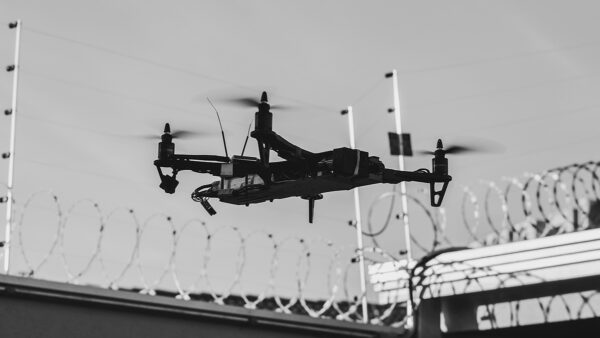
Flock Safety has been all over the news in recent years, sparking intense debates about its widespread network of automated license plate reader cameras used to track the movements of ordinary Americans. Critics argue the technology creates a persistent surveillance grid that records where people drive, when they travel, and who they associate with, often without individualized suspicion or a warrant. Yet a greater threat to privacy is already taking shape through Flock, and companies like it. The firm’s aggressive expansion into aerial platforms threatens to transform static street-level monitoring into a mobile, nearly invisible mesh of airborne surveillance.
In October 2024, Flock Safety acquired Aerodome for more than $300 million. Aerodome, a young startup focused on Drone-as-a-first-responder technology, developed an NDAA-compliant, American-made drone system now marketed under the Flock Alpha name.
Flock Alpha Combines Plate Readers, Thermal Imaging, Live Video, and Gunshot Detection
The Alpha functions as a mobile flying extension of Flock’s existing camera network, but its capabilities far exceed those of any stationary pole-mounted unit. According to company materials and independent reporting, the drone can read license plates from up to 2,000 feet away using a multi-sensor payload that includes high-resolution optics, thermal imaging, and low-light performance. It integrates directly into the Flock network and software suite, allowing plate reads captured in the air to feed the same databases and hot-list alerts that ground-based Falcon cameras already populate.
The Alpha does not stop at automated license plate recognition. It also includes a gunshot-detection capability that can trigger automated launches when sensors detect potential gunfire. This technology is conceptually similar to systems such as ShotSpotter, which has faced sustained criticism over accuracy. A 2021 report from the Chicago Office of Inspector General examined tens of thousands of ShotSpotter alerts and found that evidence of a gun-related criminal offense was documented in only about 9 percent of police responses. Independent analyses and city data from other jurisdictions have similarly questioned whether acoustic gunshot detection consistently delivers actionable results or simply generates large volumes of responses that yield little evidence. Pairing an imperfect acoustic system with a rapidly deployable aerial platform risks amplifying false positives while expanding the geographic reach of the response.
Beyond plate reading and gunshot alerts, the Alpha can transmit live high-definition and thermal video feeds directly to a real-time crime center or control room. Operators can observe streets, parking lots, and public spaces in real time, directing the aircraft as needed. Unlike traditional police helicopters, which are loud and highly visible, drones operating at altitude can be remarkably quiet. This reduces the chance that people on the ground will even know they are being watched. The combination of range, quiet operation, and seamless data integration means law enforcement can maintain persistent visual coverage of areas without the logistical and financial burden of manned aviation.
Rooftop “Hives” Could Provide Around-the-Clock Coverage
Police departments are already installing automated docking stations, often called “hives,” on station rooftops and at other fixed locations. These docks allow drones to launch autonomously when an alert is received, navigate to coordinates, stream video, and then return home when battery levels drop. Once back at the hive, the aircraft lands, swaps or recharges batteries, and is ready for the next mission—often in under 90 seconds. Agencies can operate multiple hives across a jurisdiction, enabling near-continuous aerial coverage at a fraction of the cost of maintaining helicopter fleets. The result is a system that can keep eyes in the sky around the clock without requiring a pilot on every flight.
Flock is not alone in this space. Skydio, another major player in public-safety drones, produces aircraft with similar autonomous docking and flight capabilities. Skydio systems can integrate live video feeds into Flock’s software platform, enabling agencies that use both vendors to view drone footage alongside fixed-camera footage, license plate data, and other sensors in a single interface. Company materials and deployments describe networks of docks arranged in “hives,” sometimes envisioned on buildings throughout a city. While proponents emphasize beneficial uses such as locating missing persons or providing rapid situational awareness during emergencies, the same infrastructure that enables those missions also creates a flexible surveillance blanket whose coverage can shift in seconds.
Taken together, these systems allow government agencies to construct a mesh of surveillance that is far harder to detect or map than today’s fixed Flock cameras. Stationary ALPR units are visible; their locations can be noted, photographed, and sometimes challenged in court or through public records requests. Drones, by contrast, can be repositioned rapidly. A neighborhood that had no aerial coverage one hour can have multiple aircraft overhead the next, triggered by an LPR hit, a gunshot alert, a 911 call, or a manual command. The mobility itself becomes a feature that complicates oversight and public awareness.
From License Plates to Electronic Device Fingerprints
An even more concerning evolution is already visible on the technological horizon. While no widely deployed police drone is yet publicly known to carry a system exactly like SignalTrace, the concept is under active development and marketing. SignalTrace, offered by Leonardo’s ELSAG division, is designed as an add-on for license plate reader infrastructure. It passively collects wireless signals broadcast by nearby devices—smartphones, smartwatches, earbuds, fitness trackers, and vehicle infotainment systems- and correlates those identifiers with ALPR data. The system creates, the company says, an electronic fingerprint that links devices that travel together with a particular vehicle. Investigators can then track the device signatures even if plates are changed or obscured.
If a similar signal intelligence capability were integrated into a drone platform, the implications would be profound. An aircraft could fly a neighborhood grid, capture license plates, and simultaneously map the wireless signatures associated with homes, vehicles, and individuals, all without entering private property or obtaining a warrant based on particularized suspicion. The data harvested could reveal not only who owns which cars but which electronic devices routinely travel with them, effectively turning everyday consumer electronics into tracking beacons. For gun owners and others concerned about government overreach, this fusion of aerial mobility, plate reading, acoustic detection, and device fingerprinting represents a qualitative leap beyond current surveillance tools.
The companies involved frame these systems as force multipliers that improve response times, officer safety, and crime-solving rates. Flock materials highlight rapid arrival times, reduced need to dispatch patrol units for certain calls, and successful recoveries of missing persons. Autonomous docks and multi-drone coordination are presented as efficient, scalable solutions to the resource constraints faced by many departments. Yet efficiency and capability do not automatically equate to constitutional restraint. The same features that allow a drone to reach a shooting scene in under two minutes also allow it to linger over residential streets, follow vehicles for extended periods, or systematically collect data across entire communities.
Why Gun Owners Should Pay Attention
Legal and policy frameworks have not kept pace with the technology. Fourth Amendment protections against unreasonable searches were developed in an era of physical intrusions and limited technological capability. Courts have begun to grapple with prolonged vehicle tracking and bulk data collection, but the combination of autonomous aerial platforms, real-time multi-sensor fusion, and potential device-signal correlation raises novel questions. When does continuous or on-demand aerial observation of public spaces cross into a search? How long may data be retained, and who may access it? What limits, if any, exist on correlating plate reads with wireless device signatures? Absent clear statutory rules or robust judicial oversight, the default trajectory appears to favor expanding collection first and litigating the boundaries later.
Gun owners have a particular reason for vigilance. Firearms-related data already appears in various law-enforcement systems through background checks, registration regimes in some states, and investigative databases. Layering mobile aerial surveillance capable of reading plates from significant distances and potentially linking vehicles to personal devices increases the risk that lawful activity, traveling to a range, a gun store, or a political event, becomes part of a permanent digital record. Even if individual officers act in good faith, the existence of searchable, long-term repositories of movement and association data creates opportunities for mission creep, political targeting, or simple error.
The path from fixed ALPR cameras to autonomous drone fleets and potential signal-intelligence add-ons has unfolded rapidly. Flock’s acquisition of Aerodome in 2024, the subsequent development and marketing of the Alpha platform, integration pathways with competitors such as Skydio, and the parallel emergence of systems like SignalTrace illustrate how commercial technology vendors and public agencies can jointly expand the surveillance perimeter with limited public debate. Each incremental capability, quieter flight, longer range plate reading, automated launch, live video sharing, and device correlation can be justified in isolation as a public-safety improvement.
Collectively, they form something closer to a continuous, adaptive observation system whose presence is difficult for ordinary citizens to detect or challenge.
Burchett Bill Aims to Stop Flock Cameras From Tracking Americans — Including Gun Owners
About John Crump
Mr. Crump is an NRA instructor and a constitutional activist. John has written about firearms, interviewed people from all walks of life, and on the Constitution. John lives in Northern Virginia with his wife and sons, follow him on X at @right2bear, or at www.crumpy.com.





“Flock Alpha” is not that catchy a name. How about “Skynet”? But seriously, I can see logical expansion of several other concepts, both by entities using this system, and by those opposed to it: AI drone flock operation, where AI decides who are the “usual suspects” and how to follow them; more dedicated anti-drone weapons, including guns and “hunter/killer” drones.to sneak up and destroy other drones; “cry wolf” automated fake gunshot generators that make gunshot detection systems even less-reliable; and there are sure to be weaponized drones fitted with missiles, bombs or guns to deal with us “undesireables”. Yep, hello… Read more »
Even George Orwell is turning over in his grave.
There are some technologies that should be denied to governments. If governments have shown us anything, they have shown us a disturbing propensity to misuse and abuse technology (as well as the law), to the detriment of the law-abiding citizen (while treating us as if we’re all potential criminals). The never-ending increase in the ability of governments to collect information about us that it has no right to know must be stopped. This won’t make us less safe than we are, it can only make us less safe than we might be. The additional safety comes at too high a… Read more »
Looks like I need to increase my 12 gauge shells cache.
A brave new world for sure.
Read a interview with Flock surveillance cameras CEO Garrett Langley. He says his goal is to have Flock surveillance cameras in every city in America. Flock surveillance cameras have made Garrett a multimillionaire. He sounds like a smug smart ass. He makes wild claims that the Flock surveillance cameras have solved a million crimes. Huh? And so a million people are now in jail? I’m sure. He said the Flock surveillance camera stop crime, stop kidnappings , stop cars from being stolen, and stop drug dealing. He said the cameras are for your own good. Article said that many people… Read more »
Does anyone remember 1984 or a Brave New World, how about Fahrenheit 451? Big Brother is every where there is no place that is safe
There are a number of comments here on drone defense weapons. We (the People) should develop those now, whether we use them or not. In the future, we may not have time to develop them and at that point Federal regulations may not matter.
While it is illegal to shoot at drones I would be curious to see whether it is illegal to shoot down a test drone that you launched for the purpose of testing. If we can develop these, we could make a lot of money selling them to other places that are under drone attack now.
HLB
Shooting down a drone is a federal felony. But, one can’t help it if their drone loses control, crashes into another unknown aerial obstacle.
“This reduces the chance that people on the ground will even know they are being watched” Yep, this is what bothers me; Officer George Orwell uses the aerial surveillance of drones just like he does the fixed Flock video cameras to check on an ex wife, girl friend, “boy friend” or any of the other thousands of illegal reasons for this device. We are becoming just like Great Britain with cameras everywhere