

On February 8th, 2024, my brother had started his morning exercise walk. It was 6:27 am his time when I received the phone call; it was still dark in northern Wisconsin. It wasn’t what I expected.
Only 200 yards from his home, on a lonely country lane with dense forest and brush on both sides, he was confronting a pack of wolves, their reflective eyes easily visible in the beam of his headlamp. The pack of six was less than 30 yards away. Wolves are common in the area. Common and protected. The brush was fairly thick; the eyes were relatively low to the ground. It was clear what the animals were. Their behavior was alarming. He shouted. He made short rushes at them. They were not intimidated or alarmed. He had a Glock 23 and a spare magazine. He dropped my call and called his wife, only two hundred yards away. She arrived in a couple of minutes, bringing his 12 gauge tactical 870 with tac light forend and red dot sight, stoked with buckshot. As the vehicle approached, the wolves left. My brother said the feel of the 870 in his hands was comforting.
Just a few months ago, in 2023, a black wolf had closed to within 15 yards of the 15-year-old daughter of a close friend while she was hunting deer. The wolf had run off when Sarah turned around with her rifle. Her encounter happened only 300 yards from where my brother confronted the pack. He and I came across a road-killed young wolf in the fall of 2022, about a quarter mile in the opposite direction.
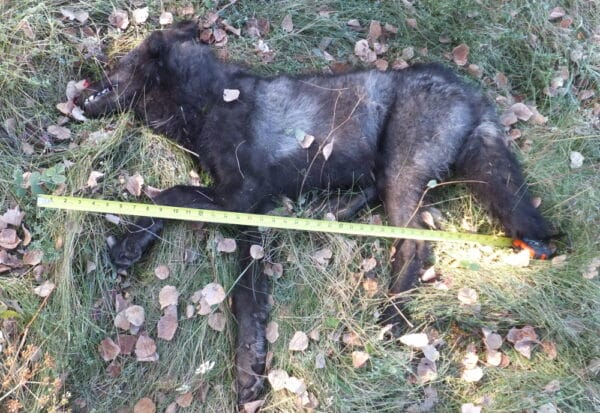
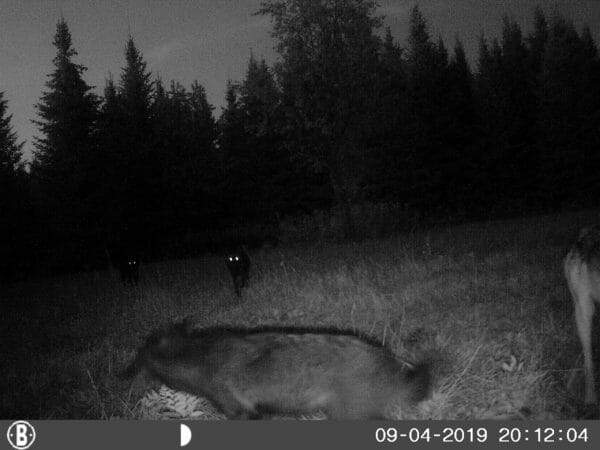
The picture of a pack of wolves from a game camera, taken in 2019, was taken about a mile from his home.
Only a month ago, a wolf was shot in self-defense just 60 miles away.
Wolves that hold their ground when confronted with a human and wolves that do not retreat when yelled at or bluff charged are a problem, as explained by Dr. Valerius Geist, the eminent biologist, and expert on wildlife management. The myth of the harmless wolf developed because people in North America were commonly armed and capable of dealing with wolf packs. The introduction of modern firearms, steel traps, snares, and poison made humans the uncontested apex predator. Wolves learned to avoid humans to survive. The myth of the harmless wolf was born.
Protect wolves from humans with punishing legislation, prevent them from being shot, trapped, snared, or poisoned, and they lose fear and respect for humans. They are subject to the immutable laws of physics. They have developed a healthy fear of cars, which have become their main “predator.”
Those who constantly call for more and more wolves do not have to live with them. They live in urban centers and read fables about wolf behavior, such as “Never Cry Wolf” by Farley Mowat. Mowat made a great living by telling tall tales, but his work was mostly fiction, depicted as fact.
If you wish for an easy read that gives a realistic picture of wolves, read “The Wolves of Alaska” by Jim Reardon. He treats Mowat gently, a bit too gently, perhaps.
As time progresses, more people will be killed by large predators in the United States. There was a reason our forefathers worked hard to rid the land of large predators. They are not fun to live with when you depend on production from the land to survive.
60 years ago, this correspondent did not worry about wandering the woods of northern Wisconsin unarmed. We often carried firearms while hunting, trapping, or shooting varmints. We didn’t worry about it if we were unarmed.
Today, when I enter the woods, I carry a handgun as a matter of habit and caution. I consider Thomas Jefferson’s advice on exercise:
“…I advise the gun. While this gives a moderate exercise to the body, it gives boldness, enterprize, and independance to the mind. Games played with the ball and others of that nature, are too violent for the body and stamp no character on the mind. Let your gun therefore be the constant companion of your walks.
About Dean Weingarten:
Dean Weingarten has been a peace officer, a military officer, was on the University of Wisconsin Pistol Team for four years, and was first certified to teach firearms safety in 1973. He taught the Arizona concealed carry course for fifteen years until the goal of Constitutional Carry was attained. He has degrees in meteorology and mining engineering, and retired from the Department of Defense after a 30 year career in Army Research, Development, Testing, and Evaluation.


“She arrived in a couple of minutes, bringing his 12 gauge tactical 870 with tac light forend and red dot sight, stoked with buckshot.” An intelligent man. Having the time to do so, rather than attempt to deal with the problem with his handgun, send back for more firepower! I’m a devotee of this school. The one that believes that pistols are for unexpected lethal encounters, whereas long guns are for expected lethal encounters. If we know we’re going to be shooting something, we generally choose a rifle or a shotgun. With certain exceptions, OFC. Like bow and handgun hunters,… Read more »
Between the known four-legged predators, and the unknown two-legged kind, a wise man will be armed whenever he departs his front door. This is known as “an old man’s wisdom” and is how I got to be an old man.
A smart man is willing to increase the odds in his favor.
Wolves in Wisconsin and Venezuelan illegal alien street gangs in New York. We live in a dangerous world. One should go through life well armed and trained.
nice article. I half expected the protagonist have a shotgun slung over his shoulder as well as a pistol in his belt. A couple of years ago a deer hunter in Eastern Washington had a similar experience. Maybe a bit more dynamic and certainly a bit more lonely. The Smackout Pack territory is in Ferry County, a very rural place with most of the county being public land, part of the Colville National Forest. The hunter saw a large wolf in the middle of the trail he was treading. The wolf was staring at him as the remainder of the… Read more »
The man was out on his morning exercise walk, how much stuff should he carry? I thought he was properly prepared for the day.
I have land east of Hayward. Last November I hunted deer for a day. I didn’t see any deer, but there were wolf tracks in the snow. I suppose the progressives prefer the wolves to kill the deer instead of hunters.
I live in northern WI “wolf territory”. I’ve lived here since 1991, hunted the nothwoods since 1964 when I was age 14. Up until 2015, I had never seen a wolf in the wild, nor knew anyone that wasn’t around in the 1930s-40s who had seen one. While bear baiting in the summer of 2015, I was amazed that we had over 200 pictures of wolves on our 3 trail cameras overlooking 3 bait sites. I even got a picture of 3 wolves driving a decent sized bear off a bait ! In 2016 baiting season, I had a pack… Read more »
Instead of dropping your call he should have dropped some wolves. Once he reloaded he should have called his wife.
I think a air horn you buy at walmart for your boats would work just fine. If that don’t hurt their ears they have to be deaf. lol I would like to try one on a bear attack to see what would happen. I think that would be better than bear spray.