
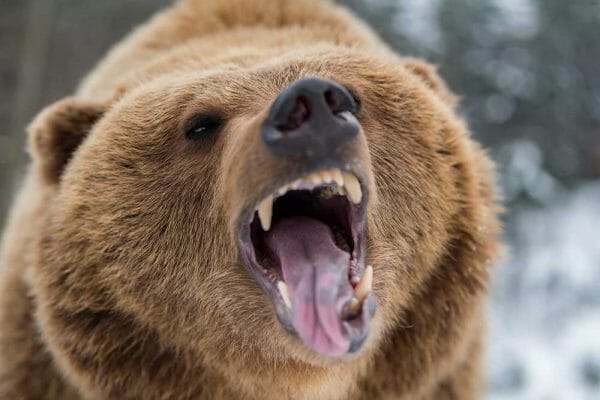
On the evening of May 21, 2025, Justin Lee and his brother-in-law, John Long, were charged by a grizzly bear and were forced to shoot it in self-defense.
They were hunting for mushrooms along Spring Creek, on a property owned by Justin, a few miles north of Choteau, Montana. Both men are longtime residents of the area. The creek has lots of mature cottonwoods, waist-high dead grass, and a fair amount of brush in some areas. Justin and John drove to the property on a side-by-side four-wheeler. When they were close to the area where mushrooms had been found, they parked the side-by-side and proceeded on foot.
Justin is 57 years old, and John is 43. Justin is disabled and cannot move fast on foot. John was about 50 yards ahead in the woods when Justin saw him running back toward him, saying, “There’s a bear! There’s a bear!” John said he had seen a bear and a cub.
The bear was south of them. Justin could see and hear the bear moving cross-wind toward the east, trying to get wind of them. The wind was mostly from the northwest, about 15 mph. In complex terrain, wind forms eddies and swirls around in complex patterns.
They saw the bear moving toward them from about 50-70 yards away, now southeast of them. The bear stood up, sniffing and looking. She appeared to get their scent and started jogging toward them. Justin thought: she is trying to work herself up to a charge.
At 30 yards, the bear put her ears back and charged. Justin and John drew their pistols and started firing. John was on Justin’s right, about 10 feet away. He was armed with a 1911-style .45 ACP. Justin had a Glock 20 chambered in 10 mm. John fired five shots, Justin fired three shots.
Justin said, “the bear looked as big as an elephant coming toward us.”
Justin believed bear spray would have been useless because of the variable wind. Justin was using a mix of Federal full metal jacketed and hollow point rounds in the Glock, while John was using his .45 ACP.
At about 20 yards, the bear, obviously hit, veered to Justin’s side and out of sight, moving north. North was toward the property boundary. Mary Sexton owned the property on the other side. They called Mary to alert her to the possibility of a wounded grizzly coming her way. They re-mounted the side-by-side four-wheeler and headed toward Truchot Hill, hoping they would be able to spot the bear from the top of the hill. On the way, they stopped at Sheriff VanSetten’s home and let him know what was going on. They called the local Montana Fish, Wildlife, and Parks (FWP) Wildlife Management Specialist, Chad White, and informed him of the encounter.
Live Inventory Price Checker

|
20 Gen 5 Mos 10mm Auto Semi-Auto Handgun - Glock 20 Gen 5 Mos 10mm Auto 4.61'''' Bbl (3)15rd Black Us | Brownells.com | $ 620.00 |
|

|
20 Gen 5 Mos 10mm Auto Semi-Auto Handgun - Glock 20 Gen 5 Mos 10mm Auto 4.61'''' Bbl (3)10rd Black Us | Brownells.com | $ 620.00 |
|

|
Glock 20 Gen 5 10mm Auto Magazine - Magazine Fits Glock 20 Gen 5 10mm Auto 15-Round Black | Brownells.com | $ 25.99 |
|

|
Glock 20, 20SF Gen 5 Magazine 10mm Auto 15-Round Polymer Black | MidwayUSA | $ 24.99 |
|
Justin and John drove to the top of Truchot Hill and used binoculars to spot the bear. They located it near the boundary of the Sexton property, about 300 yards away. The bear was down, but not dead. It had traveled about a hundred yards from where the conflict had taken place. As they watched the bear, it alerted, got up, and moved off, out of their sight. When investigators found the bear, it had expired.
The bear was a sow, about 300 lbs. It would probably have weighed over 400 lbs in the fall, after it would lard up for the winter.
Justin believes the incident only lasted about 15 seconds, but it seemed much longer.
With a little training and practice, an ordinary person can learn to draw and fire two aimed shots in two seconds. Both men carried pistols specifically because of the potential need for self-defense. They did not expect to use them; they carried them “in case.”
May 21st, 2025 was that “in case” day.
Justin said he did not want to shoot the bear, but it was necessary. He had seen lots of bears, and the bears had always run away. For whatever reason, this bear was unafraid of humans. It was the rare exception. Most grizzly bears, even sows with cubs, run away from humans. Most bears have been taught or have an instinct to avoid humans because humans are dangerous.
When Justin was a child, he played on and explored Spring Creek. Today, children are not allowed to do so because of the danger posed by grizzly bears. Grizzly bears have become common near Choteau. There have been several defensive shootings of grizzlies in the area, as well as serious injuries inflicted by grizzly bears.
In 2021, Leah Lokan was dragged from her tent and killed inside the village of Ovando, Montana, about 70 miles from Choteau. Leah had bear spray, but no firearm.
Grizzly bears can learn to respect humans as dangerous predators to avoid. The easiest way to accomplish this is to allow them to be hunted.
Alaska has about 30,000 grizzly bears. The lower 48 states have about 2,000 grizzly bears. The two populations of bears kill about the same number of humans. Most of the bears in Alaska are subject to regular hunting seasons, although significant grizzly populations in Alaska are not. None of the grizzly bears in the lower 48 have been subject to regular hunting seasons for at least 34 years, and most for 48 years, several bear generations.
Sweden has had a European brown bear population (grizzly bear) increase similar to the population increase in the lower 48 states, from about 500 bears treated as pests in 1977 to about 2,800 bears in 2016. In that period, two humans were killed by bears. There were regular hunting seasons over the whole period. The number of bears allowed to be harvested was tightly regulated after 1977.
In the lower 48 states of the United States, the grizzly bear population was about 700 in 1975. Very limited hunting in Montana was stopped by 1991. The grizzly bear population increased to close to 2000 by 2016. There was no legal hunting for grizzly bears in the lower 48 after 1991. From 1977 to 2016, 17 humans were killed by grizzly bears in the lower 48 states. The vast majority of the grizzly bears in the lower 48 states were never hunted from 1977 to the present.
Correlation does not prove causation, but it can be a good indicator. Higher-level mammals such as grizzly bears learn from and respond to hunting pressure. Restoring the hunting of grizzly bears in the lower 48 will likely reduce grizzly bear attacks on humans.
Handgun Defenses Against Bear Attacks – 170 Documented Incidents, 98% Effective
About Dean Weingarten:
Dean Weingarten has been a peace officer, a military officer, was on the University of Wisconsin Pistol Team for four years, and was first certified to teach firearms safety in 1973. He taught the Arizona concealed carry course for fifteen years until the goal of Constitutional Carry was attained. He has degrees in meteorology and mining engineering, and retired from the Department of Defense after a 30 year career in Army Research, Development, Testing, and Evaluation.

smart men, carry in case something happens
Great job in collecting the details
Fire arms have been proven to be very effective in defending ones self
The naysayers here have never been around grizzly bears,
Montana, or dealt with the shifting winds here.
I really appreciate your in-depth Bear articles Dean. I’ve said this before, I certainly hope you’re considering building these very informative and potentially life saving articles into a book. It would make a great addition to everyone’s library whether you’re a hunter, hiker, mushroom picker or just someone who goes outdoors living in or visiting apex predator locations.
Good thing they had not had any mushrooms, might not have thought bear was a threat , wow man look at the hairy chick ………
With a few caveats, it appears that bear spray can sometimes work. That is, assuming you become aware of the bear in plenty of time to be able to nimbly climb a tree and prepare your bear spray, AND the bear isn’t sufficiently enraged to go ahead and kill you anyway even after you spray it (and possibly yourself depending on wind direction), you’ll sort of hopefully probably be mostly fine, maybe! 🙂
https://www.youtube.com/shorts/a9t_VOWc0IM
I dont believe half these stories about bears charging people. first of all even shot a few times the bear had plenty left to kill one of them maybe both but she didnt. I think they just felt like shooting it from maybe 20 yds and she just ran away
“The bear was south of them. Justin could see and hear the bear moving cross-wind toward the east, trying to get wind of them. The wind was mostly from the northwest, about 15 mph. In complex terrain, wind forms eddies and swirls around in complex patterns.”
What’s this “complex terrain”? I don’t think I’ve ever heard anyone refer to “complex terrain” before, to describe how wind swirls…. Yeah, wind swirls. So what?