
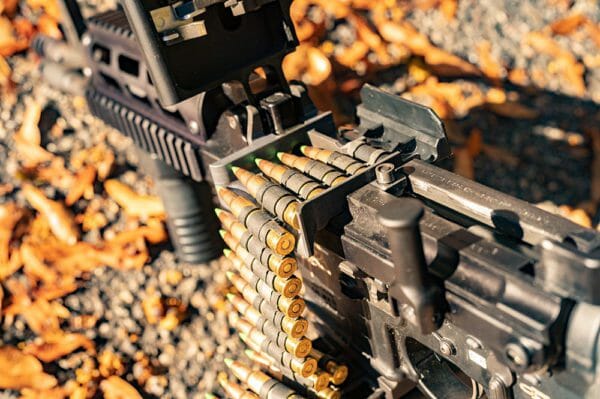
A new bill has been introduced by Congressman Jimmy Patronis (R-FL) in the United States House of Representatives that would repeal the Hughes Amendment. The bill, titled the “Firearm Freedom Act of 2026,” would undo the restrictions Congress placed on machine guns in 1986.
In 1986, Congress passed the Firearms Owners’ Protection Act (FOPA), a measure intended to reform certain aspects of federal gun control laws and protect the rights of law-abiding gun owners. However, during a late-night session, Democrats added the Hughes Amendment. This addition effectively closed the machine gun registry and banned the transfer of machine guns manufactured after May 19, 1986. The amendment was passed by a highly contested voice vote, with questions later raised about its procedural legitimacy.
The new legislation seeks to reverse what many view as an unconstitutional stripping of rights from American citizens by once again allowing the legal transfer and ownership of newly manufactured machine guns by civilians.
Proponents argue that fully automatic firearms are protected under the Second Amendment, which guarantees the right to keep and bear arms. However, federal courts have generally been hostile to challenges against regulations on automatic weapons. Judges have often cited the Supreme Court’s reasoning in District of Columbia v. Heller (2008), describing machine guns as “dangerous and unusual” weapons not in common use for lawful purposes, thereby justifying the ongoing restrictions.
🚨BREAKING🚨@PatronisFL just introduced the GOA-backed Firearm Freedom Act of 2026, H.R. 9009.
40 years after the Hughes Amendment was signed into law, this is the first bill ever introduced to repeal it and restore the rights the Founders intended Americans to have. pic.twitter.com/5Nzn4fRnQx
— Gun Owners of America (@GunOwners) May 22, 2026
The Heller decision affirmed that the Second Amendment protects an individual right to possess firearms for self-defense, but it also included language noting that certain “longstanding prohibitions” and regulations on “dangerous and unusual weapons” remain permissible.
Lower courts have leaned heavily on this language to uphold the Hughes Amendment’s ban on post-1986 machine guns. As a result, it is widely considered unlikely that the judicial branch will overturn the restriction on its own. This judicial pushback underscores why legislative action may be the most viable path forward. The best, and perhaps the only realistic way to eliminate these decades-old restrictions on machine guns is through a direct change in federal law.
Despite strong support for Second Amendment rights among many conservatives, the bill faces an uphill battle in Congress. While most Republicans publicly champion gun rights, a significant number draw the line at machine guns, viewing them as excessively powerful tools better suited for military use than civilian ownership.
Even if the Firearm Freedom Act manages to pass the House of Representatives, it is likely to encounter stiff opposition in the Senate. There, procedural rules often require a supermajority of 60 votes to overcome a filibuster and advance most legislation, making passage particularly challenging in a divided chamber.
Bills like this usually fail upon their first introduction. The strategic purpose behind reintroducing such measures in successive congressional sessions is to gradually build awareness, secure cosponsors, and cultivate broader political support over time until there are enough votes for successful passage. Whether the Firearm Freedom Act can achieve this momentum over the next few years remains to be seen. The odds are currently stacked against it due to entrenched political divisions, competing legislative priorities, and lingering Democrat concerns about firearm accessibility.
Nevertheless, the introduction of this bill by Rep. Patronis marks a notable development in the ongoing national conversation about gun rights. Backed by groups like Gun Owners of America (GOA), it represents the first comprehensive legislative effort to fully repeal the Hughes Amendment. Supporters see it as a long-overdue correction to what they describe as an infringement on constitutional liberties.
New Legal Strategy Challenges ATF’s Interpretation of the 1986 Hughes Amendment Machine Gun Ban
About John Crump
Mr. Crump is an NRA instructor and a constitutional activist. John has written about firearms, interviewed people from all walks of life, and on the Constitution. John lives in Northern Virginia with his wife and sons, follow him on X at @right2bear, or at www.crumpy.com.



If a machine gun is appropriate for the government armed services, then we civilians must have them to oppose the tyranny that n the government, just as we learned in the war for our freedom and resulted in the 2nd amendment-protection from our government!!
This isn’t going anywhere. It’ll die and that’ll be that.
If they repeal it and change the tax to $0 or drop MGs entirely from the NFA then I’m getting a bunch of .22 LR full autos. ARs, belt feds, miniguns — they are all the awesomest range toys that people can actually afford to shoot.
In 1985 I bought a selective fire Mac 11 for $350 plus the tax. Shot the snot out of it, then eventually sold it for $6000. This would really shake up the class 3 market.
As intended the Second Amendment was meant to UPHOLD your GOD GIVEN right to be able to use and own any weapon commensurate or greater in power than that which can be used against you. Whether it is used for DEFENSE or OFFENCE is dependent on the perceived situation, not on some bloody democrap politicians feelings.
Democrats and criminal government only want to take away that right BECAUSE they KNOW and INTEND to do things they have ALREADY done which deserve an appropriate response by WE THE PEOPLE. Regardless of subject matter.
Sadly, this bill is already dead. It was dead before the ink was dry.
Unfortunately, the neocon “leadership” will never allow this to be voted on. Otherwise, they would have to explain to their constituents why their not pro-2A.
If nothing else let’s hope it moves the overton window in the direction of liberty.
the entire gun control bs is unconstitutional scotus should come out and say as much watch the left try to put that back
“…have often cited the Supreme Court’s reasoning in District of Columbia v. Heller (2008), describing machine guns as “dangerous and unusual” weapons not in common use for lawful purposes,…” ie Government infringement on the citizen acquisition of machine guns. Remove the Hughes thingy, watch machine gun ownership soar Government circle logic…lil peeps can’t have ’em. They are not in common use. SH;RE;LMAO This “in common use” will bite 2Aers one day when new firearms technology pop on the scene, are banned because not in common use….yet. As might have been with ARs in late 1950s, metallic ammo in mid 1800s,… Read more »