
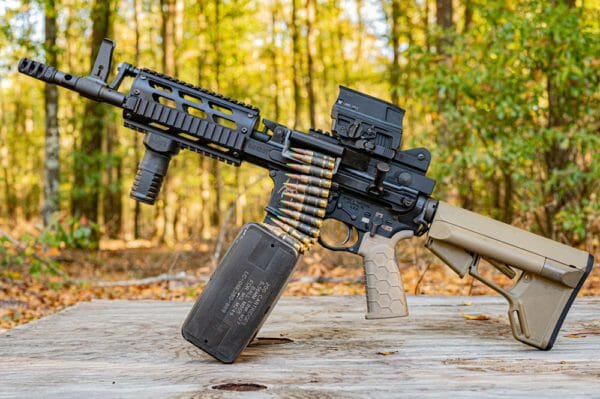
Rep. Lauren Boebert has introduced the Freedom from Taxes Act of 2026, a bill aimed at stripping out the remaining tax penalties attached to the National Firearms Act (NFA).
Boebert’s bill does not tear down the entire NFA, reopen the machine gun registry, or repeal the Hughes Amendment. But it does take a direct shot at one of the government’s oldest excuses for keeping this unconstitutional scheme alive: the tax.
The bill would reduce the remaining NFA transfer tax from $200 to $0 and eliminate the Special Occupational Tax paid by Federal Firearms Licensees who deal in, manufacture, or import NFA-regulated firearms.
The text of the bill amends the Internal Revenue Code by changing the NFA transfer tax under Section 5811 and the making tax under Section 5821 from “$200” to “$0.” It also adds language ending the special tax under Section 5801 for years beginning after the bill takes effect.
Boebert’s office described the legislation as a bill to “fully repeal” the remaining excise taxes imposed on machine guns and destructive devices under the NFA. Her office also said it would reduce the annual Special Occupational Tax burden from $1,000 to $0 for importers and manufacturers and from $500 to $0 for dealers.
“Taxing our constitutional rights is unacceptable and unconstitutional,” Boebert said in announcing the bill. “The Freedom from Taxes Act builds on the progress we made in the One big Beautiful Bill by completely eliminating the final NFA taxes on machine guns and destructive devices. My bill also eliminates the burdensome Special Occupational Tax that’s been crushing our small businesses and manufacturers. The government should not be imposing penalties on law-abiding citizens exercising their Second Amendment rights.”
Gun Owners of America endorsed the bill and framed it around the 40th anniversary of the Hughes Amendment, the 1986 law that shut down new civilian registration of machine guns. GOA said Boebert’s bill would reduce the $200 NFA tax on machine guns and destructive devices to zero.
Erich Pratt, GOA’s Senior Vice President, said GOA opposed the Hughes Amendment from the beginning and still opposes infringements on the right to keep and bear arms. Pratt called the NFA tax an unconstitutional “sin tax” and said Boebert’s bill would restore the right to own a machine gun without paying that tax.
“From its inception, GOA opposed the Hughes Amendment when it was signed into law. Forty years later, GOA still opposes any infringements on the right of the people to keep and bear arms. That’s why Gun Owners of America is proud to endorse Representative Boebert’s bill that would reduce the $200 NFA tax on machine guns. Under this GOA-backed legislation, the right to own a machine gun without paying a ‘sin’ tax would be fully restored—just like the Founding Fathers intended.”
This bill would remove the tax burden. It would not, by itself, undo 18 U.S.C. § 922(o), the federal machine gun ban added by the Hughes Amendment. That section still says, with limited exceptions, that it is unlawful for any person to transfer or possess a machine gun, while protecting lawful possession of machine guns possessed before the effective date of that subsection.
This bill would not suddenly make post-1986 machine guns available to ordinary gun owners. It would not end the ATF approval process. The underlying registration requirement of the NFA would still exist.
The NFA’s $200 tax was designed to be punitive. In 1934, $200 was an enormous sum of money. Congress knew exactly what it was doing. It used taxation as a weapon against gun ownership.
That creates the next legal problem for the federal government. The Supreme Court upheld the NFA’s dealer registration and tax provisions in Sonzinsky v. United States in 1937 by treating them as a valid exercise of Congress’s taxing power. The Court did not bless a free-floating federal power to register and restrict every firearm Washington dislikes. It upheld the law as a revenue measure. If Congress reduces the NFA taxes to $0, the government’s old excuse starts to collapse.
That argument is already spreading among gun-rights advocates. Brandon Herrera pointed out on X that if the NFA taxes are reduced to zero, the government has a much harder time defending a registry supposedly tied to tax collection. That does not mean Boebert’s bill repeals the NFA by itself, but it sharpens the constitutional attack against it.
Once the tax is gone, the registry looks less like revenue collection and more like what gun owners have always said it is: a federal gun-control scheme hiding behind the tax code.
And just like the NFA taxes that were removed from SBR’s and suppressors by the Big Beautiful Bill, why are these items being registered if there are no taxes?
According to the Supreme Court in a ruling from 1937, the NFA is only constitutional because Congress has the legal… https://t.co/fi825osWnA
— Brandon Herrera (@TheAKGuy) May 21, 2026
The bill also matters for small firearms businesses. The Special Occupational Tax is one more annual federal burden on FFLs operating in an already hostile regulatory environment. Between ATF inspections, shifting rulemaking, recordkeeping requirements, compliance traps, and constant political attacks, the firearms industry is treated like a suspect class for doing business in constitutionally protected arms.
The bill is backed by Gun Owners of America and the National Rifle Association. Boebert’s office listed Reps. Scott DesJarlais, Barry Moore, Thomas Massie, and Eric Burlison as cosponsors.
This bill is not the finish line. Full repeal of the NFA, along with the Hughes Amendment, is required.
If lawmakers believe the Second Amendment means what it says, they should zero out the taxes, repeal Hughes, dismantle the NFA’s unconstitutional treatment of commonly possessed arms and accessories, and stop allowing ATF to act like a national gun-control legislature.
The Freedom from Taxes Act is a step in the right direction. It attacks the tax scheme. It exposes the absurdity of making Americans pay a federal penalty to own arms. And it gives gun owners another opportunity to force Congress to answer a simple question:
If the right to keep and bear arms belongs to the people, why is Washington still charging them to exercise it?
The Hughes Amendment Explained: How a 1986 Voice Vote Banned New Machine Guns for Americans
About Duncan Johnson:
Duncan Johnson is a lifelong firearms enthusiast and unwavering defender of the Second Amendment—where “shall not be infringed” means exactly what it says. A graduate of George Mason University, he enjoys competing in local USPSA and multi-gun competitions whenever he’s not covering the latest in gun rights and firearm policy. Duncan is a regular contributor to AmmoLand News and serves as part of the editorial team responsible for AmmoLand’s daily gun-rights reporting and industry coverage.

AG Cummings said in 1934 gov had no authority to prevent citizens from buying and having machine guns. He used the tax code as a way to get around the 2nd. He admitted it. Congress likewise then admitted they had no policing power over citizens arms. The Hughes amendment is blatantly unconstitutional… yet so is the entire NFA, taxing an enumerated right and requiring permission from feds to exercise your rights, both of which scotus has already ruled unconstitutional in regards to freedom of religion and speech. The right to arms cannot be taxed no turned into a permit or… Read more »
On this day in 1802, President George Washington’s devoted widow and the nation’s first lady, Martha Dandridge Custis Washington, died at her Mount Vernon home. She was 70 years old.
Hey, while your helping out the gun owners, let’s defund the BATFE!
need a bill where citizens may arrest government agents for violating rights
Boebert’s bill may “sharpens the constitutional attack against [the NFA]” but it could also dull the chances of current law suits to remove suppressors, SBRs, SBSs and AOWs from the NFA. On the other hand, it would make it far more financially viable to become a manufacturer and legally make your own machine guns.
Does anyone recall when and where AG Bondi said it is perfectly legal for the federal government to transfer new machine guns to civilians if it chose to do so?
On this day in 1775, John Hancock was elected president of the Second Continental Congress. He is famous for his large signature on the Declaration of Independence, which he jokingly remarked that King George could read without his spectacles.
Chance of this bill becoming law: between 0 and none…