
Horns were blaring. Traffic was backed up for a mile. People in cars and trucks, or on the sidewalk cheering the procession on, were waving flags and screaming in triumph.
It was San Antonio, and evidently the Spurs had just advanced and edged closer to some sort of playoff victory. My younger son texted me a clip he’d recorded when he was caught up in the spontaneous parade while driving home from work.
Sports have never been my thing, and I generally pay no attention to any of them (except when teams or players do something stupid, subversive, and anti-gun). Longtime readers know I’ve frequently remarked on how when I die and go to hell my punishment will be to be forced to watch games.
“I’m afraid I will never understand,” I texted back.
“Me neither, but it was fun driving in it,” he replied.
“I’m sure,” I responded, and felt I should explain. “I’m reading a book right now written by a friend about Rome, and I see many parallels between Americans literally obsessed with entertainment and sports trivialities and Romans being distracted by their corrupt and tyrannical rulers with bread and circuses. It does not end well.”
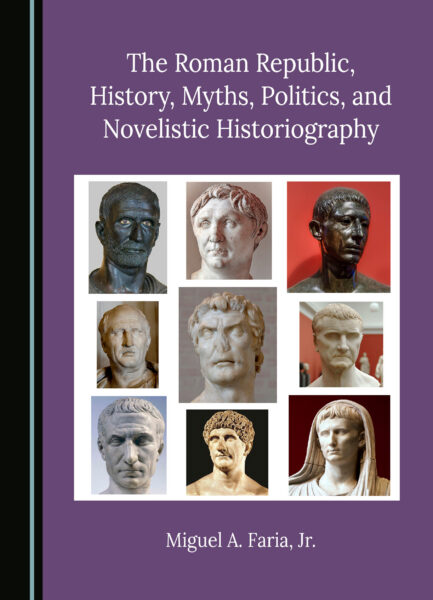
The book is The Roman Republic, History, Myths, Politics, and Novelistic Historiography, and the author is Miguel A. Faria Jr., “retired neurosurgeon and neuroscientist, medical editor and author, medical historian and medical ethicist, public health critic and advocate for the Second Amendment to the U.S. Constitution.” I began following his work after reading his landmark “The Perversion of Science and Medicine (Part III): Public Health and Gun Control Research,” in which he documented how the government was promoting a naked political agenda masked as “science” to advance a citizen disarmament agenda. His has become one of the few voices I listen to without finding concerns.
Faria’s experience with the costs of tyranny is firsthand. His parents were Cuban underground freedom revolutionaries, and at 13, he escaped with his father from the communist Castro regime. He wrote about that and more in Cuba in Revolution: Escape from a Lost Paradise. He has also established himself, along with all his other achievements, as a published authority on communism and totalitarianism, and further, is the author of Medical Warrior: Fighting Corporate Socialized Medicine, and Vandals at the Gates of Medicine: Historic Perspectives on the Battle over Health Care Reform.
I’ve relied on Faria’s “Perversion of Science” to offer credible counterarguments to fraudulent anti-gun “research,” and have also reviewed some of his books here on AmmoLand and for Firearms News, including:
- ‘America, Guns, and Freedom’ Offers Antidote to Anti-Gun Quackery
- A Tale of Two Revolutions: Revisiting the American and French Revolutions
Those and curated posts on The War on Guns blog show the many reasons I believe Dr. Faria’s work is essential for dedicated Second Amendment advocates, and although not specifically focused on the right to keep and bear arms, ancient Rome provided the bedrock on which the foundations for our own Republic were set.
That said, it’s a serious read, and while compelling, it requires a commitment, making it fair to consider the tremendous commitment required to research and write the book. All told, it’s 522 pages, including parts and chapters, illustrations, appendices, notes, the bibliography and index. Because so much of my work involves reading source material to use in my own writing, it took me longer than most, oftentimes only progressing a few pages at a time, to find my way to the end long after I started.
It’s not about the rise and fall of the Roman Empire but the rise and end of the Roman Republic, with Julius Caesar assuming powers that essentially ended republican governance. Per the synopsis:
“The history of the Roman Republic has been shrouded in myth, assailed by gaps in historical knowledge, and even immersed in political biases. But in this book, the author has succeeded in penetrating the mist, using both ancient and modern sources, as well as numismatic information and other illustrative materials and artforms. He narrates the history of ancient Rome—from its beginnings with the legendary seven kings of Rome, the founding and struggles of the Republic, the wars of conquests and civil wars, to the collapse of the Republic and the inception of the Roman Empire with Augustus. Peace is finally established, and the Augustan Renaissance and the Pax Romana followed, hinting at the course of Western civilization. One lesson is learned: Liberty and civic duties are too valuable to be forsaken for the material safety of ‘bread and circuses’ because in the end citizens so partaking may end up with neither liberty nor safety.”
Throughout the covered history the reader will see familiar names like Hannibal and Spartacus (and Scipio Africanus and Crassus, who respectively defeated them), names that ring a bell for many although what they did and stood for may be less understood, like Cicero and Pompey, and more contemporarily “famous names” like Caesar, Mark Antony, Cleopatra…
Then there are names less familiar to modern readers, like citizen-patriot and former consul Cincinnatus who, tired of politics, declined reelection and retired to his farm. When Rome was threatened, a delegation found him plowing in his field and informed him he had been made dictator. After he defeated the threat, he returned to his field (and was made dictator a second time years later at age 80 to put down a conspiracy/rebellion).
“Two millennia later…George Washington exemplified those virtues just like Cincinnatus,” Faria reminds his readers.
Another name that stands out is Lucius Cornelius Sulla, who, after military victories, was subjected to betrayals and intrigues, but after prevailing, being confirmed dictator, and restoring the power of the Senate and the laws of the Republic, “abdicated the dictatorship, became a private citizen, and died in 79 BC while in retirement.” You can read about him in an excerpt from The Roman Republic posted at RealClear History, and get a feel for the stories and understandings awaiting readers in the rest of Faria’s book.
Faria also provides a critique on author Colleen McCoulough’s commercially acclaimed “Masters of Rome” historical fiction series, giving credit for scholarly accuracy and insights where due, but also pointing out where her own political bias unjustly disparaged some Roman leaders while presenting Caesar as essentially flawless and brilliant.
There’s plenty more, too much to include in a review, but a few other impressions merit being called out. Having been a voracious reader of his science fiction work when younger, I confess ignorance that author Isaac Asimov was also an accomplished historian of Rome and was pleased to find his work extensively cited. I also didn’t know that Faria was a collector of Roman coins, and note many photographic examples credit “Author’s private collection.”
It’s a cliché to say a book is a wealth of information, but it’s true, and if you are interested in history, and believe it’s essential to understanding the past to seeing how it affects where we are today to make sense of it all, and if you understand that learning is a process best achieved with effort, you may find the read as rewarding as I did. It may not be as immediately gratifying as going wild over a regional sports win by latter-day gladiators but should serve your substantive interests a lot better in the long run.
You can get a hardback or ebook copy of The Roman Republic, History, Myths, Politics, and Novelistic Historiography by Miguel A. Faria, Jr. at Cambridge Scholars Publishing.
Why the US Supreme Court Skipped AR-15s This Term — And Why It’s Coming
About David Codrea:
David Codrea is the winner of multiple journalist awards for investigating/defending the RKBA and a long-time gun owner rights advocate who defiantly challenges the folly of citizen disarmament. He blogs at “The War on Guns: Notes from the Resistance,” is a regularly featured contributor to Firearms News, and posts on Twitter: @dcodrea and Facebook.





I agree with you David, I would rather watch paint dry than watch sports.
David, I find you a kindred spirit to some degree though I take enjoyment in watching one of Hemingway’s three real sports, Formula 1 (while trying to ignore its woke governing body), and my early sci-fi reading was more Heinlein, Laumer, Harrison, and Brunner.
I’ll bookmark this author for now. If I can finish my slog through “Two Treatises of Government” and manage the 2 volumes of “Democracy in America” he will find a place on my “to read list.” Or some of his books may become a gifts to my State rep. and senator. Thanks for the review.
Article said that baseball team Chicago White Sox is dropping country music as being racist ant not inclusive.
It is being replaced with gay pride day and free gay pride ball caps.
They are also having a ‘ homies night’ with a free ball cap that says ‘ I’m frum da crib’.
Chicago White Sox want to be politically correct and inclusive.
In big cities like NYC, to distract people, they have female entertainers on stage singing and dancing in their underwear. You never saw Frank Sinatra do that.
The only sport I’ve ever enjoyed is man’s favorite sport (no, the other one). Regarding the ancient Roman title of dictator, it was a temporary position constitutionally conferred in times of crisis by the Senate. It was never meant to grant permanent rule. This changed in 44 BC when Julius Caesar assumed power.
The history of Rome’s generals is the history of Rome. I would like to recommend “In the Name of Rome” by Adrian Goldsworthy. A very readable history of who did what.
The except from this history on Sulla after he returned to Rome is absolutely disqualifying: He was confirmed dictator, restored the power of the Senate that had been crippled by the populares, and reorganized the state according to the old laws and traditions of the Republic, the mos maiorum. Having done so he abdicated the dictatorship… The old laws and traditions of the Republic allowed for a six month long dictatorship. His was a couple of years long. tried to destroy much of that mos maiorum although major reforms were desperately needed, and his revenge as the author put it was a… Read more »