
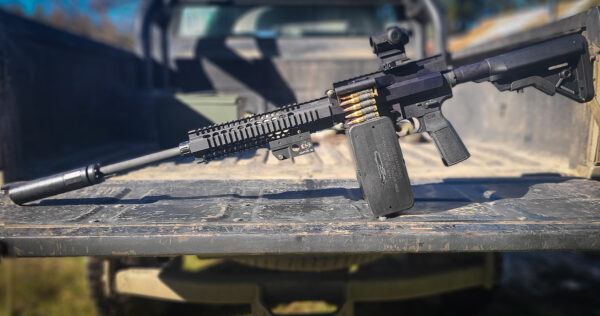
As a shooter with roughly 30 years under my belt, a veteran Army Ranger, and a professional reviewer for nearly 10 years, I’ve seen many new products come and go. I don’t really get excited by conceptual product announcements or early pre-alpha products. I’ve seen too much vaporware. Had my heart broken too many times!
So when the Lima Six was announced, I tracked it, but only with the faintest hope. A belt-fed upper receiver for the AR15? Well, not the first. Under $3,000? Well, that sounds great, but we’ll see… right?
Well, the Lima Six is here, and I’m a couple thousand rounds deep into it.

Before I jump right into tech specs and range time, this is a product that deserves a little more background. Around March 2024, a guy named Harvey posted on AR15.com that he had a dream of producing a belt-fed upper and was ~30 hours into the design. Over the course of the next couple of years, he very publicly walked through the design process and kept publishing updates. CAD files were turned into prototypes, which became a finished product by December of 2025.
21 months from announcement to production, while going from a one-man operation to a full-fledged business. The Lima Six upper receiver is real.
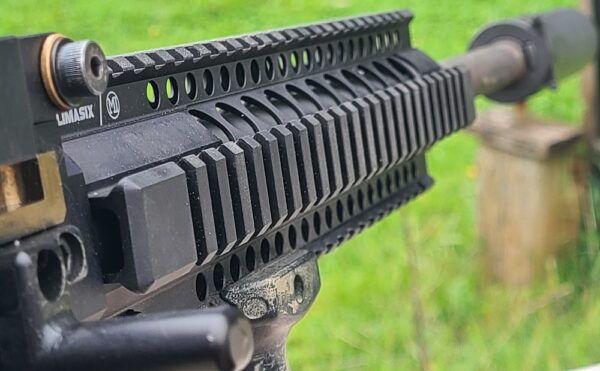
Let’s hit the OEM tech specs, then break down the design before hitting the range.
Tech Specs:
- 5.56X45mm NATO
- 7075-T6 Upper Receiver and Top Cover, Type III Hardcoat Anodized
- 18” Chrome Lined Chrome Moly Vanadium Heavy Barrel
- Midlength Gas System (Direct Impingement)
- Midwest Industries 10” T-Series Combat Quad Rail
- Billet Machined Hardened 17-4PH Feed Tray
- K-Spec bolt with Dual Ejectors
- 8620 Bolt Carrier, Full Auto Cut
- Tool Steel Belt Feed Components
- Billet Machined Aluminum Charging Handle
- Threaded ½-28 with A2 Flash Hider
- Uses M27 5.56 links
- Uses M249 style “nutsacks”/drums
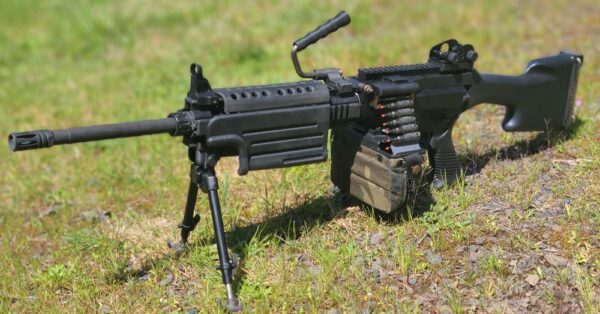
Well, the tech specs make it sound like nearly any other AR-15 pattern receiver. Far from it, though, there are some extremely noticeable differences.
First off, yes, the Lima Six bolts onto a mil-spec AR15 lower receiver, with slight exceptions in the buffer and bolt catch, covered below.
The Lima Six upper is stretched, meaning there’s an extra 3/4″ of bolt carrier travel, while Lima Six says “assists in delinking rounds from the links. It also results in lower perceived recoil, and a more controllable rate of fire.” But, this also means the buffer system CANNOT use a standard carbine buffer with AR15 buffer, so an A5 buffer tube is the key. You can also use an AR10 short buffer (2.5″, H2) with a carbine buffer tube, but that means no FRT or Super Safety in case you were wondering.
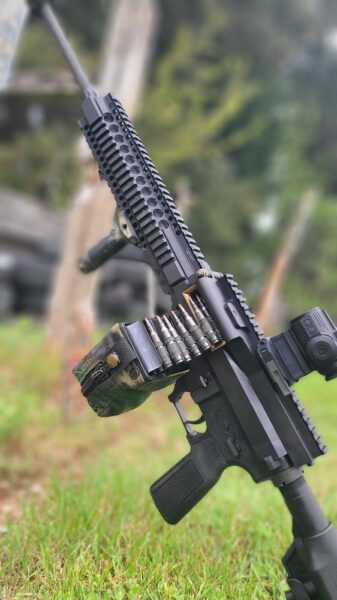
The Lima Six also needs a little change on the bolt catch/release. The Lima Six comes with a new bolt catch, so you don’t have to track one down. Aftermarket bolt releases are available and are excellent. Rumor has it that one of the aftermarket options will replace the OEM design soon.
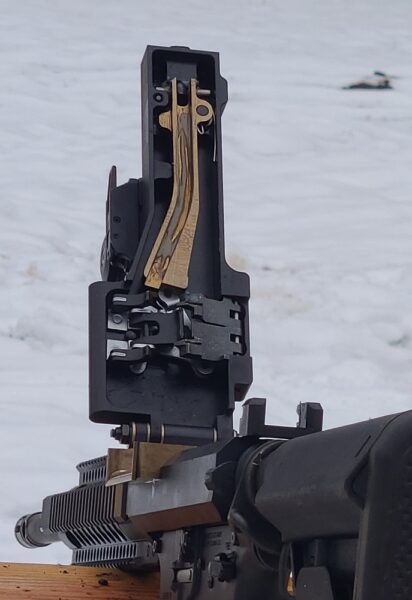
The top cover on the upper receiver is obviously M249-inspired, but again, there are differences. The top cover release point is a button on the rear. The top cover also has a “tensionable front pivot, two-point latch engagement, and an adjustable set-screw to take up any slack that may be present. These features result in an extremely reliable ability to hold zero even after repeated opening and closing. Initial testing shows that sub 2-MOA accuracy is achievable.” I’ll be putting that accuracy claim to the test.
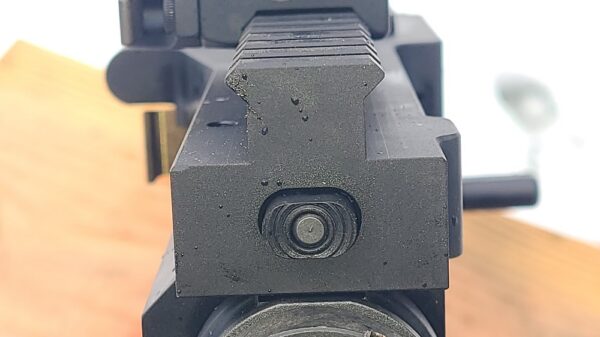
The Lima Six features a reciprocating charging handle, which is definitely uncommon on AR-15 pattern rifles. When you grab it with your right hand, always with your palm to the sky. In the unlikely event of a cookoff on a belt-fed, you want your thumb joint out of the way.

If you’re interested in barrel swaps, fast-swapping isn’t an option right now. Some will contend that a closed-bolt belt-fed should absolutely have this feature, with cook-offs being a concern. How much of a concern? Soon… soon.
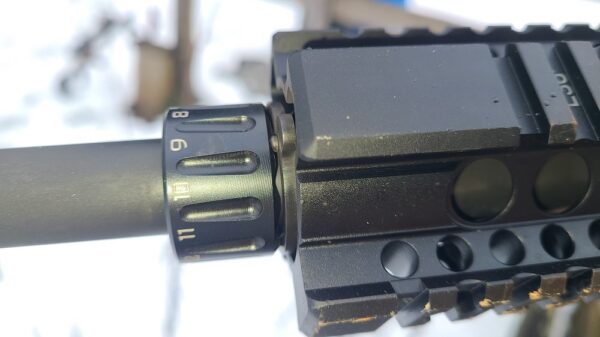
My Lima Six came with a Riflespeed adjustable gas block, which is a lifesaver on this rifle. Dialing in the right amount of gas to run a belt-fed, while suppressed or not, isn’t an easy task, given the wide variety of ammo out there. The Riflespeed gas block is the fastest gas adjustment method I’ve used on an AR.
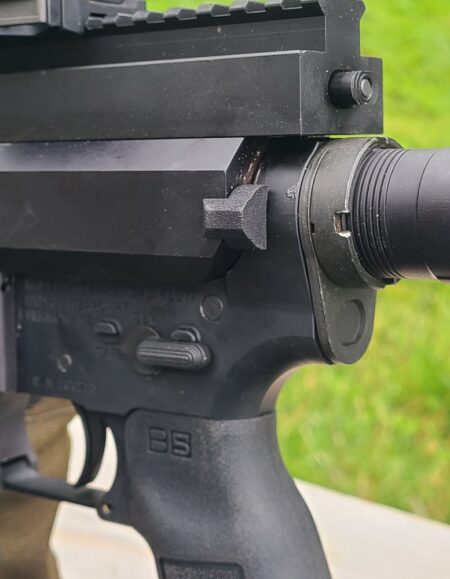
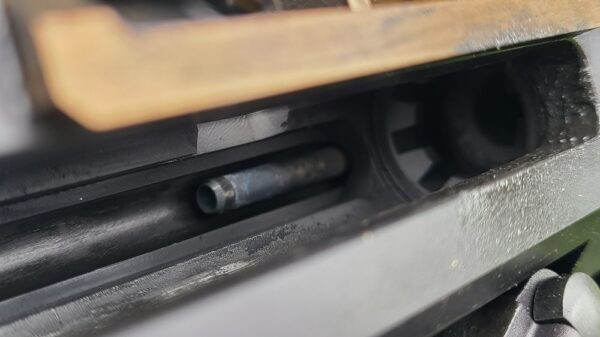
Finally, there’s a little gas port on the rear left side of the upper receiver. This is plugged with an included gas port plug. This is a 3d printed part. Early models were made from a weaker filament. Mine snapped and was replaced with a foam earplug until a newer, more durable replacement was shipped out. The earplugs worked fine even during suppressed fire, so there’s not a lot of gas pressure there.
Aftermarket:
Since this is a product that doesn’t work with many existing parts, I thought it was important to mention what is currently available and what I’ve heard is in the works.
- Red Right Hand is offering Lima Six-to-RPD conversions, heat mitigation systems, and handguards
- Inoculum Group has a magazine-to-drum adapter, and is developing a full-fledged Lima Six matching lower receiver with a dedicated drum slot
- Hydra Weaponry has an AR15 lower receiver with modular magwells, to include a Lima Six drum option
- KAK offers barrels, a water-cooled Lima Six upper variant, and gas blocks
- Spite Werx is developing a series of M249 style furniture for the Lima Six. Prototype parts are currently on my Lima Six, and production list may include a stock, handguard, grip, bipod, heatshield, and iron sights
- Hutson Arms is making a long stroke piston conversion kit
Install and Break-In:
I initially installed the A5 buffer tube, Lima Six bolt stop, and Lima Six upper onto a standard mil-spec lower receiver. This worked fine, with exception to the fact that there’s no way for me to attach the drum without an adapter (which I hadn’t ordered). So with 15 round belts dangling, I started reviewing.
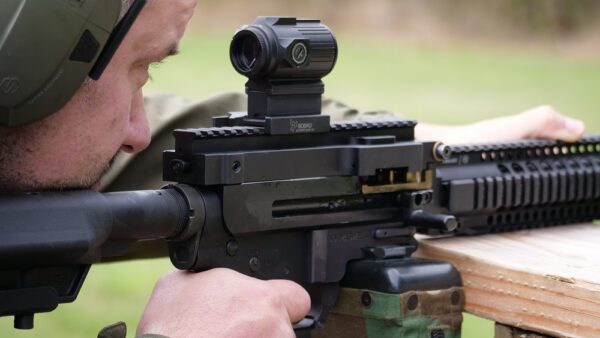
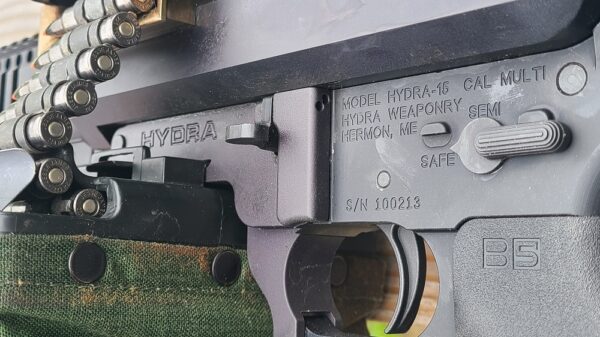
A short time later I moved up to the Hydra Weaponry Hydra-15 lower, which has removable/interchangeable magwells. I tossed the AR-15 magazine well, and slid on the nutsack adapter front half instead, moving to 100- and 200- round SAW nutsacks and drums. Big improvement.
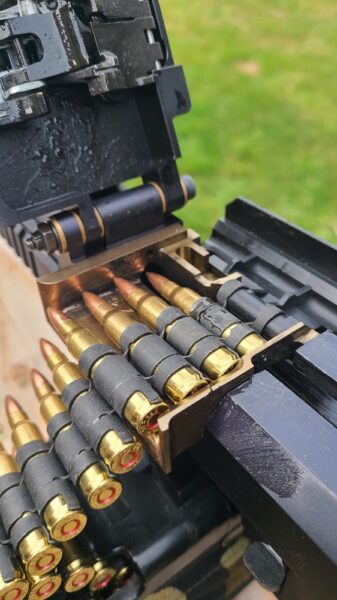
Operating the Lima Six is interesting. As the lovechild of an M249 and an AR-15, this incorporates elements from the manual of arms of both originating designs. The biggest thing to get used to is that, despite being a closed bolt weapon, the Lima Six needs the bolt locked to the rear to close the top cover. I thought I broke something (and nearly did) because I didn’t read the manual before trying to dry-operate the gun.
Speaking of the manual, a big shout-out to Guilian McFarland at Lima Six. He’s a marketing guy, an Army Tanker (eww), and was responsible for writing the Lima Six technical manual. Despite not being a machine gunner by trade, he managed to write an excellent manual that covers all the finer points of operating a system like this.
Brass to the grass and palms up on the charging handle are two important points for those new to belt-fed guns with reciprocating charging handles.
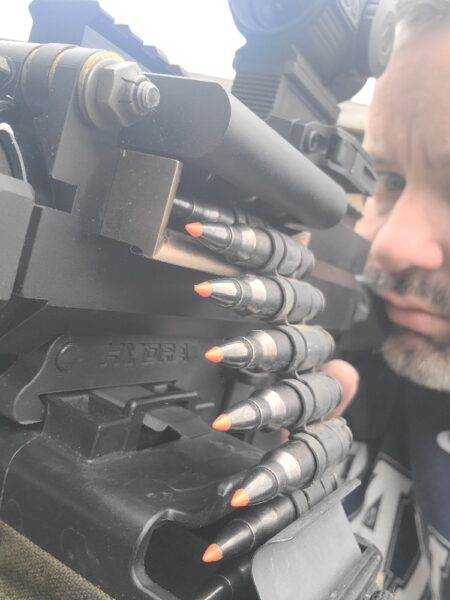
The break-in period for a Lima Six is 200 rounds, during which you’re asked to stick to paced semi-auto fire, run with the gas system wide open, with the included buffer. After the 200-round ease-in, I followed the recommendation to switch to an H3 buffer.

I started working with Prvi Partisan PPU Rangemaster 55gr ammo, a vintage 100-round nutsack, and a box of old M27 links. During the break-in, I had 3 failures to extract, which disappeared when I turned the gas down. There was also a little hitch in the charging handle early on, where it needed a bit of a lift to go backward. I racked the bolt 100 times, and it disappeared. Lima Six is aware of it, and it’s been ironed out.
I did put on a Griffin Armament M4SD-L a little early, but I like cans, and I like hearing. One click down on the Riflespeed gas adjustment, and the gun was still running great.
By the time the break-in was complete, the upper was running like an industrial, high-velocity ammo de-loader.
Live Inventory Price Checker
|
PMC X-Tac 5.56 NATO Ammo 62gr M855 Green Tip LAP 1,000 Rounds | GunMag Warehouse | $ 479.99 |
|
|
Small Rifle Military Primers For 5.56mm Nato Ammo - #41 Small Rifle 5.56 Nato Military Primers 1,000/Box | Brownells.com | $ 104.99 |
|
|
Kel-Tec 223 DEFENDER 5.56 NATO Semi-Auto Rifle - Tan - 16.1" - 20 Round | Primary Arms | $ 839.99 |
|
|
|
Maxim Defense PDX 5.56 NATO 20+1 Round Semi Auto AR Pistol, Black - MXM47803 | Palmetto State Armory | $ 2493.99 $ 2245.99 |
|
Range Time:
I ran through my entire stash of 55gr PPU ammo in a hurry. Needing a resupply, I reached out to Ammunition Depot and had a shipment of PMC Bronze 55gr ammo at my door in a hurry. I also ran through some Frontier 68gr match during accuracy testing.
Here’s my impressions after a few months and a couple thousand rounds with this gun: the Lima Six is f’ing amazing.
The heavy bolt and A5 length buffer system take the low recoil impulse of .223 down to absurd levels. The operating noise is also surprisingly low, lower that a standard AR15 and an M249/249s. This really shows me how loud “port pop” is on most AR’s. The bolt glides smoothly, bathed in grease. Just remember the old Ranger acronym for bolt fed’s and barflies: Always Needs Ample Lube. Keep the Lima Six greased up, and she’ll be happy. I’m 2,000 rounds in, mostly suppressed, and all I’ve done to the internals so far is a wipe down with a rag and new lube slathered on.
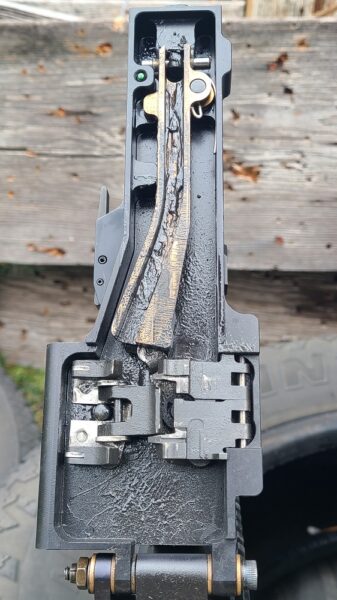
The assembled Lima Six upper weighs about 7lbs 6 oz. That’s really not bad considering the alternative. The gun is really well balanced as well, even with a modest buttstock like the one I was using. My usual work AR’s with light, IR laser, suppressor, etc., is more front-heavy than the Lima Six.
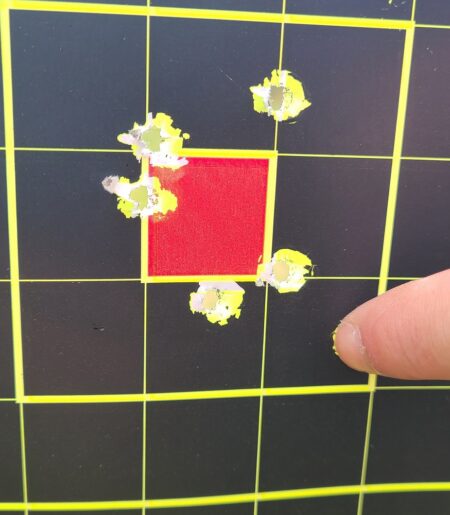
Accuracy testing with a 5-25x scope, shot from a rest, showed consistent groups between 1.9-2.9 MOA, with PPU and Frontier ammo. That’s a belt-fed with a mil-spec trigger… yeah, I’m impressed. Would that tighten up with a two-stage trigger? Many years of evidence suggest yes, but I don’t want to mess with the FRT setup.
Did I mention the Lima Six works well with most Forced Reset Triggers and Super Safeties?
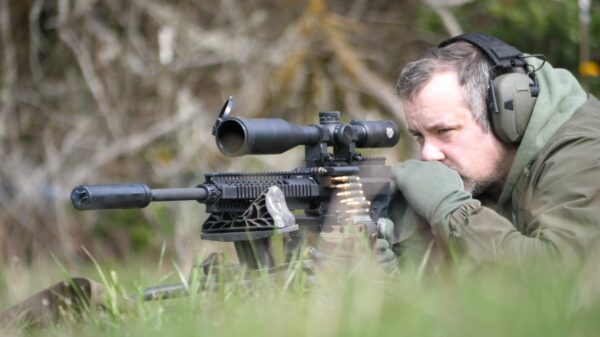
Linking up the PMC Bronze 55gr meant one click wider open on the gas adjustment. I’ve been using the Arizona Regulator, a drop in FRT that didn’t need any parts replacement or modification.
Does it run? Hell yeah!

The Lima Six is badass even in semi auto. With an FRT, a Super Safety, or a registered sear, you’re looking at a really impressive machine. Whether you’re looking for recoil therapy, an expensive smile maker, or just wanna lay some hate on that pack of coyotes, an FRT is a must-have option with the Lima Six, even if you aren’t going to use it often.

Competition:
So what is the competition for the Lima Six? Here’s what I see, and the pros and cons against each.
- AR-15 running a D60 drum: This is cheaper than an L6 up front and doesn’t rely on links, but drums are bulky, intermittently reliable, and, most of all, significantly less cool than a belt of ammo. Who wants a D60 when you can have a 200-round drum?
- Fightlight MCR: The MCR has been around for a while now. Uppers are between $1,000-$4,000 more expensive than the Lima Six, depending on which features you might need. The piston gas system is nice, but the ones I shot weren’t adjustable at all. Further, they were both pretty unreliable, but your mileage may vary.
- M249S: The factory semi-auto, closed bolt variant of the M249 SAW. I’ve had one, and I liked it, but it’s still nearly 20lbs unloaded. These definitely scratch the nostalgia itch, but at ~$10,000, that’s not remotely feasible for most.
What’s Next?
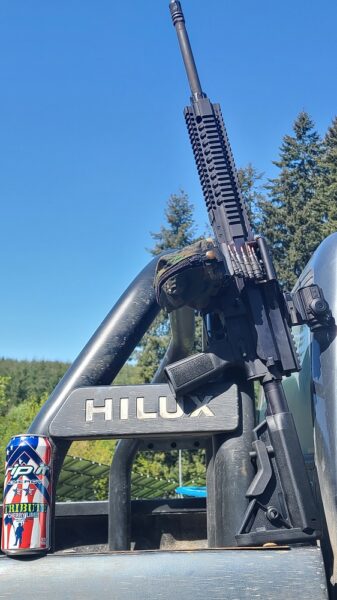
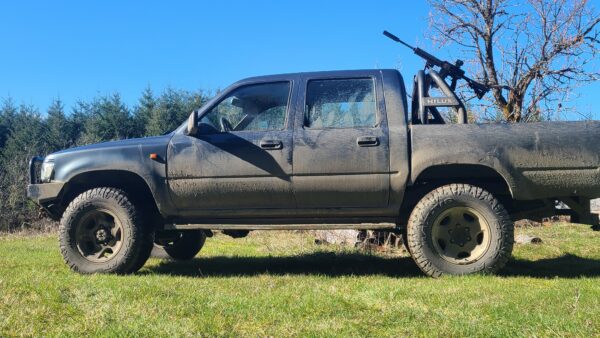
I’m not done with the Lima Six. It’s so rare and impressive for a new design to be thought up, designed, manufactured and delivered in such a short timeframe, and to be so damn nice as well. This system is so impressive I’ve planned out a full year’s worth of articles coming up. I’m working now on a video review. Next, I’m going to feature the Spite Werx m249 furniture conversion, cover a Hilux Technical build, review all the related lowers (Hydra, Inoculum) and maybe just have some fun too.
Bottom Line:
I’m 2,000 words in, and I have a lot more to say about the Lima Six, but I have to wrap it up. A build kit (you provide some parts, barrel, and handguard among them) runs ~$2,000. The complete upper with bolt catch, buffer spacer, and recoil spring runs $2,999. It’s not cheap, but it is the least expensive option on the market, while attaining an extremely high standard of quality.
The Lima Six is not only pure sex appeal, but it’s also highly functional.
If you’re thinking about it, get one. If you’re dreaming about one, start socking away some money, and it won’t take long.
About Jens “Rex Nanorum” Hammer
Jens “Rex Nanorum” Hammer is an Alaskan Expatriate living in Oregon with his wife and kids. Growing up on commercial fishing vessels, he found his next adventure with the 2nd Bn, 75th Ranger Regt. After 5 tours to Afghanistan and Iraq, he adventured about the west coast, becoming a commercial fisheries and salvage SCUBA diver, rated helicopter pilot instructor (CFII), and personal trainer, before becoming a gear reviewer and writer.




Is an AR10 version in development?
How’d you get a Hilux in the US? I want one, but heard it’s impossible.
Nice review. I will wait till they make one that fires 7.62.
the original AR in 7.62 had the gas tube on the left. when asked to scale it down to the barely adequate 5.56 stoner had Jim Sullivan do it and he moved the gas tube to the top. he also did away with the cocking hook under the carrying handle and put it where it is today
Thank you, Mr. Hammer, for a great review! I’ve been keeping tabs on the L6 since its’ inception.
The L6 would be a cheaper and fun way to owning and firing the MG, but as I stated in another article, The budget for ammo would be a non-starter for sure.
I’d still like to own a Rheinmetall MG 3, the Browning M2 .50 Cal., Thompson submachine gun (“Chicago typewriter”) and the M249 SAW.
I love it. Like me Rex, you live in Oregoneistan where they are crying about 30 round mags being “extended magazines and AR15’s being weapons of war”. I am sure this gun would get the same title. I would love to see them freak at a demo of how it works. LOL. I can’t stop laughing at the thought of seeing the look on their faces and the terror in their eyes when they saw the actual gun. Better not carry any pictures of that in Potlandia. There wouldn’t be enough safe spaces for them to hide. I LOVE IT!!!!!!!… Read more »
You seriously fired that without eye protection???