
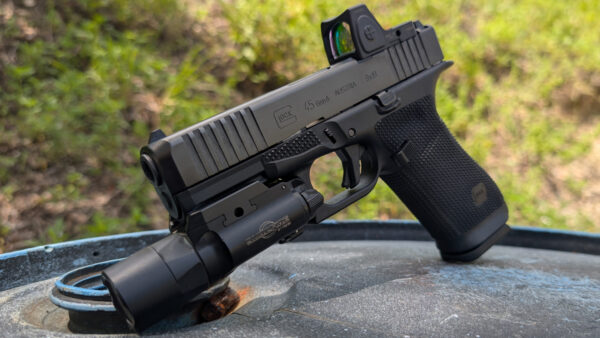
California has responded to the United States Department of Justice (DOJ) lawsuit challenging the state’s Glock-style pistol ban by arguing that Glocks do not fall within the scope of the Second Amendment’s plain text.
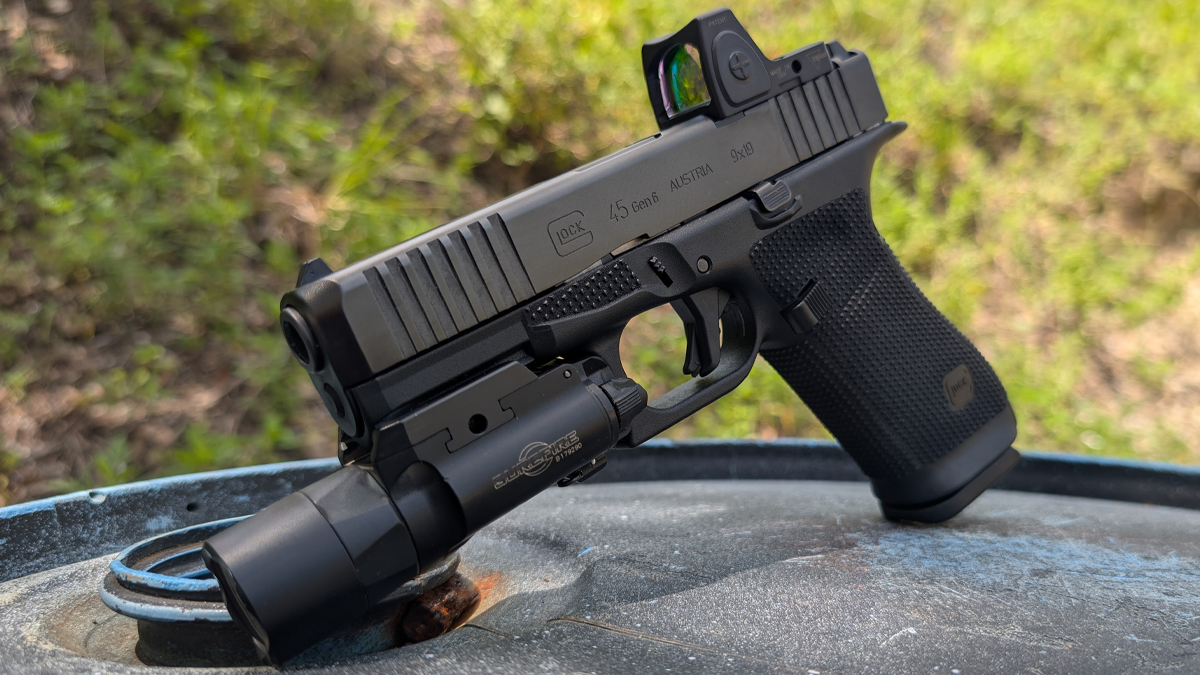
The state recently enacted a ban on all pistols with a cruciform trigger bar, classifying these firearms as “machine gun convertible pistols.” California justifies the ban by arguing that such pistols can be modified with a machine gun conversion device (MCD), known as a “switch,” which transforms a semi-automatic handgun into a fully automatic firearm. Many believe California is targeting Glock-style pistols because Glocks are the most popular handgun brand in the country.
DOJ Targets California’s Glock Ban
On July 1, 2026, the DOJ filed a lawsuit challenging the enactment of Assembly Bill (AB) 1127. In the suit, United States of America v. California and Robert Bonta, the DOJ claims that the law banning Glock-style pistols violates the Second Amendment. The government argues that Glocks are in common use and that, under the Supreme Court’s decision in Heller, the state cannot ban arms in common use. The plaintiff believes the law is facially unconstitutional. The DOJ also filed for a temporary ex parte temporary restraining order (TRO). An ex parte TRO would be issued without a hearing.
California filed a motion opposing the ex parte TRO, making several bold claims, including that the plaintiffs fail to meet the first step of the Bruen analysis. The first step of a Bruen analysis is to examine the plain text of the Second Amendment to determine whether the conduct is protected. The first question is whether the plaintiffs are members of “the people”—that is, members of the political community who have reached the age of majority (18 in the United States). Since the DOJ is representing all Americans, the answer is unquestionably yes.
The second question is whether the arm is bearable. Glocks are bearable arms. In fact, Heller was a challenge to Washington, D.C.’s handgun ban. While Heller acknowledged that firearms that are “dangerous and unusual” can be banned, in United States v. Wolford the Supreme Court held that courts cannot shoehorn additional restrictions into step one. California appears to be doing just that. Its case relies on the United States Court of Appeals for the Ninth Circuit’s rejection of a “simplistic approach.”
California Says Glocks Are Not Protected Arms
The defendants claim “there is no constitutional right to factory settings” and that they are merely banning a factory setting, not an “arm.” They argue that companies can simply redesign their firearms to make them less “convertible.” The defendants further contend that if the United States government wins, California’s ban on machine guns might be in danger of being ruled unconstitutional.
Because Glocks can be converted to machine guns by using an MCD, the state argues that the most popular handgun in the world is “dangerous and unusual.”
They also claim that machine guns can “fire more than 1,000 rounds per minute, allowing a shooter to kill dozens of people within a matter of seconds,” and that Glocks are basically machine guns. The state asserts that the ban does not “meaningfully impair[] an individual’s ability to access firearms.” For these reasons, California holds that it does not need to proceed to step two of the Bruen analysis and that Glocks are not covered by the plain text of the Second Amendment.
State Leans on Ninth Circuit Gun-Control Rulings
California argues that even if the court proceeds to step two, the state would still prevail. The defendants claim that AB 1127 is consistent with the nation’s historical traditions of firearms regulation and cite the Ninth Circuit’s Bruen analysis in Duncan. The state attempts to avoid using laws from the founding era by pointing to the Ninth Circuit’s claim that “[m]ass shootings are clearly a societal concern that arose only in the 20th century” and that firearms that existed at the founding “fired much slower than the firing rate of a modern semi-automatic firearm.”
Even though California tries to avoid citing specific laws from the founding era, it does highlight categories of laws. One category is gunpowder storage laws. These laws existed but only addressed the storage of gunpowder to prevent fires; they did not restrict the keeping or bearing of arms. The state also points to trap gun laws. Trap gun laws did not ban any arms—they simply prohibited setting up booby traps, such as a gun that would fire when someone opened a door. The third category cited is restrictions on particular weapons “after their use by criminals exposed an especially dangerous use of the weapon,” though the state provided no specific examples.
The defendants state that, at a minimum, more time would be needed to compile historical analogues for Bruen’s step two analysis. Given the time required, the state believes a TRO is inappropriate and that the law should remain in place.
Maryland Glock Ban Case Adds National Pressure
This case is the second challenge to a Glock ban. The Firearms Policy Coalition (FPC), the National Rifle Association (NRA), and the Second Amendment Foundation (SAF) are currently suing Maryland over its Glock ban in The National Rifle Association of America v. Moore.
Supreme Court Says Courts Can’t Smuggle Gun Control Into Bruen Step One
About John Crump
Mr. Crump is an NRA instructor and a constitutional activist. John has written about firearms, interviewed people from all walks of life, and on the Constitution. John lives in Northern Virginia with his wife and sons, follow him on X at @right2bear, or at www.crumpy.com.




They are right. The 2A doesn’t protect any weapons.
It tells the government it has no authority to control the peoples right to keep and bear arms.
Even the Bruen decision is wrong.
Two steps is one to many.
Step one does the proposed law effect arms? If yes full stop case dismissed, the law is illegal.
The second step of providing historical analogs is unnecessary because thoes laws were also illegal. They only existed because nobody fought against them.
What a load of BS! Unusual? There are millions of Glocks in the state and country. A weapon cannot be banned because it’s possible to convert it to full auto, as every weapon can be converted, usually within hours. In addition, citizens have every right to full auto, as even the AG and senate debating the NFA acknowledged, and that Gov have no authority to ban them! The 2nd doesn’t protect a specific style, caliber, firing system or size of weapon; the 2nd expressly prohibits and denies government any authority over citizens’ arms
Dear Commiefornia tardos, machine guns are LEGAL under the 2nd Amendment. So are cannons.
DO. NOT. COMPLY!!!!
Doesn’t matter what crapistan or any commie state says. F’ em!!!!!!
This is a great opportunity for men from free states to do the lords work and traffic glocks to commie states for profit.
Don’t bother citing federal interstate infringements. Running firearm blockades is THE MOST American thing you can do.
Celebrate 250……….Arm up and carry on.
Meanwhile, back at the ranch, the standard side arm for many California law enforcement agencies remains a product of Glock. Go figure.
“The defendants claim ‘there is no constitutional right to factory settings’” While there is SOOOOO much in California’s reasoning that is laughable, I especially got a kick out of this one. Just think what they could get away with if this were to actually be upheld: No cruciform weapons (Glock ban), no standard-capacity magazines (magazine bans), no select-fire weapons (machine gun bans), no threaded barrels (indirect suppressor bans), no detachable magazines/pistol grips/folding stocks/etc (evil-looking rifle ban and/or only featureless rifles allowed), must have feature xyz (state-approved handgun roster), and more. Rejecting this one claim alone would be the first domino… Read more »
oh, my, my, my, how far then can they reach into their own posterior and pull out something to throw against the wall to see what will stick.
someone should check it the a.g. of commiefornia actually has a law degree and bar license.
i don’t think even the 9th circus court would rule for the state, but stranger thing have happened recently.
this was good, i needed something to make me laugh, thank you.
“They also claim that machine guns can “fire more than 1,000 rounds per minute”. Since Commiefornia banned magazines over 10 rounds that would be extraordinary, swapping out 100 magazines in a minute. They don’t know squat about guns. They’re just being good commies, trying to take away our guns, anyway they can. Then we can be like the U.K., France, etc. where the citizens can’t defend themselves against an invading army of illegal turd worlders.
They won’t be able to make it stick in the courts, a big yawn.
As the First Amendment protects only that speech which is considered objectionable (speech not considered objectionable doesn’t require protection, therefore the amendment wasn’t written to protect such speech), so, too, does the Second Amendment protect only those arms that government might seek to ban or regulate* out of existence. Note that both amendments aim at moving targets. What is objectionable (in arms or speech) varies over time, depending on whims of society and popular sentiment. It is exactly infringements from these (and other) sources the amendments were meant to prevent (that is, they are meant to protect from “democracy”). It… Read more »