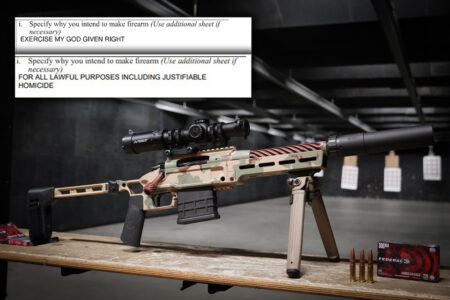
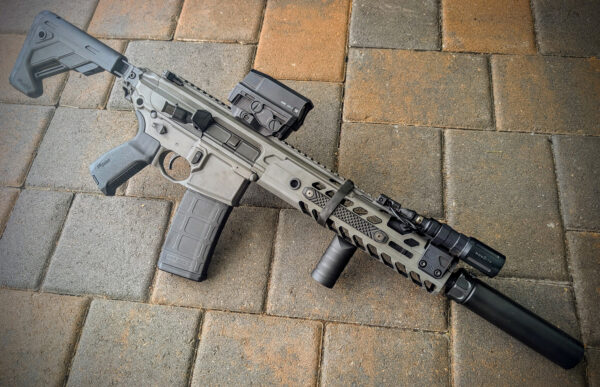
A federal judge has permanently enjoined the Bureau of Alcohol, Tobacco, Firearms and Explosives (ATF)from enforcing major registration and transfer requirements of the National Firearms Act of 1934 against a broad coalition of plaintiffs after Congress zeroed out the longstanding $200 tax on short-barreled shotguns, short-barreled rifles, silencers, and “any other weapons.”
In Silencer Shop Foundation v. Bureau of Alcohol, Tobacco, Firearms and Explosives, U.S. District Judge James Wesley Hendrix ruled that the challenged regulatory scheme is unconstitutional because it no longer functions as a revenue measure under the Taxing Clause—the sole constitutional foundation Congress invoked when it passed the NFA more than ninety years ago.
The National Firearms Act was enacted in 1934 (NFA) purely as a tax statute. Congress imposed a $200 making and transfer tax on certain firearms and devices—short-barreled shotguns (SBS), short-barreled rifles (SBR), silencers, and any other weapons (AOWs)—and layered on extensive administrative requirements: Form 1 and Form 4 applications, fingerprints, photographs, local law-enforcement notification, and entry into the National Firearms Registration and Transfer Record. Machine guns and destructive devices remained subject to the same $200 tax. The stated purpose was to raise revenue while simultaneously constricting the market for these items through the heavy tax and regulatory burden.
Congress Eliminated the NFA Tax but Left the Registry
That tax framework changed with the “One Big Beautiful Bill Act”, signed into law on July 4, 2025. Effective January 1, 2026, the legislation set the transfer and making taxes for SBS, SBR, silencers, and AOWs at zero dollars. Machine guns and destructive devices continue to carry the $200 tax. Once the revenue justification disappeared, Silencer Shop Foundation and a large group of co-plaintiffs filed suit. They argued that the registration, application, and approval requirements that had been justified solely as tax-enforcement mechanisms could no longer stand.
The plaintiffs include Gun Owners of America, the National Rifle Association, B&T USA, LLC, Palmetto State Armory, LLC, SilencerCo Weapons Research, LLC, the Virginia Citizens Defense League, the Firearms Regulatory Accountability Coalition, and fifteen states, as well as the Silencer Shop Foundation itself.
The government attempted to salvage the regulations by pointing to the still-existing special occupational tax paid by manufacturers, importers, and dealers. Officials claimed the remaining regulatory apparatus remained “necessary and proper” to the collection of that occupational tax. Judge Hendrix rejected the argument. He found the recharacterization neither “plainly adapted” nor “proper” under the Necessary and Proper Clause. The court refused to allow the agency to rewrite the constitutional basis of a statute after Congress had removed its original revenue foundation.
Judge Rejects Government’s Commerce Clause Argument
The ATF and Department of Justice also invoked the Commerce Clause. Judge Hendrix rejected that claim as well. He emphasized that Congress never relied on the Commerce Clause when it enacted the NFA. The statute’s text, structure, and placement in Title 26 of the United States Code—the Internal Revenue Code—demonstrate that it was conceived and passed exclusively as a tax measure. Unlike the Gun Control Act of 1968, which contains explicit jurisdictional hooks for interstate commerce, the NFA contains none. The court held that judges may not retroactively recharacterize a statute under a power Congress never exercised. Earlier Fifth Circuit dicta suggesting a broader reading were deemed non-binding, pre-dating the Supreme Court’s decisions in United States v. Lopez and United States v. Morrison, and inconsistent with earlier circuit precedent.
Notably, the plaintiffs abandoned their Second Amendment claims after prevailing on the enumerated powers argument. With the court’s agreement, Judge Hendrix exercised judicial restraint and declined to reach the Second Amendment issues. The ruling, therefore, rests solely on the absence of a valid taxing power once the tax itself was eliminated, leaving any constitutional challenge under the Second Amendment for another day and another case.
Who Is Protected by the NFA Injunction?
The permanent injunction bars the ATF, the Department of Justice, Acting Attorney General Blanche, ATF Director Cekada, and anyone acting in concert with them from enforcing the challenged provisions—specifically 26 U.S.C. §§ 5812(a)–(b), 5822, 5841(a)–(c) and (e), 5842(b), 5861(b)–(f) and (i), and the related regulations—against the plaintiffs, their agencies and political subdivisions, their members, and their current and future customers in transactions involving the plaintiffs or their commercial members.
Consistent with the Supreme Court’s decision in Trump v. Casa, the relief is limited to the parties before the court and does not extend nationwide.
Judge Hendrix stayed the injunction for seven days to give the government an opportunity to seek emergency appellate relief. The decision marks a significant, if currently party-limited, curtailment of the administrative machinery that has governed short-barreled firearms, silencers, and AOWs for generations. Whether higher courts will expand, narrow, or reverse the ruling remains to be seen, but the district court’s core holding is clear: once Congress removed the tax, the regulatory superstructure built solely upon that tax lost its constitutional footing.
Trump DOJ Defends NFA Gun Registry Despite Supreme Court’s Wolford Ruling
About John Crump
Mr. Crump is an NRA instructor and a constitutional activist. John has written about firearms, interviewed people from all walks of life, and on the Constitution. John lives in Northern Virginia with his wife and sons, follow him on X at @right2bear, or at www.crumpy.com.