
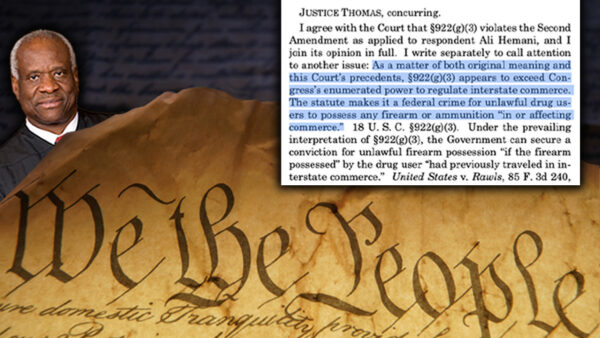
Justice Clarence Thomas used his concurrence in United States v. Hemani to target a constitutional problem even larger than the federal government’s ban on gun possession by marijuana users: Congress may never have had the authority to federalize ordinary, intrastate firearm possession in the first place.
The Supreme Court unanimously ruled that 18 U.S.C. §922(g)(3) could not constitutionally be applied to Ali Hemani merely because he regularly used marijuana. Thomas joined Justice Neil Gorsuch’s opinion for the Court in full. He then wrote separately to question whether the federal statute survives scrutiny under the Commerce Clause.
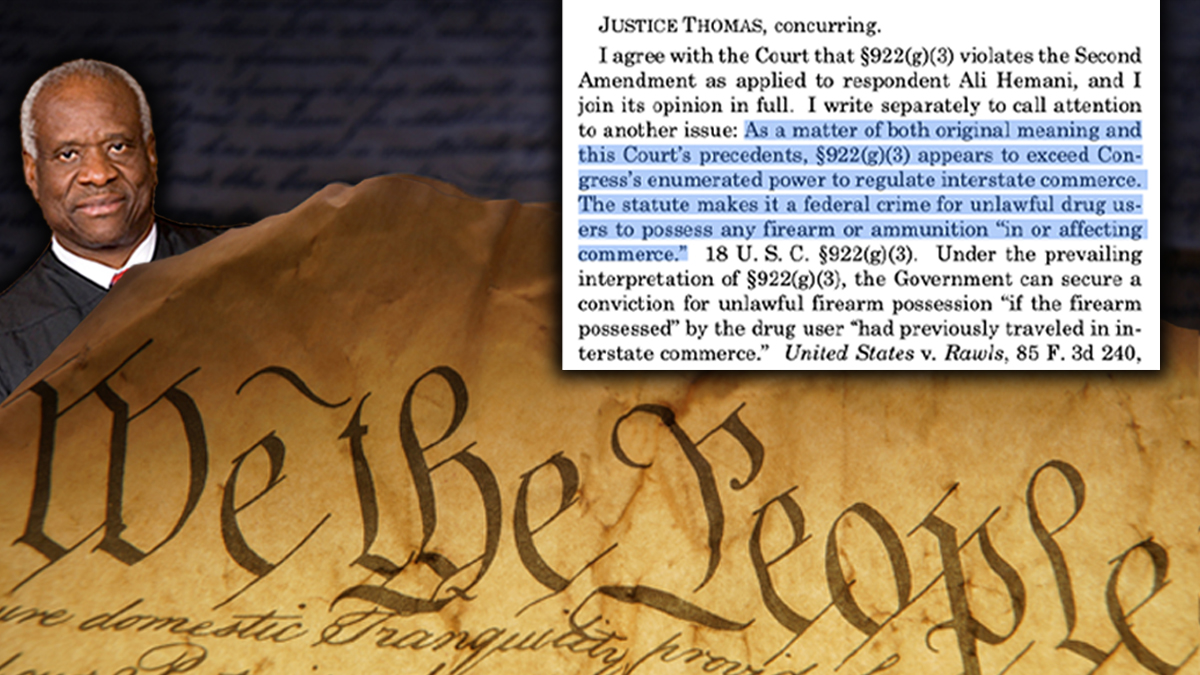
“As a matter of both original meaning and this Court’s precedents, §922(g)(3) appears to exceed Congress’s enumerated power to regulate interstate commerce,” Thomas wrote. “The statute makes it a federal crime for unlawful drug users to possess any firearm or ammunition ‘in or affecting commerce.’ 18 U. S. C. §922(g)(3).”
The Federal Government’s “Minimal Nexus” Theory
That language sounds like a connection to interstate commerce, but the government’s actual burden is remarkably thin. Under the prevailing interpretation, prosecutors need only prove that the firearm crossed a state line at some point in its history. The accused does not need to have bought it across state lines, transported it interstate, or used it in any commercial transaction.
Hemani allegedly possessed his firearm in his Texas home. The government relied on the fact that the gun had previously traveled in interstate or foreign commerce. For Thomas, that distant historical connection cannot turn local possession into interstate commerce.
“The Commerce Clause does not authorize Congress to ‘regulate or ban possession of any item that has ever been offered for sale or crossed state lines,’” Thomas wrote.
Accepting that theory, he warned, would convert the Commerce Clause into a general federal police power constitutionally reserved to the states.
Thomas’s Warning Reaches Beyond Marijuana Users
Thomas’s argument reaches well beyond §922(g)(3). Section 922(g) contains the federal government’s broad list of prohibited persons, including convicted felons, fugitives, certain people subject to restraining orders, unlawful drug users, and others.
Thomas repeatedly discusses §922(g) as a whole and tells the Supreme Court and lower courts that they “should revisit the constitutionality of §922(g).”
His originalist analysis is straightforward. The Constitution gives Congress authority to regulate commerce “among the several States.” It does not give Washington a general power to regulate every firearm located inside a state merely because that gun once moved through the national marketplace.
Local Gun Possession Is Not Interstate Commerce
Thomas wrote that the commerce power cannot cover “mere gun possession” any more than it gives the federal government nationwide authority over “marriage, littering, or cruelty to animals.”
Local possession, standing alone, is not buying, selling, shipping, or any other form of interstate commerce.
He also argues that §922(g) conflicts with the Supreme Court’s modern Commerce Clause cases. In United States v. Lopez, the Court held that possessing a gun in a local school zone was not economic activity substantially affecting interstate commerce. Thomas sees no principled reason why the government can evade Lopez by adding a jurisdictional phrase and pointing to a firearm’s decades-old journey across a state boundary.
Thomas also dismantles the lower courts’ reliance on Scarborough v. United States. Courts have treated Scarborough as establishing that a firearm’s past interstate movement is constitutionally sufficient. Thomas says that gets the case wrong: “Scarborough’s holding was statutory, not constitutional.” It interpreted what Congress required, not whether Congress possessed the constitutional authority to require so little.
Thomas Invites a Broader Challenge to §922(g)
The concurrence does not strike down §922(g), and Thomas wrote only for himself. The issue was not formally presented in Hemani, so his analysis is not binding law. But it is an unmistakable invitation to gun-rights litigants to bring the right case.
Thomas closed by warning that it has been 26 years since anyone received relief from the Supreme Court through a Commerce Clause challenge. Congress’s enumerated powers, he stressed, must be “taken seriously.”
Hemani won because the government could not disarm him consistent with the Second Amendment. Thomas is asking the next, even more fundamental question: What constitutional authority did Congress have to regulate his purely local gun possession at all?
Supreme Court Rejects Gun Ban for Marijuana User in Major 2A Win
About Duncan Johnson:
Duncan Johnson is a lifelong firearms enthusiast and unwavering defender of the Second Amendment—where “shall not be infringed” means exactly what it says. A graduate of George Mason University, he enjoys competing in local USPSA and multi-gun competitions whenever he’s not covering the latest in gun rights and firearm policy. Duncan is a regular contributor to AmmoLand News and serves as part of the editorial team responsible for AmmoLand’s daily gun-rights reporting and industry coverage.



Thomas’s concurrence can easily give the impression that he would like to see the Commerce Clause, in all of its manifestations, reduced to no more than regulating the occurrence of commerce as it crosses a State border. The Commerce Clause is the underpinning of a tremendous amount, if not most, of the many Federal laws and regulations affecting our every day life. Using the Hemani example, the Federal Government could tax or prohibit the commerce of cannabis across State or international boundaries but it would be up to the States to make it legal or not in their State. If… Read more »