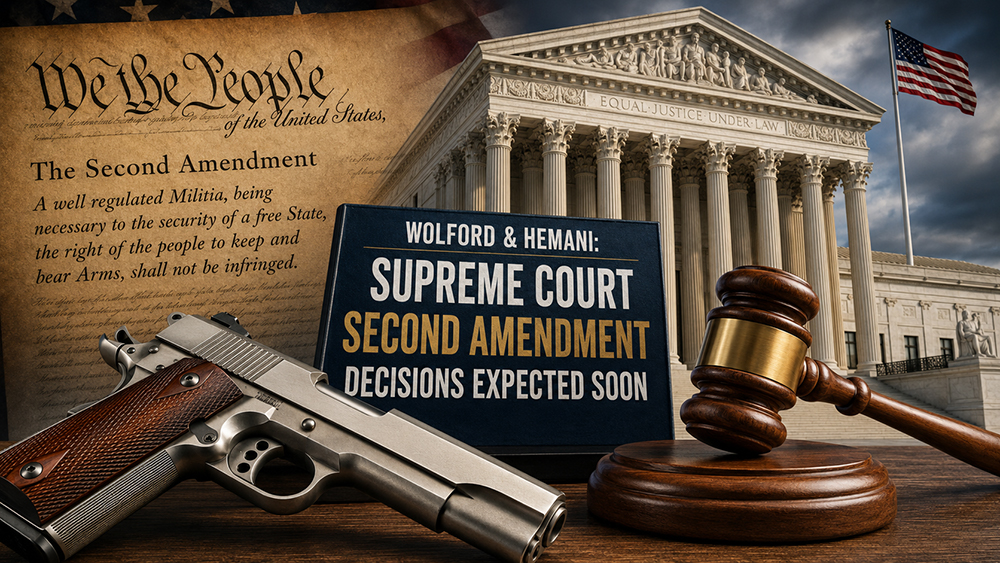

Two Second Amendment cases have been heard by the Supreme Court this term. The Supreme Court’s opinions in those two cases are expected to be announced before the end of June 2026.
The two cases are the Wolford case, out of Hawaii in the Ninth Circuit, and the Hemani case out of Texas in the Fifth Circuit.
Wolford is essentially a question of whether a state can define “sensitive” locations so broadly as to prevent people from being armed in most public places. Specifically, Wolford asks whether Hawaii has the authority to require property owners to actively choose to allow private carry on their property, or whether the State will ban private carry on their property.
The Hemani case is a fairly straightforward question: Can the government strip people of their Second Amendment rights if they are users of a substance (marijuana) which the government has deemed to be illegal, even if they are not carrying arms while impaired?
Both cases have the potential to further clarify the standard set in the Bruen decision for how courts are to decide Second Amendment issues. The Bruen decision was straightforward. If the case involved an infringement of Second Amendment rights, as provided by the text of the Second Amendment, the burden of showing that such limitations were necessary was on the government. The government had to show that there was a longstanding tradition of such limitations dating back to the time of the ratification of the Bill of Rights.
Live Inventory Price Checker
|
|
Winchester 5.56 Bulk Ammo 55 Gr FMJ, 1000rds - WM1931000 | Palmetto State Armory | $ 649.99 $ 529.99 |
|
|
Winchester - 5.56 Nato - 5.56x45mm - 62 Grain - FMJ | True Shot Ammo | $ 110.00 |
|

|
Winchester 5.56 MM M855 62 FMJ Lake City 420RDs STRIPPER CLIP (GREEN TIP) | Bereli | $ 569.00 |
|
|
|
Winchester 5.56 NATO 55 Gr FMJ BT 500 Projectiles | Ammunition Depot | $ 71.49 |
|
If the government could show a longstanding tradition, then it was shown that such a limitation was considered understood as part of the right to keep and bear arms at the time of the ratification of the Bill of Rights.
In the Rahimi decision, the Supreme Court appeared to ease the restrictions somewhat. The decision allowed laws from the time of the ratification, which had a loose connection to the statute in question, to meet the Bruen test if the essential intent was the same. Both Wolford and Hemani present cases to the Supreme Court that could be used to narrow or broaden how lower courts interpret Bruen as seen through the lens of Rahimi.
The Supreme Court hears about 70 cases each year. Thousands of cases apply to be heard by the Court. In addition to the 70 or so cases heard on the merits, the Supreme Court has been burdened by numerous lawsuits against the Trump administration. These cases have taken up much of the Court’s time as they react to frivolous challenges to Trump’s administrative decisions. The Supreme Court has issued at least 35 emergency orders related to Trump’s administrative actions. The more “emergency” actions, the less time to spend on cases on the merits. The vast majority of these cases have been decided in favor of the Trump administration.
Both the Wolford and Hemani decisions are expected to be released by the end of June 2026.
Both cases could shape how lower courts apply Bruen after Rahimi: Wolford on public carry and private-property default bans, and Hemani on whether the government may disarm people based on unlawful drug use without proof they were armed while impaired.
Reminder: the Supreme Court has indicated that it may announce opinions on Thursday. We will be live blogging beginning at 9:30 a.m. EDT tomorrow. https://t.co/KZk3tV9Unx
— SCOTUSblog (@SCOTUSblog) June 10, 2026
Bruen’s Text-and-History Test Spreads Beyond the Second Amendment
About Dean Weingarten:
Dean Weingarten has been a peace officer, a military officer, was on the University of Wisconsin Pistol Team for four years, and was first certified to teach firearms safety in 1973. He taught the Arizona concealed carry course for fifteen years until the goal of Constitutional Carry was attained. He has degrees in meteorology and mining engineering, and retired from the Department of Defense after a 30 year career in Army Research, Development, Testing, and Evaluation.