
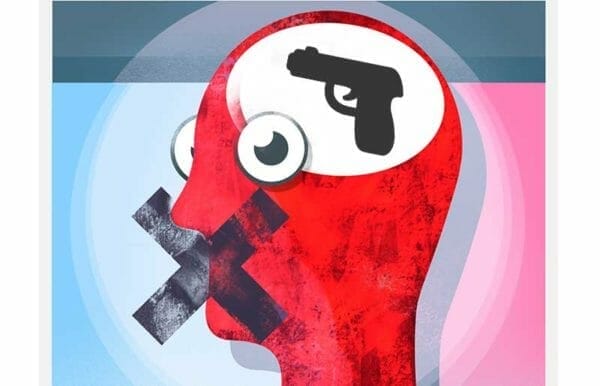
Social media companies argue that their content moderation decisions are a form of editorial discretion protected by the First Amendment. Conservative critics of those companies reject that argument, even as they complain that the platforms’ decisions reflect a progressive agenda.
That contradiction is at the heart of two cases that the Supreme Court recently agreed to hear, which involve constitutional challenges to state laws that aim to correct the bias that Republicans perceive. Although supporters of those laws claim they are defending freedom of speech, that argument hinges on a dangerous conflation of state and private action.
The 2021 Florida law at issue in Moody v. NetChoice requires social media platforms to host speech by any “candidate for office,” even when it violates their content rules. The law also says platforms may not limit the visibility of material “by or about” a political candidate and may not “censor, deplatform, or shadow ban a journalistic enterprise based on the content of its publication or broadcast.”
The law does not cover relatively small, right-leaning platforms such as Gab, Parler, Rumble, and Truth Social. It applies only to the largest platforms, such as X (formerly Twitter), Facebook, and YouTube, which Republicans have long accused of discriminating against conservative speech.
Florida politicians made it clear that they were trying to address that perceived imbalance. The bill’s legislative findings, which complain that Facebook et al. have “unfairly censored, shadow banned, deplatformed, and applied post-prioritization algorithms,” assert that the state has a “substantial interest in protecting its residents from inconsistent and unfair actions” by those platforms.
“If Big Tech censors enforce rules inconsistently, to discriminate in favor of the dominant Silicon Valley ideology,” Gov. Ron DeSantis declared upon signing the bill in May 2021, “they will now be held accountable.” Lt. Gov. Jeanette Nunez said Florida was “tak(ing) back the virtual public square” from “big tech oligarchs” who were determined to “censor … views that run contrary to their radical leftist narrative.”
Four months later, Texas Gov. Greg Abbott signed the law at issue in NetChoice v. Paxton, which says social media platforms may not “censor” speech based on “viewpoint” and defines censorship to include not just deletion but also any steps that make user-posted content less visible, accessible or lucrative. Like Florida’s statute, the Texas law is limited to the largest platforms, which Abbott said were trying to “silence conservative viewpoints and ideas,” adding, “It is now law that conservative viewpoints in Texas cannot be banned on social media.”
In May 2022, a panel of the U.S. Court of Appeals for the 11th Circuit unanimously ruled that the major provisions of Florida’s law probably violated the right to exercise editorial judgment, which the Supreme Court has recognized in diverse cases involving a Miami newspaper, an electric utility’s newsletter, and a private organization’s St. Patrick’s Day parade. The 11th Circuit noted that “private actors have a First Amendment right to be ‘unfair’ — which is to say, a right to have and express their own points of view.”
A divided panel of the U.S. Court of Appeals for the 5th Circuit rejected that conclusion when it considered the Texas social media law later that year. Because they rely heavily on algorithms, do not review content before publication and take action against only a tiny percentage of messages, Judge Andrew Oldham said in the majority opinion, Facebook et al. “are nothing like” a newspaper.
Writing in dissent, Judge Leslie Southwick objected to that characterization. While “none of the precedents fit seamlessly,” Southwick said, a social media platform’s right to curate content is analogous to “the right of newspapers to control what they do and do not print.”
In arguing that the 5th Circuit got it right, DeSantis, Abbott, and like-minded politicians assert that Facebook et al. are pursuing a left-wing agenda while simultaneously denying that the First Amendment protects their right to do so. The Supreme Court should not let them have it both ways.
Read Related: Help Us Break Through the Big-Tech Anti-Gun Filters, WhiteList AmmoLand News ~ VIDEO
About Jacob Sullum
Jacob Sullum is a senior editor at Reason magazine. Follow him on Twitter: @JacobSullum. During two decades in journalism, he has relentlessly skewered authoritarians of the left and the right, making the case for shrinking the realm of politics and expanding the realm of individual choice. Jacobs’ work appears here at AmmoLand News through a license with Creators Syndicate.


hence the distinction between platform and publisher. social media platforms being public, (privately owned but used by the public) if they allow anyone/everyone to sign up for their platform should not be able to censor another’s speech unless it violates law. publishers on the other hand, are private enterprises that upon contract with another publish the others, or their own ideas, therefore are entitled to have say in what they put publish. you cannot be both a publisher and platform at the same time as fakebook and others claim. elon fixed the X, formerly known as twitter, much to the… Read more »
Look at it this way. You have a can of gas and the can is old and has some rust in it. You put a funnel in the gas tank to pour the fuel in. Not wanting to contaminate your tank or fuel system, you use a funnel that has a filter in it to keep contaminants out. You are prescreening your fuel.
Prescreening fuel is the same as speech. If it cannot flow freely into the tank or the ears of the people because it is hindered by a filter, it is not free.
Oregoneistan
I can only offer my own opinion, “Freedom of Speech” limits the government’s ability to interfere with speech of individuals or non government institutions whereas private enterprise does retain the right to control whatever is offered on their own platform ( if you don’t like then don’t read it) .Don’t restrict my right to read or write because you don’t agree with me, this is one of the pillars that make America great.
As long as we conflate private businesses that provide public platforms for speech, with private platforms for speech, we will be stuck in this conundrum. Whether it is owned by a private (non-government) business or not; does a platform that offers speech to anyone with a pulse, accessible to the general public, constitute a private platform? I say NO. For a platform to be private, membership must be required to post, as well as to access posts, and the platform can censor their interested membership, but not the general public. Just the same, we need to decide if it is… Read more »
How much government money does a company have to take, how many government contracts does it have to have, how many shady backroom deals does it have to make, how many politicians does it have to buy, and how much government dirty work like sharing it users info and censoring content government doesn’t like does a company have to do before it is no longer considered private and becomes subject to the constitution?