

When I started my reloading hobby, dinosaurs roamed the earth – or so it seems from my current perspective. Reloading equipment was pretty basic in the late 1970s. I was trying to assemble all the pieces needed to put together handgun loads on a teacher’s salary in a tiny town in central Indiana. Money was tight; I didn’t have a lot of spare change. But I did end up with an RCBS Jr, single-stage press, Uniflow powder measure (both in the photo above), and their 505 balance-beam scale. I added as much equipment as I could.
Would I have added a chronograph, if I could? Of course. Even back then, I knew that it would never be as good as it could have been unless you understood the ballistics of whatever load you were assembling. So, around 1980 I added a Shooting Chrony – the one that folded in half when not in use – and was a happy camper until I shot it.
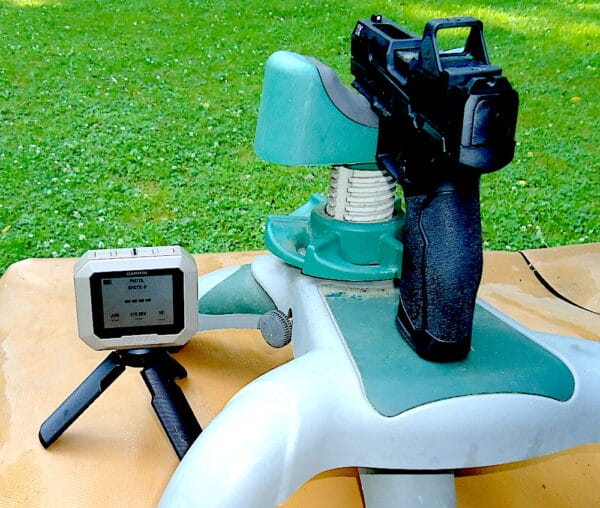
I won’t go into how many chronos I’ve put bullets into. I have one now that I can’t destroy, as it’s a Garmin Xero C1 Pro radar unit. There are no sunscreens or supports to shoot. The technology is superb and Mike-proof. Look for its review to pop up here soon.
Do You Need A Chronograph?
Alright, enough about me. I told you all that to make a point. If you are ever going to be a serious reloader, you’ll buy a chronograph. That’s a pretty bold statement. Let’s examine why I made it. What, exactly, are the benefits of owning a chronograph for reloading?
Velocity Readout
This is the most obvious benefit of owning a chronograph. I remember before I owned a chrono (I’ll call it that from now on), I would guess how fast my bullets exited the muzzle. This was especially important to know for hunting loads. After I bought my first chrono, it was as if the clouds parted and the sun shone in on my reloading efforts. I knew exactly how fast my loads were. That was important to know, especially if I loaded hollow point or soft point bullets. I knew that unless I hit a certain velocity range, they most likely wouldn’t expand.
Another benefit of knowing your velocities has to do with semi-autos. You need a certain speed for the gun to function, either a long gun or a handgun. You may think you’re getting that by guessing, but if the slide isn’t working properly, you may misdiagnose it and want to dump that “unreliable” 1911 or whatever, It may be all it takes to make the gun work is to know your velocities and to get them into the proper range. (Maybe you are saying, ‘Just use factory ammo’ – there was a time when I couldn’t afford factory ammo, and I had to shoot my reloads).
Standard Deviation.
This is a number that is very important to know. SD is a standard statistical measurement of how the data is dispersed from the mean. The larger the number, the further apart your velocities are scattered. For shooters, you don’t want a large SD. That means that your loads are clustered close to the average velocity. The further out they are, the less likely the load will be accurate. Here’s a quick, made-up example… if your .223 loads run 3150, 2580, 3340, 2660, and 3400, you will most likely not have 1-MOA accuracy since the numbers are so widely separated. The bullets will be spread out on the target. The only way to know this for sure is by using your handy chrono.
Another thing that this might tell you is that you need to examine your reloading methods – if you’re getting that wide a dispersion, there’s something wrong. You might check your powder measure to make sure it’s dropping uniform charges.
Load Development
Another benefit of using a chrono in your reloading is fast Load Development. Let’s say you are looking for a load to use in a steel competition, and you’ve just bought a new gun in a caliber you’ve not shot much before. You can buy boxes of factory ammo and hope you hit the right combination, or you can head to your reloading bench. Let’s say you have three bullets and four powders you want to try. After consulting your loading manuals, you’ve got several combinations to try. You head to your range and set up targets. You are smart, however, and you also set up your chrono. So, not only will you be able to check for accuracy, but you’ll also have statistical data to consider as well.
Modern chronos like the Garmin Xero C1 Pro will do all the heavy lifting for you and tell you average velocity, individual velocities, extreme spread, standard deviation, and energy.
When you are done shooting, and you take your targets home, you will have more than one way of evaluating loads. Of course, the targets are key – if the holes are close together, that’s a winner. But you’ll also want to check the stats. Let’s say you have two loads that are fairly close “on paper” but the SD and ES of one load are higher than those figures from the other load. You might want to consider developing the lower-numbers-load over the other one because the accuracy potential is greater for the load with the lower-numbered stats. You need a chrono to gather that statistical data.
Those are just three reasons to use a chrono as part of your reloading method – there are others that you will discover after you’ve used one for a while. With the new, small radar-based units, you can take it with you in a pocket for every range trip. (My Garmin is as small as a Go-Pro camera and fits in my shorts pocket).
There is no reason anymore not to have a reliable, accurate chrono with you every time you shoot. I know that it’s changed the way I do gun reviews – it’s SO easy to check the ammo’s velocities through whatever gun I’m testing. I’ve come across a few surprises because of it. There are units from Garmin, Labradar, and a new one from Caldwell that is not out yet as of this writing. They’re not cheap … all three of these have a list price of $500-$550 … but they are sold for less online. They are worth owning.
For the price of a lesser-expensive gun, you will have an entire ballistic statistical world opened to you. These things don’t wear out, so your investment is sound. I know that I was very glad I “took the plunge” and bought my first chrono – I learned so much about not only my loads but also my reloading methods. If you are in a similar situation – you want to know all you can about your loads – there needs to be a chronograph in your future. They are easier to use than ever before. They can link via Bluetooth to your phone (and then your laptop), and there are zero wires or sky screens to install. Just set it on the shooting bench and go. Isn’t it time you added one to your reloading kit?
Live Inventory Price Checker
|
Garmin Xero C1 Pro Chronograph | MidwayUSA | $ 499.99 |
|
|
Garmin Xero C1 Pro Chronograph | GunMag Warehouse | $ 599.99 |
|
|
Garmin Xero C1 Pro Chronograph | Primary Arms | $ 499.99 |
|
|
|
Garmin Xero C1 PRO Chronograph | Palmetto State Armory | $ 556.99 $ 499.99 |
|
About Mike Hardesty
With experience spanning over 45 years, Mike Hardesty has long enjoyed shooting and reloading. An inveterate reloader, he casts bullets and reloads for a diverse array of firearms, each handled with long-practiced precision. Living in rural Indiana, his homestead boasts a personal 100-yard range where he shares his love for guns to his four sons, their wives, and eleven grandchildren. As a recognized author, his writings have been featured in notable platforms like Sniper Country, Bear Creek Arsenal Blog, Pew Pew Tactical, TTAG, Dillon Precision’s Blue Press, and Gun Made, revealing his ongoing passion for firearms at the age of 72.
Yes I need a chronograph but not at that price .
With Mike having just 45 years of experience .
I must of walked with and hunted dinosaurs a couple decades before that.
I agree having a chronograph.
is great.
Chronographs and reloading, Do you need one? The answer is NO, you need two. Well not really but I use two and the reason why is because that is how I make sure that my numbers are correct because of the consistency of both. I put them directly in line front to back. My older one in front so I can read the numbers and my newer one in back because it transmits the numbers to my phone. I liken it to using my electronic powder measure. I use it, I trust it but only after I have double checked… Read more »
I’ve had the Beta Chrony for about 20 years now, and at the time I got mine, it was the second-best one in their lineup. Aside from getting a few errors from not having it properly aligned from time-to-time (my fault), I’ve been pretty happy with mine. Seeing all the newer devices that interface with a smartphone or computer make me want a new one, but with the price of primers and powder being what they are these days, I just keep plugging along with my old dinosaur.
Having a chronograph will sometimes give a reloader a surprise on the particular load they got from a manual. Actual velocities may be substantially higher or lower than what the manual stated. In one instance I recorded a velocity 200 FPS faster than what I expected. The Garmin chronograph, however, is overpriced for the feedback it gives. The Caldwell Ballistic Chronograph has as many functions as the Garmin at 25% of the cost.
Truly a shame Mike and I have never crossed paths since we’re fairly close in age, are both from central Indiana and are proud users of the Lee Turret Press (I’m on my second one since I wore my first one out in 1996 or thereabouts. I began reloading in 1971, but didn’t get my first chrono until around 1988. Today I use a very old Beta Chrony. I have to say that while I’ve never put a bullet through any of my chronographs, I have blown them over several times by having the unit a wee bit too close… Read more »
After shooting two chronographs I consider buying the Garmin a bargain. By the way, the .223 puts a neat little hole through your chronograph at 10 feet. I would have thought it would damage the exterior much more than it did. I love the Garmin, it links to my cell phone so I have all my data available so I can just plug it into by ballistic app. Well worth the money.
I’ve been wanting one for awhile now but I suspect that Garmin has a price point that they don’t want their units sold below. When all of the major retailers, stores and on line, have a price of $599.99 something is up and it stinks of collusion.