
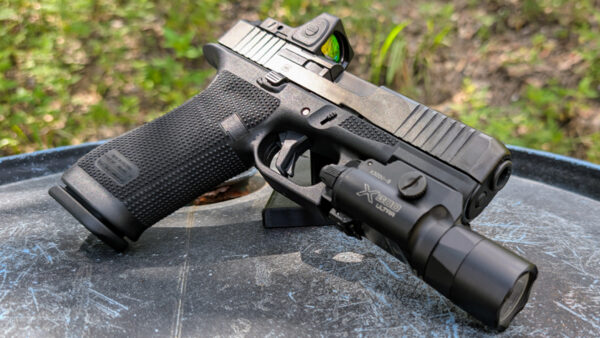
The constitutional fight over Maryland’s Glock ban comes down to one question: Can the state ban law-abiding citizens from acquiring some of America’s most popular handguns because criminals can illegally modify them with an already-prohibited machinegun conversion device?
Gun-rights groups say the answer is clearly no. Maryland now says Glock-style pistols can be treated differently from other semiautomatic handguns because of what they could become after an illegal modification.
That dispute is at the center of Bathras v. Moore, the federal Second Amendment challenge to Maryland Senate Bill 334.
Amended Complaint Adds Maryland Gun Owners and Dealer
AmmoLand covered the original lawsuit after the National Rifle Association, Firearms Policy Coalition and Second Amendment Foundation sued Gov. Wes Moore and other Maryland officials on May 26—the same day Moore signed SB 334. That immediate filing leaves Maryland’s newly asserted laches defense, which requires unreasonable and prejudicial delay, with no apparent factual basis.
A June 25 amended complaint added Maryland residents David J. Bathras Sr. and Roslyn Mickens, along with Atlantic Guns in Rockville. The case is now captioned Bathras v. Moore.
Bathras owns a Glock and wants to purchase additional Glock-style pistols. He also wants to retain the ability to sell or transfer his current handgun through lawful channels. Mickens is a registered gun collector and licensed firearms instructor who also wants to acquire covered pistols.
Atlantic Guns has sold firearms in Maryland since 1950. The dealer says the law will force it to stop stocking and selling a substantial category of popular defensive handguns.
These plaintiffs are challenging a law that directly prevents them from buying, selling and transferring arms they otherwise may lawfully possess.
Maryland’s Ban Targets Factory-Built Semiautomatic Pistols
Beginning January 1, 2027, SB 334 prohibits ordinary Marylanders from manufacturing, selling, purchasing, receiving or transferring what the state calls a “machine gun convertible pistol.”
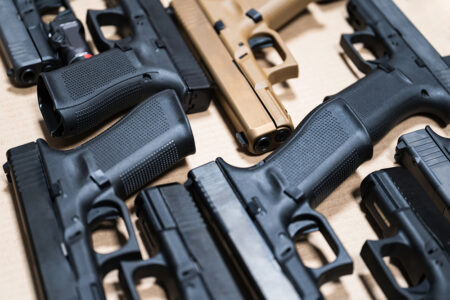
The definition targets semiautomatic pistols with a cruciform trigger bar that can supposedly be converted into a machinegun by replacing the slide’s backplate with a pistol converter. That language is expected to cover nearly every Glock, along with Glock-pattern pistols such as the Palmetto State Armory Dagger, Ruger RXM and many Shadow Systems handguns.
A first offense can bring up to three years in prison, a $5,000 fine or both.
A factory Glock is not a machinegun. It fires one round per function of the trigger. Making it fire automatically requires someone to install an illegal conversion device or otherwise unlawfully alter the firearm.
Federal law already treats the conversion device itself as a machinegun. Maryland also bans pistol converters as “rapid fire activators.” Neither prohibition is being challenged. The lawsuit is about whether Maryland can ban the unmodified handgun because someone could attach a separate piece of contraband to it. As the amended complaint states:
“That is a handgun ban. The fact that the ban targets only one category of popular handguns does not make it constitutional.”
Plaintiffs Say Heller Protects Glock-Style Pistols
The plaintiffs’ Second Amendment argument begins with District of Columbia v. Heller. The Supreme Court held that handguns are at the core of the right to armed self-defense and that commonly possessed firearms cannot be banned as “dangerous and unusual.”
Glock pistols are plainly common. The amended complaint cites sales rankings, ATF production figures, civilian market data and widespread law-enforcement use. It alleges that Glock manufactured more than half a million handguns for the American market in 2021 alone, before imported pistols are even counted.
The complaint also notes that Glock pistols are widely issued to police—including Baltimore officers. Maryland considers these handguns suitable for police defensive use while attempting to block ordinary citizens from buying the same basic firearms.
Under New York State Rifle & Pistol Association v. Bruen, the plaintiffs argue, the analysis is straightforward. Glock and Glock-style pistols are bearable arms. Buying and acquiring them is necessary to exercise the right to keep and bear arms. Maryland must therefore prove that its ban is consistent with the nation’s historical tradition of firearm regulation.
The amended complaint says no such tradition exists.
Live Inventory Price Checker

|
GLOCK Blue Label G19 Gen 6 9mm Pistol - Aimpoint COA Optic - 3x 15rd Mags | Primary Arms | $ 885.20 |
|

|
GLOCK Blue Label G19 Gen 6 9mm Pistol - AmeriGlo Night Sights - 3x 15rd Mags | Primary Arms | $ 592.30 |
|

|
GLOCK Blue Label G19 Gen 6 9mm Pistol - GLOCK Night Sights - 3x 15rd Mags | Primary Arms | $ 565.68 |
|

|
GLOCK Blue Label G19 Gen 6 9mm Pistol - Fixed Sights - 3x 15rd Mags | Primary Arms | $ 513.65 |
|
Maryland Says Glocks Are Different
Maryland’s July 13 answer disputes the plaintiffs’ central claim that Glock-style pistols are not meaningfully different from other semiautomatic handguns.
The state instead says certain Glocks are “semiautomatic firearms that are capable of being fully automatic weapons.”
That appears to be the foundation of Maryland’s Second Amendment defense: These pistols can be singled out because their design allegedly makes illegal conversion easier.
But the state’s wording blurs the difference between a lawful factory pistol and the machinegun created after someone installs an illegal conversion device. The converter is not part of the unmodified handgun. Glock does not manufacture the illegal switches, and neither do the manufacturers of Glock-pattern pistols.
The government cannot turn a legal handgun into a machinegun on paper by pointing to an illegal part that is not installed. By that logic, an AR-15 could be banned because illegal auto sears exist, or a shotgun could be prohibited because a criminal might cut down its barrel.
The constitutional analysis should concern the arm as lawfully manufactured and possessed—not a hypothetical contraband configuration.
Maryland Avoids the Common-Use Evidence
Maryland also refuses to concede that Glock pistols are among the most commonly owned handguns in America.
When responding to the complaint’s allegations about Glock’s market share, production numbers, sales rankings and law-enforcement use, the state repeatedly says it is “without knowledge or information.”
That is a remarkable position for a government defending a sweeping firearm ban. Maryland knew enough about Glock pistols to prohibit their future sale and transfer, but it now declines to acknowledge public evidence showing just how common they are.
Common use is central because Maryland cannot plausibly call a firearm “unusual” when millions are owned for lawful purposes. A handgun does not lose Second Amendment protection simply because anti-gun legislators give it a menacing new name.
The Supreme Court reinforced that point in Wolford v. Lopez. At the plain-text stage, the question is whether the regulated weapon is an “Arm.” Maryland cannot avoid that threshold by relabeling an ordinary semiautomatic pistol a “machine gun convertible pistol.”
Maryland Has Not Offered a Historical Tradition
Maryland’s answer says Bruen “speaks for itself,” but the filing identifies no Founding-era or Reconstruction-era tradition of banning ordinary handguns because criminals might illegally modify them.
The state may present a fuller historical argument in later briefs. An answer is not ordinarily where the government lays out its entire constitutional defense. Still, Maryland has now made clear where the parties disagree.
The plaintiffs say Glock-style pistols are common semiautomatic handguns protected by Heller and Bruen. Maryland says their potential for illegal conversion makes them different.
That leaves the court with a basic choice: Judge the handgun as it lawfully exists, or allow Maryland to ban it based on a crime somebody might commit with a separate illegal device.
The Second Amendment protects the actual firearm in the citizen’s holster—not the imaginary machinegun Maryland politicians have constructed around it.
California Tells Court Glock-Style Pistols Aren’t Protected by Second Amendment
New Jersey Glock Subpoenas Are Part of Nationwide Push Against America’s Most Popular Pistol
About Duncan Johnson:
Duncan Johnson is a lifelong firearms enthusiast and unwavering defender of the Second Amendment—where “shall not be infringed” means exactly what it says. A graduate of George Mason University, he enjoys competing in local USPSA and multi-gun competitions whenever he’s not covering the latest in gun rights and firearm policy. Duncan is a regular contributor to AmmoLand News and serves as part of the editorial team responsible for AmmoLand’s daily gun-rights reporting and industry coverage.

I can think of at least a dozen firearms, that are, Designed, to be convertible to select-fire, with drop in components.
Some by exchanging or adding just one part.
I hesitate to list them here as it may cause Wes Moore, Gavin Newsom, and their minions, heads to explode, resulting in my being accused of a bicoastal mass murder.
Wow… any pickup truck can be turned into a “tactical” by simply bolting or welding in a tripod and topping it with a minigun, M2, or any other machine gun. Given simplicity of this modification – we obviously need to ban pickup trucks. Oh yeah – guess it’s not much different for SUVs or cars so ban those as well. My daughters old prius is obviously a machinegun-convertible vehicle and thus uniquely eligible to be banned for that reason! Regardless of whether one thinks priuses should be banned for other reasons, this logic is nonsensical. Just like all the other… Read more »
Ban poIiticians! ALL have the potential to become corrupt. And 95% WILL!
The growing menace of machine gun attack.
With the addition of some highly-refined, fissile uranium and a few high tech gewgaws, any firearm can be turned into an atomic bomb.
Law like this just remind us that our own governments treat us all as potential criminals. This is not how it’s supposed to work here.
At least some firearms need no mods to go full auto. I knew a man who loaded some hot .45 long Colt into a pre-60 SAA. Primers blew. Cocked the hammer and trigger was still pulled. Fast shooting.
Wonder if these anti-gun buffoons realize how many Glock pistols and switch, they’re bans are probably selling?