
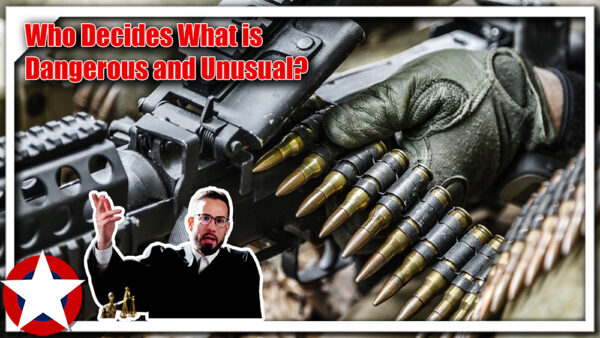
In District of Columbia v. Heller (2008), the United States Supreme Court said that the Second Amendment does not protect the right to keep and bear “dangerous and unusual weapons,” it protects only arms in “common use.” In support of its conclusion, the Court cited the following authorities and case law:
United States v. Miller, 307 U. S. 174 (1939), at 179. 4 Blackstone 148-149 (1769); 3 B. Wilson, Works of the Honourable James Wilson 79 (1804); J. Dunlap, The New-York Justice 8 (1815); C. Humphreys, A Compendium of the Common Law in Force in Kentucky 482 (1822); 1 W. Russell, A Treatise on Crimes and Indictable Misdemeanors 271-272 (1831); H. Stephen, Summary of the Criminal Law 48 (1840); E. Lewis, An Abridgment of the Criminal Law of the United States 64 (1847); F. Wharton, A Treatise on the Criminal Law of the United States 726 (1852). See also State v. Langford, 10 N. C. 381, 383-384 (1824); O’Neill v. State, 16 Ala. 65, 67 (1849); English v. State, 35 Tex. 473, 476 (1871); State v. Lanier, 71 N. C. 288, 289 (1874).
Neither the Heller opinion nor any of the cited authorities and case law support that conclusion. Most of the Court’s citations are circular, but all invariably point to English common law and statutes that preceded the adoption of the Second Amendment.
Moreover, had the Court bothered to read its own citations, which in turn cited English common law and statutes, it would have discovered that England did not ban “dangerous and unusual weapons.” England’s prohibitions on the bearing of dangerous and unusual weapons (the citations point to body armor) did not prohibit the possession of those arms. What was prohibited was bearing those arms in public except for certain limited exceptions, such as quashing riots and stopping affrays (e.g., street fights).
Moreover, there was no “common use” test. England was a class-based society with restrictions on the arms one could keep and bear, depending on one’s class. For example, in feudal England, only the upper classes could keep and bear what we today call broadswords, except traveling merchants, whose social class would normally have precluded them from doing so. Not that English peasants and serfs could have afforded to purchase a broadsword.
Which isn’t to say that the lower classes never touched a broadsword. But it would have been in a public defense context, and they were not expected to purchase a broadsword or other weapons of war that they could not afford.
If there were a weapon in “common use,” it was the English longbow, which they could afford. The right to keep and bear arms, and the specific arms protected by the Second Amendment, which we American citizens have the right to keep and bear, simply cannot be reconciled with English statutory and English common law. At least not unless American citizens are analogous to Medieval English serfs and peasants. True, this is a view widely shared by judges and politicians, but it was not the view of the Founding Fathers who wrote the Second Amendment, or the American People who voted to enact the Second Amendment into law, or the view of those who wrote the Fourteenth Amendment that was likewise enacted into law by the American People.
During oral argument in my California Open Carry lawsuit, Judge Bybee put to me that the Second Amendment was based on the English Bill of Rights. I responded by saying that we expanded on those rights. Had I been given the time to elaborate, I would have reminded him that the English Bill of Rights applied only to Protestants (and only some of them), not to Catholics. And, of course, the English “right” to keep arms was a statutory right, not a fundamental right that we Americans have even if there were no enumerated Second Amendment right. Statutory rights exist at the whim of the legislature, and the English Parliament has long since ended any right to keep arms, let alone bear them for the purpose of self-defense.
Judge Bybee would go on to write the 7-4 en banc opinion in Young v. Hawaii (2021) that held there is no right to bear any concealable arm in public, openly or concealed, because their mere existence offends the king.
The United States Supreme Court vacated the Young v. Hawaii decision and threw the case back to the 9th Circuit in 2022.
With the exceptions of prohibitions on the use and/or carrying of concealed weapons, which existed from the 13th century, and throughout the history of American colonial and American states, Heller’s embracement of prohibitions on short-barreled shotguns and machine guns cannot be reconciled with the types of arms the American People intended the Second Amendment to protect when it was enacted in 1791 or when the Fourteenth Amendment was enacted in 1868.
19th-century Courts and legislatures disagreed on whether firearms that are easily and ordinarily carried concealed can be banned, but they were all in agreement that the Second Amendment protects arms used in battle.
And that included cannons, a type of arm that cannot be carried on one’s person. Heller’s exclusion of arms that one would take into battle is ahistorical and inconsistent with Heller’s first citation that justified prohibitions on “dangerous and unusual weapons” and seemingly limited the right to arms in “common use”—United States v. Miller (1939). A decision that makes no mention of “dangerous and unusual.” What Miller said was, “[O]rdinarily when called for service these men were expected to appear bearing arms supplied by themselves and of the kind in common use at the time.”
Indeed, the Supreme Court in Miller adopted the view of many 19th-century courts that the Second Amendment protects only weapons of war— “Certainly it is not within judicial notice that this weapon [short-barreled shotguns] is any part of the ordinary military equipment or that its use could contribute to the common defense.”
In 2008, when the Heller decision was published, the M-16 machine gun was part of the “ordinary military equipment,” and certainly contributed “to the common defense.”
So how did we go from the Second Amendment only protects weapons of war to the Second Amendment does not protect weapons of war?
Technically, the Heller opinion did not say that “M-16 rifles and the like” are not arms protected by the Second Amendment, but the paragraph was so poorly worded that judges have leaped to the conclusion that Heller held that they are not.
In a Fox News interview with Chris Wallace, Justice Scalia said that the Court had not decided whether hand-held rocket launchers that can bring down an airplane or firearms that can fire 100 rounds per minute are, or are not, arms protected by the Second Amendment. In the interview, Justice Scalia gave an example of what the right to keep and bear arms did not protect—walking down Main Street while carrying an executioner’s axe in a manner intended to terrorize the townfolk, as that constituted an affray.
While an executioner’s axe may have been unusual, and is certainly deadly, it wasn’t the axe per se that was prohibited; it was the carrying of the axe in a threatening manner. A woodsman’s or shipwright’s axe was commonly carried, and for certain classes of Englishmen, the carrying (bearing) of swords was required by law and custom. It was not a crime to carry them in public unless they were carried in a threatening manner.
And contrary to the defendants’ position in my California Open Carry lawsuit, which claims that simply openly carrying a firearm is, in and of itself, threatening, I have centuries of English and American common law, as well as California statutory law, saying, and California Courts holding, that merely openly carrying a firearm is not threatening.
Some people hate the mere sight of guns, and concealed carriers hate Open Carry for different reasons, but, for now, there is no Heckler’s veto of the Second Amendment.
The Supreme Court could grant an “assault rifle’’ ban cert petition, and clean up the mistakes made in Heller and NYSRPA v. Bruen, and US v. Rahimi. But I fear that if the Court does, it will simply poke more holes in the Second Amendment.
Opinion, originally published on Charles Nichols’ Substack.
About Charles Nichols
Charles Nichols is a retired engineer who has been writing about the Second Amendment since 2009, and who has been in Federal court since 2011 seeking to enjoin the enforcement of California’s bans on openly carrying loaded and unloaded firearms in public. He posts regular updates to his lawsuit at CaliforniaOpenCarry.com.



The second amendment does not list any arms that can or cannot be used, it only says shall not be infringed. Lawyers are the ones that are reading crap into it and trying to make it more than it really is based on what they think, which is worth as much as a paper weight which does one thing, and that is hold down paper, just like the 2nd amendment is supposed to hold down or restrain the government against our right to bear arms, any arms. Government needs to interpret the 2nd and all constitutional amendments as they are… Read more »
Actually, short barreled rifles and shotguns akin to the Mossburg Shock Wave were considered by the Marine Corps in the 1980’s for Military Operations in Urban Terrain (MOUT) operations. And look at the literature of the military in describing the M-14/16/4 variant Service Rifles. I have my late 1960’s version. The M-14 and M-16 are described as Service Rifles and not ‘assault’ rifles or machine guns. There is a difference, Courts need to be made aware of the differences and the differences in employment. One means of determining a well trained (regulated) rifle company from one that is not is… Read more »
“Shall not be infringed” does not need to be interpreted.
Ah Charles. Concealed carriers do not hate open carry. Most open carriers do not hate concealed carry. It is only you who is too asinine to recognize that most of us support each other in whatever mode of carry we choose. Many of us switch carry position depending on context. When hanging with antigun family, I conceal so as not to offend their sensibilities. I realize you would say I should be working to normalize open carry – but wise men choose their battles and that is not one I will win. Walking in the woods, and sometimes in other… Read more »
Just Carry…
And use it for good purposes.
The content and method of carry is a personal position, and has nothing to do with the many words that have been written about it.
HLB
“Congress Shall Make No Law” vs. “Shall Not Be Infringed”
https://www.ammoland.com/2025/01/congress-shall-make-no-law-vs-shall-not-be-infringed/
all the goobers that believe in arms restrictions are criminals under constitution and are guilty of violating their oath
Now I understand everything he has posted here on Ammoland….He is a total and complete fruitcake, with a really butthurt attitude. He must have been bullied all his younger life. I can now see why..
First off, the “in common use” requirement is idiotic as it would automatically preclude any and all innovations in weaponry. Everything was new at one point in time and only the inventors/developers had ’em then. If the Court believes it to apply to the 2nd Amendment as though it were the intent of the Founders when they drafted the Constitution, then it should have to be applied retroactively – meaning only swords & muzzle-loaders would be allowed – to the People and to the military. As for “dangerous and unusual”, I think the only things that fit in that group… Read more »
U.S. Second Amendment: Means ALL Weapons & ZERO Infringements
https://www.ammoland.com/2025/04/second-amendment-means-all-weapons-zero-infringements/