
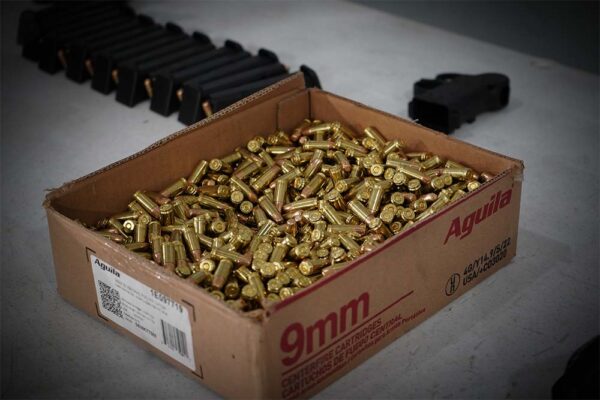
The United States Department of Justice has taken an extraordinary step in a Second Amendment case that could reshape firearms regulation nationwide. On January 5, 2026, the DOJ’s Civil Rights Division filed an en banc brief supporting gun owners who are challenging California’s ammunition background check system, declaring the state’s regulatory scheme “straightforwardly unconstitutional.”
The filing marks a dramatic reversal of traditional federal positioning. Rather than defending gun control measures or remaining neutral, the DOJ now argues that California’s Proposition 63 ammunition regime violates the Second Amendment by using bureaucratic complexity as a weapon against lawful gun ownership.
Rhode v. Bonta centers on California’s 2019 ammunition control system created through Proposition 63. The plaintiffs include Olympic shooter Kim Rhode, the National Rifle Association, the California Rifle and Pistol Association, ammunition dealers, and individual gun owners. They argue that California’s law imposes two unconstitutional requirements on citizens exercising their Second Amendment rights.
First, the law mandates a state background check for every single ammunition purchase. Second, it effectively prohibits direct sales from out of state vendors by requiring all transactions to flow through California licensed dealers. The plaintiffs contend these restrictions meaningfully burden law-abiding citizens’ ability to keep operable firearms and lack any historical precedent in American firearms regulation.
The constitutional argument rests on a straightforward premise. An unloaded firearm is useless for self defense. If ammunition is essential to exercising the right to bear arms, then any system that blocks or significantly hampers ammunition acquisition regulates the core Second Amendment right itself.
California’s law created the nation’s first point-of-sale ammunition background check system. Every ammunition transaction must occur through a licensed California ammunition vendor in person and pass through the California DOJ background check system. Direct shipments from out-of-state vendors to individuals are prohibited.
Live Inventory Price Checker
|
Superior Plated(R) 9mm (.356) Round Nose Handgun Bullets - 9mm (.356) 115gr Round Nose 1000/Box | Brownells.com | $ 93.99 $ 90.99 |
|
|
TULA 9mm Ammo 115gr FMJ Steel-Cased 1000-Round Case | The Mag Shack | $ 449.99 |
|

|
Remington Umc Bulk Pack 9mm 115gr Mc 1000rds - 9mm Luger 115gr Full Metal Jacket 1,000/Box | Brownells.com | $ 301.99 |
|
|
Federal American Eagle 9mm 115gr FMJ Ammo - 100-Round Box | The Mag Shack | $ 29.99 |
|
The system offers four paths for each purchase, all requiring fees and fresh checks. The standard check costs approximately $5 but remains valid for only 18 hours. The basic check carries a higher fee of roughly $19 and can take days to process. A Certificate of Eligibility route requires a separate DOJ issued certificate costing $22 dollars plus $5 per transaction.
The operational record reveals severe problems. Tens of thousands of lawful buyers face rejection annually due to address mismatches or database errors, not because they are prohibited persons. Evidence showed that over one third of rejected lawful buyers still could not purchase ammunition six months later. Only a tiny fraction of checks actually block prohibited persons.
After the Supreme Court’s landmark decision in New York State Rifle & Pistol Association v. Bruen, Judge Roger Benitez issued a permanent injunction against California’s law in January 2024. On July 24, 2025, a three-judge Ninth Circuit panel affirmed that decision. However, California petitioned for en banc rehearing, and on December 1, 2025, the full Ninth Circuit granted the petition, vacated the panel decision, and revived California’s law pending en banc review.
The Justice Department’s January 5 brief represents a major institutional shift. Signed by Assistant Attorney General Harmeet K. Dhillon with senior Civil Rights Division officials, the brief affirmatively backs gun owners against a state regulation. Simultaneously, a coalition of roughly 25 to 26 states filed their own amicus brief supporting the challengers.
The Justice Department constructs its argument on the Supreme Court’s framework in Bruen. The DOJ emphasizes that the right to “bear arms” means the right to be “armed and ready for offensive or defensive action.” The right protects operable arms, and both firearms and ammunition are necessary to that right. The brief cites Jackson v. San Francisco, noting that “without bullets, the right to bear arms would be meaningless.”
The DOJ’s most significant move involves making purpose central to constitutional analysis. Drawing on founding era scholarship, the brief argues that “infringement” at the founding meant regulations serving “pretextual repressive purposes.” The DOJ points to English game laws, formally about game preservation but functionally mechanisms to disarm populations, and post Civil War black codes as examples of pretextual infringements.
The brief concludes that a firearms restriction seeking to frustrate the exercise of the right to keep and bear arms constitutes a per se violation of the Second Amendment, regardless of burden severity.
Rhode v. Bonta has become a test case for whether states can use procedural mechanisms to indirectly nullify Second Amendment rights. The case remains before the Ninth Circuit’s en banc panel with oral argument scheduled for late March 2026. Given the Justice Department’s position and the multistate coalition, if the en banc Ninth Circuit upholds California’s system, a Supreme Court petition becomes highly likely.
Whether the Ninth Circuit will embrace this federal argument or chart a different course remains the question that could reshape firearms regulation across America.
About José Niño
José Niño is a freelance writer based in Charlotte, North Carolina. You can contact him via Facebook and X/Twitter. Subscribe to his Substack newsletter by visiting “Jose Nino Unfiltered” on Substack.com.


The ninth circus court of seals has changed in the recent past. I couldn’t begin to guess which way this might go. In one way I say support the requirement for the background check and fees so it goes to the supreme court and can be handed down to all states that this is unconstitutional and in the same sense I wonder what SCOTUS might say? To me, everything that deals with law today stands iffy. Beyond a reasonable doubt I know that it is unconstitutional because any law that infringes on our 2nd amendment right is illegal but even… Read more »
A lot of you probably don’t know anything about Kim Rhode. Here’s a brief bio: https://en.wikipedia.org/wiki/Kim_Rhode Not many athletes can claim they have won a medal in six consecutive Summer Olympics. Now you know why she drafted to bring this suit.
Despite the inconveniences of CA’s ammunition restrictions which have affected her ability to practice, she still won gold in Skeet last April at the World Cup. (You will never find the ammo used in international competition on a sporting goods shelf; it has to be specially ordered, and CA no longer allows shipment to your home.)
This is really good! I am adding it to my list of things that the Trump administration has done for gun owners.
All I need to know happened on December 15, 1791. Everything after that is garbage.
F the 9th Circus.
Almost every politician needs to be ended in Commiefornia. Every libtard judge needs to be ended.
The time for talk is over.